





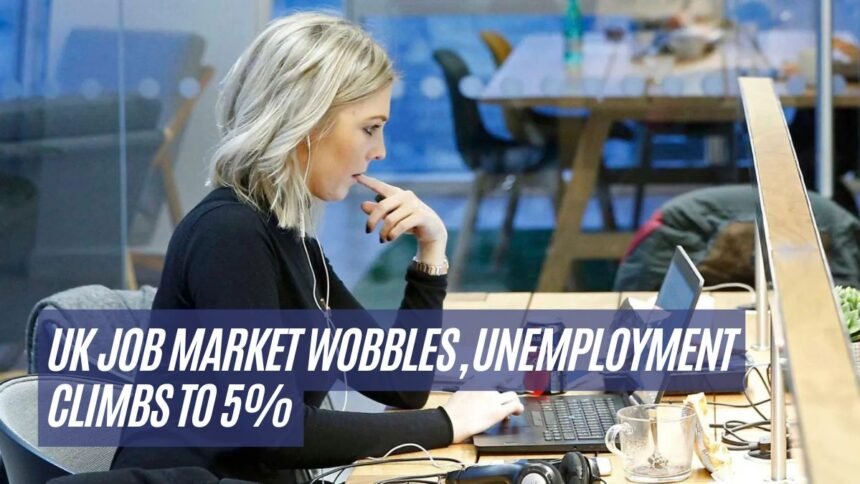
I see the UK jobless rate went up. New official figures came out Tuesday, and they showed it rose to 5% in the three months ending in September. That makes the jobs market look weak, you know?
This is the highest rate since way back in December 2020 to February 2021. The Office for National Statistics (ONS) told us this, and it makes people think the Bank of England might cut the interest rate next month in December.
The increase was bigger than what the smart analysts thought; they figured it would be just 4.9%. This news is important right before Chancellor Jeremy Hunt’s Budget on November 26th. This unexpected jump makes folks worry about the UK’s economy. At the same time, the average wage growth slowed down a tiny bit, it was 4.6% in the third quarter. That’s a bit less than the 4.7% it was in the three months to August.
While these rising jobless numbers are a real problem for the government, it simultaneously made rumors fly about an almost certain interest rate cut. This could happen when the Bank of England’s Monetary Policy Committee meets on December 18th. Danni Hewson, who is the head of financial analysis at AJ Bell, mentioned the expectations for a decrease shot right up. But, she said, “Until the chancellor’s full plans are shown, nobody’s completely sure.”
The ONS data, which was put into a chart showing unemployment from 2015 to 2025, reveals it’s been getting consistently higher since the middle of 2022. If you don’t count the crazy numbers during the Covid-19 pandemic, Tuesday’s unemployment rate is the highest since August 2016. The main bank thinks the unemployment will stay around this 5% for the next few years.
Liz McKeown, director of economic statistics for the ONS, made sure to point out the main pattern, saying, “Put together, these numbers suggest a labor market is getting weaker.” She then added, “The unemployment rate is up this last quarter to a post-pandemic peak.” However, she also shared, “The number of job vacancies, though, is pretty much the same.” Nevertheless, the ONS also warned that people should be careful with the numbers, saying they are taking extra steps to fix some problems with how good the data is.
Work and Pension Secretary, Pat McFadden, admitted there are hard parts. “There are challenges in the Labour market,” he said at a press conference in London, “But the British economy is still making jobs.” He also seemed concerned about more young people not working or training over the last five years.
Shadow work and pensions secretary Helen Whately directly blamed the government for the unemployment rise. “They are raising taxes on jobs, adding lots of red tape for companies, and destroying trust in the economy,” she strongly stated right after the ONS data came out.
Daisy Cooper, who speaks for the Liberal Democrats on Treasury matters, felt the same way. “It seems like everyone except Rachel Reeves realized that making small businesses pay more tax for giving people jobs would hurt job chances. Now the proof is plain to see,” Cooper commented, speaking from her party’s headquarters in London. They have asked HM Treasury for their comments but haven’t heard back yet.
In a first look, the number of people on company payrolls dropped a lot, falling by 180,000 in the year up to October. This is a 0.6% decrease. This drop was bigger than what many people thought would happen, which puts more pressure on the government.
It looks like companies have stopped planning to hire while they wait to see what happens next. The ONS data also shows that almost 1.7 million people are claiming unemployment benefits. That’s a little less than the figure from a year ago.
Job vacancies actually went up a tiny bit, rising by 2,000 to 723,000 between August and October 2025 compared to the three months before that. This is the first time they’ve increased in more than three years, though the total is still much lower than the peak of 1.3 million seen from March to May 2022. The numbers also show a difference in how much people are getting paid: the public sector saw a 6.6% raise, but the private sector only got 4.2%.
Yael Selfin, who is the chief economist at KPMG UK, thinks that public sector pay growth is “almost as high as it will get.” She explained that the big pay raises seen last year probably won’t keep happening because the government is trying to save money. She also expects private sector pay growth to “fall even more as more people look for jobs, making workers less able to ask for higher pay.”
Richard Carter, who leads fixed interest research at Quilter Cheviot, pointed out how important the coming Budget is. He noted that “many businesses have postponed any major hiring plans” until they understand their potential future costs. “They already had a big jump in national insurance costs this year, so they’ll probably be worried about making commitments until they know if more costs are coming their way,” he added.
Tina McKenzie, the policy chair for the Federation of Small Businesses, said the government seems to be doing nothing. She said the rise in unemployment and fewer people on payrolls shows the government has a “too casual attitude toward jobs and businesses.” McKenzie also claimed that small businesses were stopped from hiring staff because of “more and more rules, legal issues, and taxes,” and she urged Rachel Reeves to “do things that support jobs and growth.” These latest unemployment figures really highlight the growing difficulties facing the UK economy during this unsure time.