





The air around Tottenham Hotspur Stadium grows thick with a palpable sense of dread. Relegation, once a far-fetched nightmare for a club boasting one of the world’s most impressive and expensive arenas, has transformed into a stark, unsettling reality. The gamble of replacing the beleaguered Thomas Frank with the seemingly bewildered Igor Tudor has yielded no discernible bounce. Instead, Tottenham finds itself precariously perched just a single point above the drop zone, offering no glimmer of hope or evidence of capability to arrest a truly shambolic slide, epitomized by this latest defeat to Crystal Palace.
A Club in Crisis, A Stadium in Disbelief
It was an evening that laid bare the deep-seated fractures within Tottenham, a club seemingly at war with itself. The atmosphere was poisonous, a cocktail of fan hostility towards players, player frustration, and a universal disdain for the board. Even the captain’s armband, worn by Micky van de Ven, could not protect the team from its internal turmoil, nor from the disastrous events that unfolded. His sending off, remarkably, occurred while Tottenham held a fragile 1-0 lead, a moment that would trigger a complete and utter implosion.
By the time the half-time whistle blew, the Igor Tudor experiment, barely three games old, appeared to have already run its course. The expected new manager bounce has been conspicuously absent. Tottenham has been decisively beaten in all three matches under the Croatian interim, and the glaring lack of improvement makes a compelling case for immediate, drastic action before the club descends into irreversible despair. The question, of course, is who, if anyone, remains to steer this sinking ship through the final nine treacherous games of the season. The usual firefighter figures, like Harry Redknapp, are beyond their prime, while others like Tim Sherwood or the Tottenham-affiliated Chris Hughton remain outside the frame. One might even wonder if Daniel Levy, removed as chair in September, has secretly been pursuing a coaching license, given the current vacuum of leadership.
Tudor’s Tactical Gamble and Early Struggles
Levy’s departure was meant to herald a new dawn, a promise of “more wins, more often.” The grim reality, however, is a club winless in the league since the turn of the year. Teams like Nottingham Forest and a resurgent West Ham will undoubtedly study this performance with predatory intent. Tottenham looked utterly lost with eleven men on the pitch and utterly gutless once reduced to ten.
Tudor’s tactical adjustments, born more out of desperation than genuine expectation, saw a departure from the clunky 4-4-2 formation used in the Fulham defeat. Conor Gallagher, Xavi Simons, and Yves Bissouma were benched, with Radu Dragusin omitted entirely. The chosen deep 3-4-3 formation, featuring Archie Gray and Souza as wing-backs, was a clear attempt to cede possession and perhaps absorb pressure. However, it proved to be a plan devoid of true purpose. Tottenham’s counterattacks were rushed, sloppy, and lacked any discernible pattern, showcasing a team utterly devoid of confidence and cohesion.
The Red Card Incident and Tottenham’s Unraveling
Palace, by contrast, displayed a smoother, more composed approach, with Adam Wharton a picture of elegance in midfield. Tottenham endured significant aerial pressure from the outset, with Wharton forcing a save from Guglielmo Vicario within the first minute. Tottenham’s initial response, a shot from Mathys Tel, offered little solace. Randal Kolo Muani frequently found himself in trouble, and Souza, the 19-year-old Brazilian making his full debut after a January move from Santos, lasted just 43 minutes, his main contribution being a heavy tackle that forced Daniel Muñoz off with an arm injury.
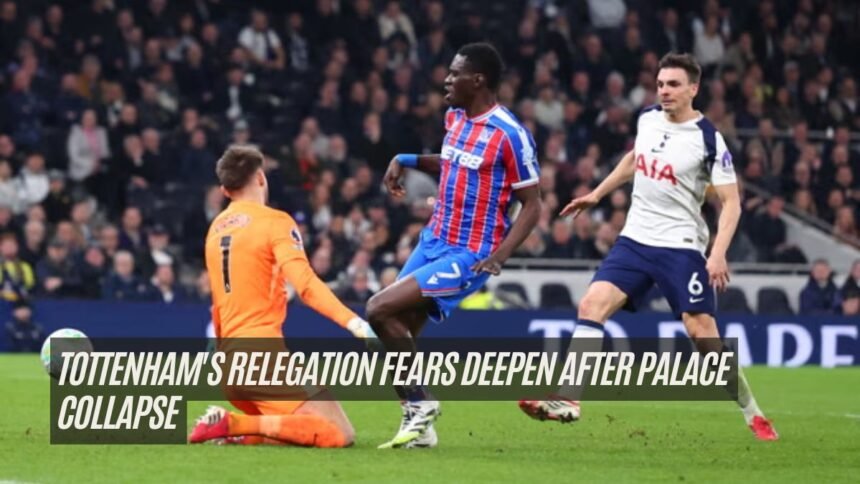
For a fleeting moment, fate seemed to smile upon Tottenham. Palace thought they had taken the lead when Evann Guessand set up Ismaïla Sarr, only for the dreaded VAR lines to intervene. To his eternal chagrin, the Senegal attacker had strayed marginally offside. Perhaps, it was Tottenham’s night after all. They seized the lead when Dominic Solanke clinically converted a cutback from Gray. Yet, this positivity lasted a mere six minutes, evaporating in an instant when Jørgen Strand Larsen’s flick released Sarr, and Van de Ven, in a moment of witless defending, pulled the forward back.
The punishment was swift and brutal. A penalty was awarded, and Van de Ven received a red card for denying an obvious goalscoring opportunity. With Cristian Romero already suspended, the loss of another key defender proved catastrophic. Tudor reacted by introducing Bissouma and Gallagher for Kolo Muani and Souza, but it was too late. Sarr equalized from the spot, and Tottenham’s collapse was complete and immediate.
Palace’s Clinical Edge and Midfield Mastery
Palace ruthlessly capitalized on Tottenham’s disarray. Their second goal arrived when Guessand dispossessed Pape Matar Sarr, allowing Wharton’s deft pass to send Strand Larsen through to finish with aplomb. The game rapidly slipped away from Tudor’s grasp. It was not long before Wharton again pierced Tottenham’s makeshift defence, sweeping a pass behind João Palhinha and sending Ismaïla Sarr through to poke the ball past an indecisive Vicario, sealing a comprehensive victory.
The crowd watched in utter disbelief. Boos echoed around the stadium when Vicario next touched the ball. Frustrated fans screamed at Tottenham analysts in the press box, while another unhappy customer accused the board of actively destroying the club. The atmosphere was not only poisonous but also tinged with a deep apathy. Images of fans streaming away from the stadium at half-time, and a ground half-empty long before full-time, painted a grim picture.
A Glimmer of Hope Amidst the Despair
Tudor, the supposed firefighter, had previously accused Tottenham of lacking in attack, midfield, defence, and even a brain after the Fulham defeat. Looking at Van de Ven’s dismissal, he probably had a valid point regarding the team’s stupidity. However, amidst the chaos, there was a flicker of heart from Tottenham during the second half, a testament to Tudor’s refusal to give up. He pointed to the impending return of injured players for the crucial run-in, a desperate plea for hope. At least someone, it seemed, was still up for the fight.
This defeat to Crystal Palace was more than just three points lost. It was a stark confirmation of Tottenham’s alarming trajectory, a club engulfed in crisis and teetering on the brink of an unthinkable relegation. The managerial merry-go-round has failed to ignite any spark, leaving a squad seemingly bereft of confidence and direction. While Igor Tudor clings to the hope of returning players, the immediate future looks incredibly bleak. Drastic measures and a monumental shift in mentality are urgently needed if Tottenham is to avoid a truly catastrophic end to the season, one that would redefine failure for a club of its stature.