




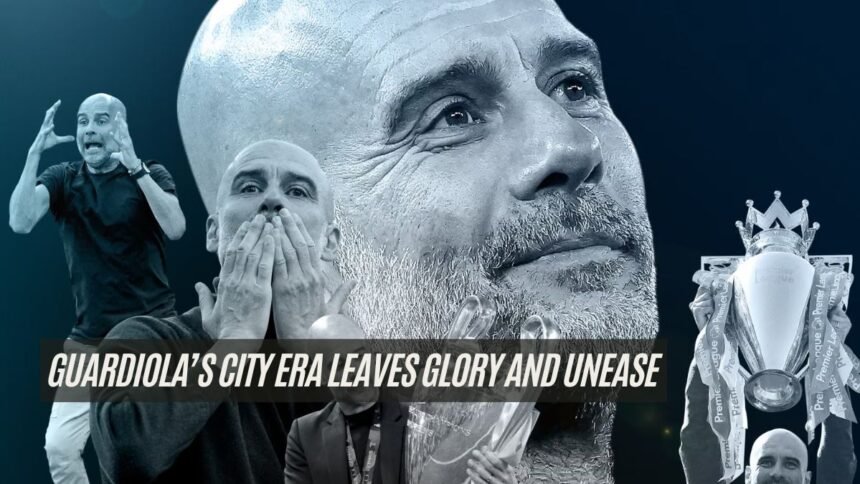
For years, it felt impossible to imagine Manchester City without Pep Guardiola pacing the technical area, demanding perfection from every movement on the pitch. Now, with no serious indication that he will extend his stay, the sense around English football is that the most influential managerial reign of the modern Premier League is finally approaching its conclusion.
Unless something dramatic changes behind the scenes potentially involving the upper hierarchy of the United Arab Emirates Guardiola’s final contract year appears destined to become a farewell tour. After a decade consumed by relentless competition, he may soon exchange tactical diagrams and title races for a quieter life away from football’s daily intensity.
A Decade That Changed English Football
The reaction to Guardiola’s expected departure has bordered on reverence. Broadcasters, former players and pundits have framed the moment as the closing chapter of a historic football dynasty. That admiration is understandable given the scale of what he achieved at Manchester City.
Under Guardiola, City collected 17 major trophies, accounting for more than half of the club’s total major honours. Beyond silverware, his sides consistently reshaped ideas about how elite football could be played.
The evolution of his teams became a story in itself. Early City sides attacked with chaos and bravery, often overwhelming opponents through movement and speed. Later versions turned into carefully calibrated possession machines, capable of suffocating rivals through territorial dominance. More recently, Guardiola adapted once again, building around the devastating efficiency of Erling Haaland while maintaining tactical sophistication.
Throughout those transformations, Guardiola remained the central figure obsessive, demanding and endlessly committed to refinement.
The Guardiola Obsession
One reason Guardiola’s influence reached beyond trophies lies in the intensity of his personality. His footballing philosophy was never presented as merely a strategy for winning matches. It became an identity.
Even during difficult moments, he refused to compromise. In his early seasons, criticism of his methods was widespread, particularly when defenders were asked to play risky passes under pressure. Yet Guardiola persisted. Players such as John Stones evolved dramatically within that framework, while others thrived in unexpected roles.
There were title-winning campaigns driven by unusual heroes, including seasons where Ilkay Gündogan emerged as a decisive scorer. Younger talents also benefited from Guardiola’s coaching. Recent examples, like Nico O’Reilly, highlighted his ability to reshape and develop players with remarkable precision.
Part of Guardiola’s mystique came from the sense that his work never stopped. Every match, training session and press conference carried the same intensity. Whether animated on the touchline or dissecting tactical details in interviews, he projected the image of a coach permanently consumed by football.
That emotional investment often produced memorable moments. During his time at FC Bayern Munich, his passion became so extreme during one Champions League match that he famously split his trousers on the touchline. More recently, his media appearances have occasionally revealed a more human side beneath the relentless perfectionism.
Success and the Questions Beneath It
Yet Guardiola’s reign cannot be discussed solely through trophies, tactical innovation and artistic football. The era also carried another narrative one that continues to divide opinion across the sport.
Much of the public conversation has celebrated City’s brilliance while paying less attention to the controversies surrounding the club’s financial conduct and ownership structure. Those issues remain inseparable from the wider story.
Manchester City continue to deny all allegations connected to the Premier League’s financial charges. Nevertheless, the accusations remain significant because they overlap heavily with Guardiola’s tenure. Around 40 of the charges reportedly relate to the period since his arrival in Manchester.
In modern football, financial power and sporting dominance are deeply connected. That reality shapes how Guardiola’s achievements are viewed by critics. Since the end of his debut campaign, City have consistently possessed one of the league’s most expensive squads, while several title triumphs were secured by extremely narrow margins.
Spending Power and Competitive Edges
The timeline of Guardiola’s reign reflects enormous investment alongside unprecedented success.
In his first season, City spent approximately £135 million bringing in players such as Stones, Gabriel Jesus, Leroy Sané and Gündogan. During that same period, the club were also accused of failing to provide fully accurate financial information.
A year later, City invested more than £180 million before winning the Premier League by a 19-point margin. Again, accusations concerning financial reporting followed.
Guardiola’s third campaign brought another major outlay, including the signing of Riyad Mahrez, as City edged the title race by a single point. The club also faced allegations connected to profitability and sustainability regulations.
Later successes carried similar scrutiny. In 2022, City captured another league crown by the narrowest of margins before adding Haaland and Julián Álvarez to the squad. During that period, the club were accused of failing to cooperate fully with league investigations. City firmly reject every allegation.
Regardless of where the legal process eventually lands, the accusations remain relevant because they form part of the competitive context in which Guardiola’s era unfolded.
Football, Ownership and Political Power
The debate surrounding City extends beyond finance. Another major point of criticism concerns the club’s ownership by Abu Dhabi interests linked to the United Arab Emirates government.
For opponents of the project, City’s sporting rise has also functioned as an exercise in soft power using football success to shape global perception. Guardiola, intentionally or otherwise, became the public face of that wider operation.
Figures such as Sheikh Mansour remain central to discussions about the club’s identity and influence. Critics argue that football’s emotional pull can distract from broader political issues connected to state ownership models.
Those arguments do not erase Guardiola’s coaching brilliance. Instead, they complicate the legacy.
The Contradiction at the Heart of City
There has always been a strange duality to Manchester City under Guardiola. On one hand, the football was often extraordinary intelligent, elegant and technically overwhelming. On the other, many observers struggled to connect emotionally with a project powered by immense wealth and institutional certainty.
For some supporters outside Manchester, City’s dominance felt inevitable from the moment Abu Dhabi’s investment transformed the club. If limitless resources combine with elite coaching and world-class recruitment, success becomes less surprising.
That perception created a certain emotional distance around their achievements. Guardiola supplied energy, personality and innovation, but the structure surrounding him often made victory appear pre-programmed.
Ironically, the ongoing charges even gave City a sense of rebellion at times. Despite being backed by enormous financial power, the club frequently portrayed itself as an outsider resisting traditional football establishments.
The Project Will Continue
Even if Guardiola departs, few expect Manchester City’s influence to disappear. The resources behind the club remain vast, and succession plans are already taking shape.
Names like Enzo Maresca have emerged as possible heirs to Guardiola’s philosophy coaches shaped by the same tactical schooling and positional principles.
That continuity is perhaps the clearest indication that this is not truly an ending. Guardiola may leave the touchline at the Etihad, but the structure he helped perfect is built to survive beyond him.
His time in Manchester ultimately leaves two intertwined legacies. One is footballing greatness of the highest order. The other is a modern reminder that elite sport is increasingly tied to wealth, politics and global influence.
Both stories now belong permanently to the Guardiola era.