






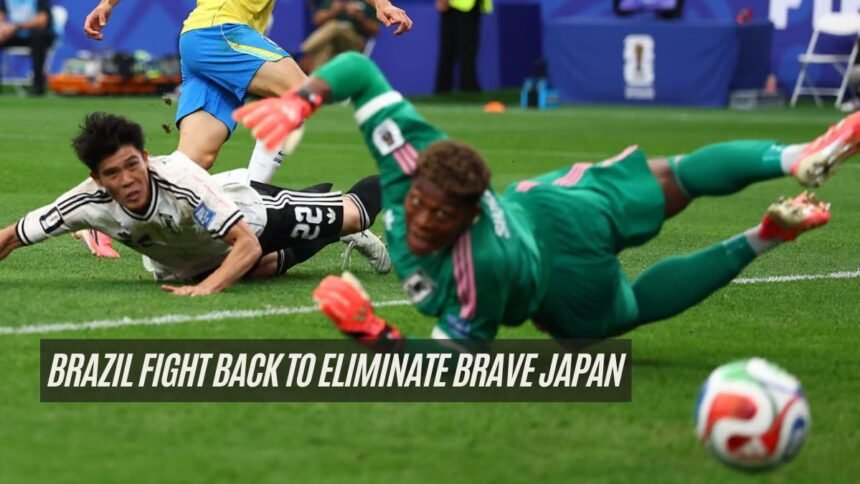
Brazil once again escaped punishment for an underwhelming display by producing a late turnaround when it mattered most. Carlo Ancelotti’s side struggled for long stretches against Japan, yet found a way to survive, continuing a pattern that has followed the Italian coach throughout his career. His teams rarely panic, remain patient under pressure, and often rely on either an opponent’s mistake or a decisive moment from their star players.
That formula proved successful again as Brazil recovered from a halftime deficit to secure a dramatic 2-1 victory. Casemiro restored parity early in the second half before Gabriel Martinelli struck the winner deep into stoppage time, completing another comeback that kept Brazil’s World Cup hopes alive.
Japan Push Brazil to the Limit
For much of the opening 45 minutes, Japan looked like the superior team. Faster in transition, more inventive with possession, and sharper in almost every duel, Hajime Moriyasu’s players caused constant problems for an aging Brazilian lineup.
With five starters over the age of 30—including five members of the defensive unit—Brazil often struggled to cope with Japan’s intensity. Their earliest-ever World Cup elimination suddenly appeared to be a genuine possibility.
However, everything changed once Ancelotti reshaped his team after the interval. The introduction of Endrick and a tactical switch altered Brazil’s attacking approach, allowing them to flood Japan’s penalty area with crosses and sustained pressure.
Another Heartbreaking Exit for Japan
Japan’s wait for a first World Cup knockout victory continues.
Moriyasu had spoken before the tournament about changing his players’ mentality, insisting they should aim to win the competition rather than simply participate. Many viewed those comments as an attempt to remove the psychological burden that has accompanied Japan through previous knockout disappointments.
Although they fell short once again, this performance may stand as one of the nation’s finest on football’s biggest stage.
Standing opposite them was Brazil—the only country to qualify for every World Cup and the tournament’s most decorated team. Brazil have never failed to reach the last 16 and have only twice finished outside the top eight in World Cup history.
Despite the defeat, Japan showed enough quality to suggest they belong among the world’s strongest sides. Injuries to three important creative players only made their display more impressive. Losing such a closely contested match against a heavyweight like Brazil is hardly a result to be ashamed of.
Defensive Discipline Frustrates Brazil
Unlike their more adventurous displays against Tunisia and Sweden, Japan adopted a more cautious game plan similar to the one they used against the Netherlands earlier in the tournament.
They defended in compact lines, choosing carefully when to press while limiting the space available to Brazil’s attackers. Vinícius Júnior, usually Brazil’s biggest threat, was kept unusually quiet thanks to the outstanding defensive work of Takehiro Tomiyasu and wing-back Ritsu Doan on Japan’s right flank.
Brazil dominated possession from kickoff but found it difficult to create meaningful chances. Aside from Matheus Cunha forcing Zion Suzuki into an early save with a low effort, clear opportunities were scarce.
As confidence grew, Japan became increasingly dangerous.
Ayase Ueda headed narrowly over from a corner before Japan deservedly broke the deadlock after 29 minutes. Kaishu Sano intercepted Danilo’s attempted pass toward the left side, burst beyond Casemiro, who appeared cautious after receiving an earlier booking, and drilled a precise low finish beyond Alisson from outside the penalty area.
Ancelotti’s Tactical Switch Changes the Match
Brazil emerged after halftime looking like a completely different side.
Ancelotti abandoned his previous setup, introducing Endrick and reorganising the team into a 4-2-3-1 formation. The adjustment immediately increased Brazil’s attacking threat, with crosses becoming the primary route into Japan’s penalty area.
Bruno Guimarães forced Suzuki into another excellent save with a header before Casemiro nearly scored when his effort was cleared off the goal line.
The equaliser eventually arrived in the 56th minute. Gabriel Magalhães delivered a delicate chipped cross into the box, where Casemiro rose highest to power a commanding header beyond Suzuki.
Brazil continued to press for a second goal. Vinícius Júnior cut inside from the left and nearly completed the comeback, but Suzuki reacted brilliantly, stretching out his left hand to divert the Brazilian’s flick onto the post.
Martinelli Delivers the Decisive Blow
Moriyasu responded by replacing both wing-backs in an effort to restore defensive balance. The substitutions slowed Brazil’s momentum for a period, but Japan no longer carried the attacking threat they had shown before halftime.
As the minutes ticked away, Brazil continued to dominate possession around the Japanese penalty area, making the winning goal feel increasingly inevitable.
It finally arrived in the fifth minute of added time.
Ao Tanaka lost possession just outside his own box, allowing Brazil one final opportunity. Bruno Guimarães calmly waited before sliding the ball across the area to Gabriel Martinelli, who squeezed his finish home to spark wild celebrations.
Brazil Advance Despite Lingering Concerns
The victory sends Brazil into the quarter-finals, where they will meet the winner of Tuesday’s clash between Côte d’Ivoire and Norway.
Even with progression secured, there remain obvious issues for Ancelotti to address. Brazil’s midfield struggled badly during the opening half, while the defensive unit frequently looked vulnerable against Japan’s pace and movement.
Yet the transformation after the break also highlighted Brazil’s enormous attacking potential. Once they found their rhythm, the quality in the final third became overwhelming.
Many will question whether Brazil can continue escaping difficult situations in every knockout match. History suggests that eventually such fortune runs out.
Then again, Ancelotti’s Real Madrid built a reputation for surviving moments of danger before repeatedly lifting the UEFA Champions League trophy.
Perhaps that same resilience could yet carry Brazil all the way to a sixth World Cup title.
Match Statistics
Possession
- Brazil: 72%
- Japan: 28%
Goal Attempts
- Brazil: 19 total (6 on target, 13 off target)
- Japan: 5 total (2 on target, 3 off target)
Corners
- Brazil: 6
- Japan: 2
Fouls
- Brazil: 4
- Japan: 10
Starting Lineups
Brazil: Alisson; Danilo, Marquinhos, Gabriel Magalhães, Douglas Santos; Bruno Guimarães, Casemiro, Lucas Paquetá; Rayan, Matheus Cunha, Vinícius Júnior.
Japan: Zion Suzuki; Takehiro Tomiyasu, Shogo Taniguchi, Hiroki Ito; Ritsu Doan, Kaishu Sano, Daichi Kamada, Keito Nakamura; Junya Ito, Daizen Maeda, Ayase Ueda.
Substitutes Used
Brazil: Endrick, Gabriel Martinelli, Luiz Henrique, Alex Sandro, Neymar, Bremer, Leo Pereira, Fabinho, Ederson Silva, Ederson, Weverton, Ibáñez, Thiago.
Japan: Yuki Sugawara, Kota Itakura, Shuto Machino, Ao Tanaka, Junya Suzuki, Kosuke Osako, Taisei Hayakawa, Yuto Nagatomo, Takefusa Kubo, Kaito Goto, Tsuyoshi Watanabe, Yuki Suzuki, Keisuke Ogawa, Ayumu Seko, Kosei Shiogai.