






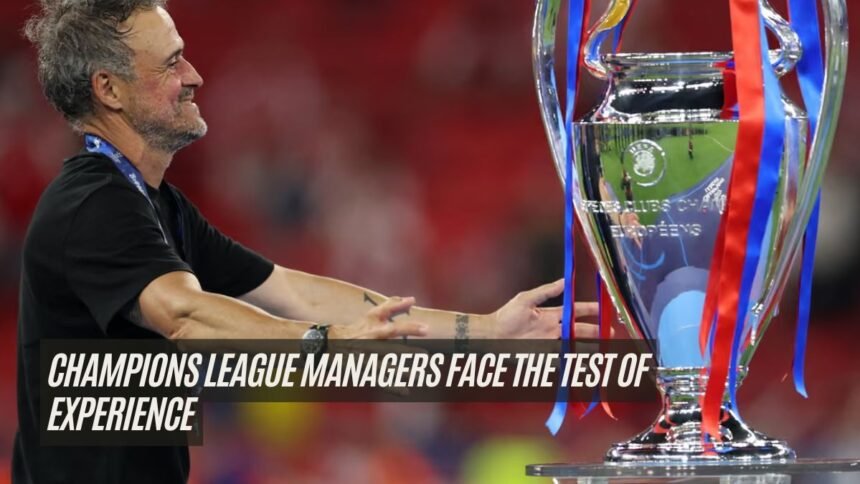
The Champions League has repeatedly shown that a manager does not necessarily need years at a club to lift European football’s biggest prize. Some coaches have reached the summit almost immediately after taking a new job, while others have relied on years of experience to navigate the demands of the competition.
That contrast will be particularly noticeable during the 2026-27 campaign. The managers involved range from coaches who have only recently arrived at their clubs to one figure who has spent almost 15 years in the same position. Their Champions League records are equally varied, with some having accumulated more than 100 appearances in the competition and others preparing to experience it for the first time.
A Season Defined by Managerial Change
The new Champions League campaign begins on Tuesday, and 14 of the 36 participating clubs are being led by managers who have been in their positions for less than 12 months.
That represents a significant level of turnover, although it is still below the figure seen in the Premier League. Eleven of the English top-flight’s 20 clubs appointed their current managers during 2026. In the Champions League, however, the distribution of managerial experience creates a more balanced picture.
At the other end of the scale, 14 coaches have already completed at least two years in charge of their respective clubs. Between those two groups sits another eight managers. Each helped their team qualify for the competition during their first full season in charge and now faces the considerably greater challenge of competing among Europe’s elite.
New Managers Have Already Proved Their Worth
Recent history provides plenty of encouragement for coaches who have only just taken over.
Chelsea, for example, won both of their Champions League titles under managers who had been appointed during the same calendar year as their triumph. Carlo Ancelotti also enjoyed remarkable success at Real Madrid at the beginning of both of his spells there, guiding the Spanish giants to European glory during his first season on each occasion.
Zinedine Zidane took that success even further. After stepping into the Real Madrid job for the first time, he oversaw three consecutive Champions League victories.
There are similar examples elsewhere. Pep Guardiola and Luis Enrique both won the competition with Barcelona at the first available opportunity. Hansi Flick, now back at Barcelona, ended his debut season as Bayern Munich coach by completing a treble.
Liverpool supporters will therefore have reason to believe that Andoni Iraola could produce a similar story. The Spaniard will be attempting to follow the example of his compatriot Rafael Benítez, who won the Champions League shortly after taking charge at Anfield.
Those precedents suggest that managerial longevity is far from a prerequisite for European success. The bookmakers, however, appear to place greater value on established coaches.
PSG Lead the Betting Despite Enrique’s Experience
Paris Saint-Germain enter the tournament as the bookmakers’ leading contenders, though Luis Enrique’s fourth season in charge is not the main reason for that status.
The French champions are attempting to defend the trophy for a second consecutive season and possess a squad with considerable depth. They also benefit from facing fewer domestic pressures than many of their rivals competing in other major European leagues, giving them another advantage as the season progresses.
Barcelona, Arsenal and Bayern Munich complete the four leading favourites. Their respective managers are also part of the group of 13 coaches who have been in their current roles the longest as the league phase begins.
The picture changes immediately after those four favourites. The next four teams considered most likely to win the competition all have managers who only arrived at their clubs during 2026.
Mourinho Brings Vast Champions League Experience
One of the most striking examples is Real Madrid’s José Mourinho.
Although Mourinho is a new arrival at the Spanish club, calling him inexperienced in the Champions League would be misleading. He has already managed 160 matches in the competition, placing him fifth on the all-time list.
Only four managers have reached a higher total. Ancelotti sits at the top with 218 Champions League appearances, followed by three members of the Premier League’s celebrated managerial elite: Alex Ferguson with 206, while Guardiola and Arsène Wenger have each managed 191 games.
Jürgen Klopp, with 102 Champions League matches, is another member of that highly regarded group of modern English football managers.
Of those five, Mourinho is the only one taking part in this season’s Champions League. His situation at Madrid therefore creates an unusual combination: he is the new manager at the club, but hardly a newcomer to the competition.
With the quality available to him in Madrid, Mourinho will have strong ambitions of reaching the latter stages. He will also be hoping to progress beyond the last 16 for the first time since 2014.
Experience Could Become Crucial in the Knockout Race
The scale of Mourinho’s European experience becomes even clearer when compared with the coaches he will encounter during the league phase.
The eight managers whose teams he will face have collectively overseen fewer Champions League matches than Mourinho has managed by himself. Even more remarkably, the 24 least experienced coaches in this season’s competition have a combined total below Mourinho’s individual figure of 160 games.
Yet limited Champions League experience does not necessarily mean a manager is taking charge of a lesser team.
Inter’s Cristian Chivu, for instance, has already managed 10 Champions League matches. That is still more than the records of the coaches currently in charge at Manchester City, Manchester United and Liverpool, whose respective totals stand at six, one and zero.
The competition will therefore provide an intriguing test of whether familiarity with European football can outweigh the energy and tactical ideas often associated with a new managerial appointment.
Sixteen Points Set the Early Target
As the league phase gets underway, one number could prove particularly important: 16.
That is the points tally that has been sufficient to earn an automatic place in the last 16. For every manager, regardless of whether they are a Champions League veteran or a newcomer, the immediate objective is therefore straightforward: collect enough points to stay clear of the playoff positions.
Once that first hurdle has been cleared, experience may begin to carry greater weight.
The knockout rounds demand a different level of composure, preparation and familiarity with high-pressure European nights. Whether those qualities come from years of experience or a manager capable of making an immediate impact will become one of the defining storylines of the 2026-27 Champions League.