





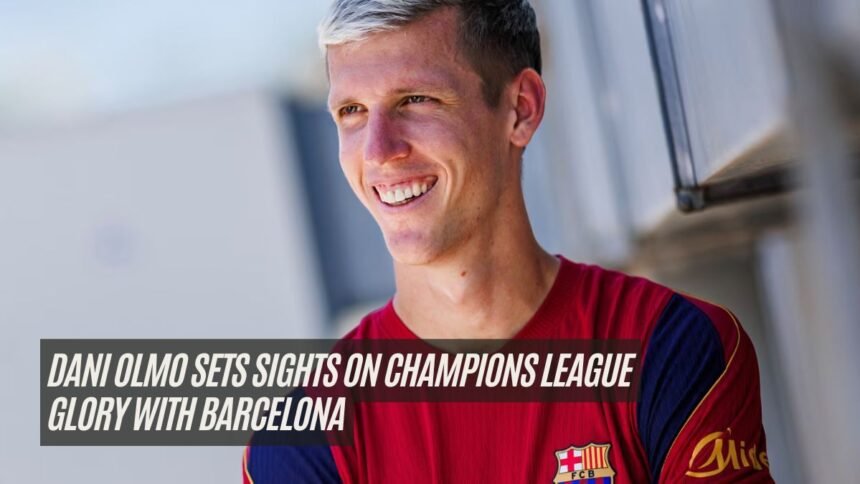
Dani Olmo points towards his right arm as he recalls the moment everything finally sank in. “Look: goosebumps,” the Barcelona midfielder says, sitting inside a room at the club’s Joan Gamper training complex.
For Olmo, the realisation that Spain had become world champions did not arrive immediately after the final whistle. The emotions built slowly, through a collection of images that remain firmly fixed in his memory.
One of them involves Ferran Torres’ mother.
“I have an image in my mind with Ferran’s mum: hugging her, the two of us in tears,” Olmo recalls. “What your son just did … what we all did … this is historic.”
Only then did the magnitude of Spain’s achievement begin to register.
During the closing stages of the match, Olmo admits it was almost impossible to believe what was unfolding. But when the referee finally ended the contest, a question began to emerge.
“Have we done it? Are we …?”
The feeling became stronger when Spain lifted the trophy. It intensified again when the players were reunited with their families and Olmo saw the reactions of his brother, partner and father.
“I’m not one to cry, but …”
The Moment Spain Reached Another Level
Eventually, there was no escaping the truth. Spain were world champions.
The achievement had become reality on 19 July in New Jersey, where Spain defeated Argentina. For Olmo and his teammates, that victory represented far more than another trophy. It placed their generation alongside the greatest Spanish side that had come before them.
“It changes you, changes your life,” Olmo says.
Even now, he is unsure whether the players have fully understood what they achieved. The reception they receive at opposing stadiums offers some indication, but he expects the significance to become clearer as the years pass.
It is, in his words, like entering another dimension reserved for a very small group of players.
As a child, Olmo viewed Spain’s 2010 World Cup winners as untouchable figures. Andrés Iniesta, Xavi, Sergio Busquets, Xabi Alonso and David Villa were the players who defined that era.
“We held on to the past, longed for that generation, how happy they made us,” he says. “Now it’s like, ‘You’re there, too.’”
That feeling brings a new responsibility. Spain have another generation capable of inspiring the next one, but Olmo’s attention has already shifted back towards club football.
From World Champions to Barcelona Duty
Just 23 days after Spain’s triumph in the United States, Olmo returned to Barcelona. Training had resumed, another European campaign was approaching and Hansi Flick was waiting for him.
The German coach had a simple message.
“You’re a champion of the world, Dani.”
Olmo responded with a laugh.
“I know, mister.”
But the celebration was already over. Barcelona had their own ambitions.
“And now [we have to do it] with Barcelona,” Olmo says.
Barcelona’s connection to Spain’s successful national side remains particularly strong. Eight members of the 26-man World Cup squad were Barcelona players. Ferran Torres has since left for Paris Saint-Germain, while Rodri has arrived from Manchester City.
Olmo believes the relationship works both ways. Barcelona’s culture of competing for trophies has strengthened Spain, while the success achieved with the national team can now feed confidence into the club.
The midfielder sees the two achievements as part of the same broader idea: continuity, belief and a commitment to winning.
“We came from a very successful year; winning the league, the Super Cup … the World Cup was the finishing touch,” Olmo explains.
Barcelona’s influence on the national team, he argues, comes from more than simply having several players in the squad. The club has a group accustomed to winning, competing and dealing with pressure.
“They know how to win and also good people – and I think we are – helps the national team,” Olmo says.
Whether a player spends a lot of time on the pitch or only a little, he believes the collective mentality remains important.
“This is a winning generation at Barcelona, too. We’ve shown that in Spain; in Europe, we’re competing for the highest prize.”
The European Trophy That Still Eludes Them
That highest prize is the Champions League, a competition Barcelona have not won for 11 years.
An entire generation has passed since the club’s last triumph in June 2015. Olmo was only 17 at the time, and there is now nobody in the current Barcelona squad who was part of that victorious team.
His own journey was only beginning.
Olmo had left the Barcelona academy he first entered at the age of nine. The previous summer, aged 16, he had chosen to leave Spain and pursue an opportunity abroad.
At Dinamo Zagreb, he had made five appearances from the bench for the senior side. It was the beginning of a career that would eventually take him through RB Leipzig before bringing him back to Barcelona in 2024.
His first season after returning ended with a domestic treble. Barcelona retained the league title the following year, but Europe remained unfinished business.
Inter eliminated them in the semi-finals, while Atlético Madrid had previously knocked them out at the quarter-final stage.
Now another Champions League campaign is about to begin, with Feyenoord visiting Camp Nou on Wednesday night. Barcelona’s ultimate ambition is to reach the final at Madrid’s Metropolitano on 5 June.
Olmo believes the disappointments of the previous two seasons have provided valuable education.
“You can feel that extra confidence,” he says. “The Champions League is decided by small details that haven’t gone our way but the last two years were experiences for the future. We were a young team.”
Asked whether that still applies, Olmo smiles.
“Still are.”
A Young Team Learning From Its Mistakes
Barcelona’s youth was evident last month against Athletic Bilbao, when they selected their youngest starting XI ever at Camp Nou. The average age was just 23.18.
Olmo regards the current group as an exceptional generation, one that has benefited from opportunities he was never certain would exist when he left Barcelona at 16.
“I’m still young … I think,” says the 28-year-old. “But I feel like a veteran.”
That sense of experience is particularly evident when he discusses La Masia.
The academy, in his view, is thriving again. Barcelona have always produced outstanding footballers, but finding regular first-team opportunities for every talented youngster has not always been straightforward.
Thiago Alcântara is one example. Despite possessing outstanding ability, he eventually moved to Bayern Munich in search of regular football at the highest level.
“In my opinion, Barcelona have the best academy in the world,” Olmo says.
He points to Marc Bernal, Lamine Yamal and the emergence of Xavi Espart as examples of the talent currently coming through. Pedri, meanwhile, remains remarkably young despite already having spent six or seven years operating at the highest level.
Barcelona therefore have something previous generations lacked: a blend of youth and meaningful experience.
The painful defeats against Inter and Atlético Madrid have also left their mark.
The first loss was particularly difficult because Barcelona could already picture themselves in the Champions League final. Against Atlético last season, Olmo believes the damage suffered in the opening game proved too difficult to overcome.
There was a lesson in both defeats.
“We’re a young team, maybe you think there’s no problem, nothing can go wrong,” he says.
That mentality has changed.
Every minute matters. Every sprint, defensive run and individual decision can influence a Champions League tie. Whether the match lasts 90 minutes or stretches beyond 120, Barcelona know they must remain switched on.
“We have to minimise the risk.”
Barcelona Still Refuse to Abandon Their Identity
Yet risk is also an essential part of Barcelona’s football.
Olmo believes that is one of the clearest differences between the club and Spain, even though there are obvious similarities in their philosophies.
He is also careful about describing Barcelona’s approach simply as “risk”. The criticism surrounding the team’s high defensive line and supposed vulnerability, he argues, can sometimes overlook how effective the system has been.
Under Flick, Barcelona continue to trust the football that has already delivered trophies.
“Flick gives us confidence, always,” Olmo says. “We believe in the idea and we will keep doing that because it has brought titles and shown us we can compete in the Champions League.”
Spain operate differently without the ball.
Luis de la Fuente still demands intensity and aggressive pressing, but the national side can retreat into a mid-block or even a mid-low defensive shape when circumstances require greater defensive resistance.
Barcelona, by contrast, generally attempt to push forward immediately after losing possession and seek quick transitions.
The two managers nevertheless share several characteristics. Both are close to their players and maintain an open-door approach when members of the squad need them.
Olmo considers both coaches strong motivators, although he gives De la Fuente a slight edge in that particular department.
Flick can appear more serious, he says, but he also knows when to relax and make a joke.
Tactically, the similarities remain obvious: attacking football, possession and a desire to control matches.
Lessons From the Inter Collapse
The experience against Inter has forced Barcelona to refine rather than abandon their principles.
Scoring six goals across the tie and still failing to progress was a painful demonstration of how small margins can decide the Champions League.
Olmo says the squad now understands that improvement does not necessarily mean changing its entire identity.
“Every year there are nuances, tweaks, adaptations,” he explains.
Barcelona have been working on ways to prevent opponents from exploiting spaces behind their aggressive approach. The objective is still to move forward, but players must recognise when patience is required.
If one player is late closing down an opponent, the rest of the team cannot simply leave the structure exposed.
Olmo believes those experiences have finally given the squad the maturity required to recognise such moments.
Rodri Brings Another Layer of Control
Barcelona’s summer additions have also changed the balance of the team.
Among them is Rodri, a midfielder Olmo believes represents the kind of control and positional intelligence Barcelona need.
The club have lost Robert Lewandowski and Ferran Torres, while a move for Julián Alvarez did not happen. Yet Olmo does not regard the changes in attack as an unsolvable problem.
“There’s no one like Robert in history,” he says.
Barcelona have already found alternatives. Raphinha can operate as a No 9, Gabriel Jesus has arrived and Hamza Abdelkarim has impressed. Flick can also use Olmo or Fermin López in the position, giving the manager several different options.
“I feel comfortable in” that role, Olmo says.
The midfielder is equally enthusiastic about the club’s recruitment elsewhere.
“The club has done an incredible job,” he adds.
Rodri, Gabriel Jesus, Karim Adeyemi and Anthony Gordon have all brought different qualities to the squad, according to Olmo.
Adeyemi and Gordon offer pace that can complement Barcelona’s attacking approach, but Olmo highlights another aspect that Flick values just as highly: what happens when the team does not have possession.
Pressing together and defending collectively remain fundamental.
And then there is Rodri.
Olmo sees the former Manchester City midfielder as the closest modern equivalent to Sergio Busquets.
Olmo’s Role in Rodri’s Arrival
Did Olmo play a part in convincing Rodri to join?
His answer comes with a smile.
“Erm, it was all very fast,” he says.
During Spain’s World Cup campaign, transfers were hardly a priority. But once speculation about Rodri’s future began circulating, the players may have exchanged a message or two.
Olmo does not suggest there was a major recruitment campaign.
“He decided and we’re so happy.”
Rodri, he believes, is almost perfectly suited to Barcelona’s football.
His positional discipline provides balance to a system that can otherwise expose the team, while his ability to hold the structure together could give attacking players such as Olmo greater freedom.
“He’s positional, brings balance, which will give me more freedom to interpret where the spaces are,” Olmo says.
The Barcelona midfielder accepts that their style will occasionally leave them vulnerable. The difference now is that the players have accumulated enough experience to recognise when they should commit forward and when they need to protect themselves.
Rodri can help them make those decisions.
“He sustains the structure,” Olmo explains.
From Barcelona’s Bikes to New York
There is also a lighter tradition developing among this Barcelona generation.
When the club won the league in 2025, four players celebrated by taking city bikes and cycling along the Diagonal. The idea began with Ferran Torres, whom the group had visited in hospital while he recovered from appendicitis.
Olmo says the bicycle was initially nothing more than the easiest way to make the journey. But the moment developed into something more.
The players repeated the idea in New York.
Before the World Cup final, Olmo, Torres and Eric García climbed onto bicycles and rode through the city as sirens sounded around them.
Given the importance of the match that was approaching, it might not have been the most conventional preparation.
Olmo laughs when remembering it.
“We would have waited until after to post the images,” he says.
Still, the players were careful and everything went smoothly.
Now the tradition has survived another major trophy.
There is only one more piece missing from the collection Barcelona want.
The journey has taken them from Barcelona to New York.
The next destination, if everything goes according to plan, is Madrid.
Olmo smiles when the possibility is mentioned. Perhaps, he jokes, they will have to remain anonymous behind masks and helmets.
“Maybe we’ll have to download the app just in case,” he says.