






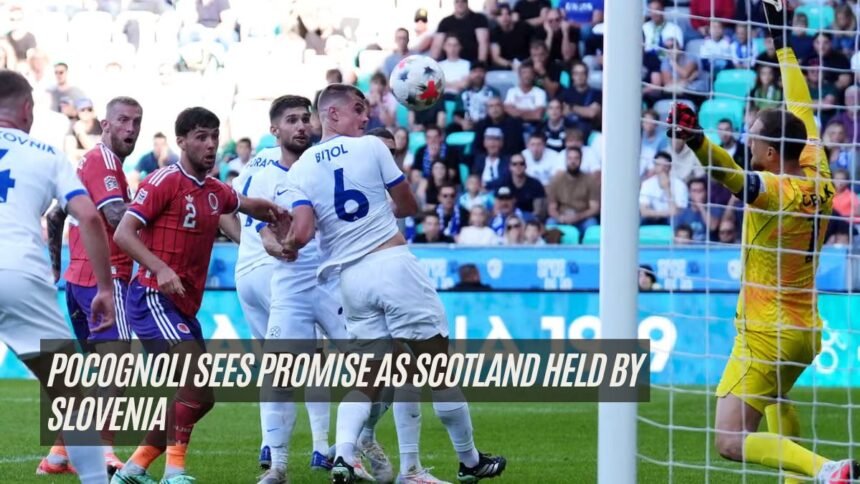
Sébastien Pocognoli had reason to smile by the end of his first match as Scotland manager, even if the occasion did not produce the victory his team increasingly looked capable of securing.
The 39-year-old once endured a difficult introduction to international football as a Belgium player, when Alessandro del Piero and Italy proved unforgiving opponents ahead of the 2006 World Cup. His first experience on the touchline in charge of Scotland was considerably more encouraging.
A clear afternoon in Ljubljana provided the setting for the beginning of Scotland’s post-Steve Clarke chapter. For much of the opening half, however, there was little evidence that a fresh era had begun.
Scotland were cautious, disjointed and struggled badly to progress the ball with purpose. That changed after the interval. Pocognoli’s side emerged with far greater urgency, repeatedly troubled Slovenia and eventually left frustrated that their improvement had produced only a 0-0 draw.
The Scottish players were applauded at the finish, with their second-half performance offering supporters something positive to take from the new manager’s opening assignment.
Familiar Scoring Problem Remains
One issue survived the managerial transition: Scotland still need to become more clinical in front of goal.
Their struggles to convert opportunities were a recurring feature during the latter stages of Clarke’s tenure, and Pocognoli immediately encountered the same problem. The difference in Ljubljana was the number of promising situations Scotland managed to create after half-time.
They did so without Scott McTominay, one of their most important attacking contributors. Turning opportunities into goals will therefore be among Pocognoli’s early priorities. His coaching background suggests it is an area he will expect to address, although developing a ruthless attacking side will require time.
Slovenia, meanwhile, appeared to have deeper concerns. They were unable to take advantage of Scotland’s poor opening period and offered little sustained attacking threat themselves.
Pocognoli nevertheless focused on the positives afterwards.
“The feeling in the dressing room is positive because of the second half,” he said. “We should have scored but I am very happy with the general performance of the strikers. It was only the last details we missed.”
His mood reflected the considerable improvement he had witnessed following the interval.
A New Chapter After Clarke
Scotland arrived in Slovenia 94 days after defeat against Brazil had effectively ended their World Cup hopes. Once elimination was confirmed, Clarke stepped down.
His departure created an unusual emotional backdrop. There remains considerable appreciation for a manager who transformed Scotland’s fortunes during his time in charge, yet there is also enthusiasm among players and supporters about what a new coaching regime could bring.
Pocognoli entered international management at only 39 and had prepared extensively for his opening fixture. Scotland’s squad, accompanied by a sizeable coaching and support team, travelled to La Manga before the Nations League encounter.
The hosts had their own disappointment to process after failing to qualify for the World Cup. Large areas of empty seating in Ljubljana suggested enthusiasm around Slovenia’s national side was hardly at its peak. Their attacking options were further weakened by the absence of Benjamin Sesko.
Pocognoli made an immediate tactical statement with his selection.
Robbie Ure was handed his senior international debut alongside Oli McBurnie, who returned to the Scotland team after a lengthy absence. It was an unfamiliar two-striker combination, but the opening 45 minutes demonstrated that selecting extra forwards achieves little when they are starved of meaningful service.
Slovenia Waste Early Opportunities
Scotland’s first-half display was comfortably the weakest part of the evening.
Their organisation without possession appeared reasonably sound, but their composure disappeared too often once they had the ball. Passes lacked conviction, attacks developed slowly and there was almost no sense of direction in the final third.
Slovenia were not especially impressive either, yet they still found opportunities to punish Scotland.
Andraz Sporar appeared to have given the hosts an eighth-minute lead when he put the ball into the net, only for the goal to be ruled out for offside.
A much better opportunity followed. Danijel Sturm created the opening and Sporar found himself with an excellent chance from around six yards, but he failed to convert.
Aljosa Matko later dragged another attempt wide of Angus Gunn’s goal, prompting increasingly nervous reactions from the travelling Tartan Army.
Scotland offered virtually nothing going forward during the same period. Their only significant threat came when Ure tried his luck from approximately 20 yards and saw his effort brush the outside of the post.
One misplaced pass neatly captured the problems. Billy Gilmour attempted to release Andy Robertson as the captain advanced down the flank, but the ball was struck with far too much weight and sailed harmlessly out of play.
It was the kind of first half Pocognoli would have wanted to erase quickly.
Whatever was said in the dressing room worked.
McBurnie Chance Sparks Scottish Revival
Within five minutes of the restart, Scotland should have been ahead.
McBurnie broke into a position from which a direct finish looked the obvious option. Instead of immediately shooting beyond Jan Oblak, however, the striker attempted to manoeuvre around the Slovenia goalkeeper.
Even from the ground, Oblak managed to extend himself and take the ball away from McBurnie’s feet before the forward could complete the move.
The missed opportunity proved significant in another sense because Scotland suddenly began playing with confidence.
Gilmour combined neatly with McBurnie in a one-two before testing Oblak. John McGinn then delivered a corner towards Aaron Hickey, who was unable to guide his effort accurately enough towards goal.
The pressure continued.
Kieron Bowie entered for Ure in the 67th minute and soon found himself denied by Oblak. From the corner that followed, McBurnie was frustrated by the Atlético Madrid goalkeeper as well.
This was an entirely different Scotland from the side that had struggled through the first 45 minutes. They moved the ball more effectively, pushed Slovenia backwards and began creating chances with regularity.
McBurnie was particularly frustrated with his inability to capitalise. He admitted afterwards that the missed opportunities would make sleeping difficult. After 17 international appearances, he is still waiting for his first Scotland goal.
Bowie Misses Scotland’s Best Late Opening
Another huge chance arrived with 12 minutes remaining.
Gilmour had grown increasingly influential as Scotland took control of the contest and produced the pass that released Bowie into a highly promising position. The substitute, however, could not provide the finish.
It was the type of opportunity Scotland could scarcely afford to waste in a match where goals had already proved difficult to find.
Pocognoli responded aggressively with his substitutions. Ben Gannon-Doak was introduced for Hickey in the 78th minute, effectively exchanging a full-back for a winger as Scotland increased their commitment to attack.
The visitors continued to push.
Slovenia were forced deeper and Scotland maintained pressure in search of the decisive breakthrough, but the home defence survived. For all the improved movement and attacking intent, Pocognoli’s team could not find the one touch that mattered most.
When the final whistle arrived, the new Scotland manager appeared satisfied with much of what he had seen.
The opening half had exposed significant weaknesses, particularly in possession and in the connection between midfield and attack. The second demonstrated how quickly the same group could become more assertive when playing with greater speed and purpose.
A point was ultimately Scotland’s reward, but their five efforts on target compared with Slovenia’s one underlined how heavily the contest shifted after the interval.
Scotland Dominate the Shooting Numbers
Possession was divided evenly, with both teams recording 50%.
The greater difference came in attacking output. Scotland produced 17 attempts in total, with five finding the target and another 12 finishing off target. Slovenia managed only four efforts across the match, three missing the target and one requiring intervention from Gunn.
The hosts earned five corners compared with Scotland’s four. Slovenia committed 14 fouls, while Scotland were penalised 18 times.
Those numbers broadly reflected a match of two contrasting halves: Slovenia had the clearer moments early on, before Scotland became the dominant attacking side after the break.
Starting Lineups and Changes
Slovenia began with Jan Oblak in goal. Zan Karnicnik, David Brekalo, Jaka Bijol, Vanja Drkusic and Erik Janza formed the defensive group, with Aljosa Matko, Adam Gnezda Cerin, Timi Max Elsnik and Danijel Sturm supporting Andraz Sporar.
Their substitutions included David Zec and Marko Zabukovnik in the 64th minute, replacing Drkusic and Elsnik respectively. Jure Balkovec and Zan Vipotnik entered after 74 minutes for Brekalo and Sporar, while Sandi Lovric replaced Cerin in the 80th minute.
Angus Gunn started in the Scotland goal behind Jack Hendry, Scott McKenna and Scott Welsh. Hickey and Robertson operated on the flanks, with Gilmour and Lewis Ferguson in midfield. McGinn supported the new attacking partnership of Ure and McBurnie.
Bowie replaced Ure after 67 minutes, while Gannon-Doak came on for Hickey with 12 minutes of normal time remaining.
Scotland’s unused options included Liam Kelly, Scott Bain, Luis Binks, Josh Doig, Ryan Christie, Lennon Miller, Jamie McPake, Liam Graham, Nathan Patterson and Kieran Montgomery.
Slovenia also had Martin Turk’s alternatives available from a bench containing Martin Vidovsek, Zan Leban, Sven Kuzmic, Tjas Begic, Zan Celar, Timi Svetlin and Tomi Horvat, alongside those who were eventually introduced.
Encouraging Signs Before Hampden Debut
Pocognoli therefore leaves his first international assignment with a mixture of encouragement and unfinished business.
Scotland did not score, and several of the opportunities they wasted were good enough to decide the match. McBurnie and Bowie will both feel they could have transformed the evening with better finishing.
Yet the response after a deeply disappointing first half was significant.
Scotland finished the game attacking rather than protecting the draw. Gilmour became increasingly prominent, the substitutes added momentum and Slovenia were ultimately relieved to escape with a point.
Pocognoli’s next test comes quickly.
Switzerland visit Hampden Park on Tuesday, when the new manager will experience his first home match in charge. After the transformation seen in Ljubljana following half-time, Scotland will hope the more adventurous version of Pocognoli’s team is the one that appears from the opening whistle.