





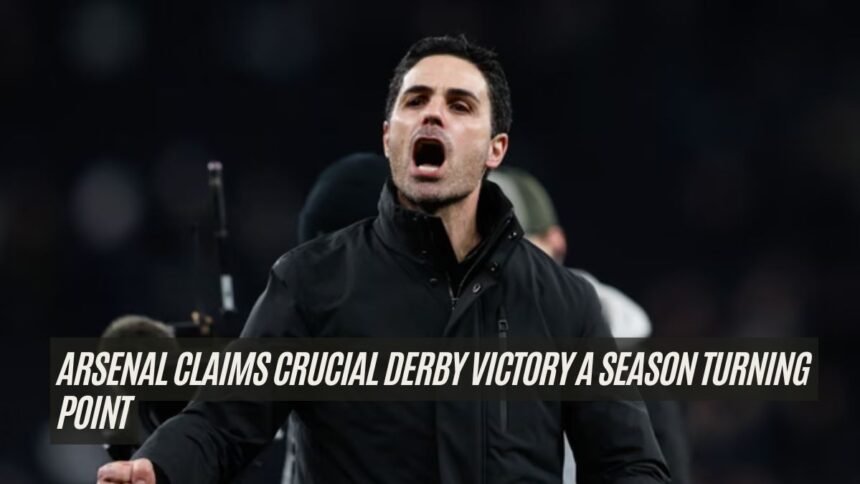
Mikel Arteta, Arsenal’s manager, found himself brimming with pride and satisfaction following his team’s emphatic 4-1 victory over Tottenham Hotspur on Sunday. This significant win not only re-established Arsenal’s five-point lead at the summit of the Premier League table but, according to Arteta, could very well be a pivotal turning point in their quest for silverware. The result was a powerful statement, an immediate and robust response to the disappointment of squandering a two-goal lead in their previous outing against Wolves, a draw that had cast a shadow of doubt.
Arteta’s Relief and Pride After Derby Triumph
The atmosphere surrounding the Arsenal camp after the Wolves draw was undeniably tense. Arteta himself admitted the feeling was one of anger, upset, and even shame. Yet, the beauty of football, as he described it, lies in its capacity for immediate redemption. The manager recounted how the team, a diverse group of different nationalities and backgrounds, rallied together. They collectively posed the crucial question, how could they transform that painful experience into a catalyst for improvement, a genuine turning point.
Arteta emphasized that this journey transcends mere professional obligation. It is a shared passion, a collective purpose that, while sometimes agonizing, ultimately promises profound rewards. The emotional toll of the Wolves game was palpable, making the Tottenham victory all the more sweet and significant.
A Resilient Response and Eze’s Brilliance
For the first time in two months, Arteta faces a week without a midweek fixture, a welcome respite. He reflected on the team’s character, stating, “It feels that we showed what we are made of, but then you have to show it again and again and again.” His immense pride and happiness stemmed particularly from the team’s resilience over the preceding 72 hours, demonstrating their ability to bounce back from adversity with conviction and determination.
Among the standout performers, Eberechi Eze garnered specific praise from the Arsenal boss. Eze, who had already netted a hat-trick in the reverse fixture at the Emirates Stadium, added another two goals to his tally against Tottenham. Arteta noted a strong desire within Eze to prove himself, acknowledging the player’s frustration at not starting the Wolves match. This individual drive undoubtedly fueled his exceptional performance in the derby.
Tottenham’s Reality Check Under Igor Tudor
Across North London, Tottenham’s new manager, Igor Tudor, faced a harsh introduction to the intensity of the derby and the scale of the task awaiting him. Tudor expressed deep sadness but also found a strange utility in the defeat. He viewed it as a stark reality check, an opportunity for every individual within the club to understand their current standing. The prescribed “medicine,” as he put it, involves introspection, with each player needing to look in the mirror and commit to changing their habits. The only path forward, he insisted, is through relentless hard work.
Mentality, Physicality, and Tactical Gaps
Tudor spoke candidly about the need to alter the team’s “mentality and brain sharpness.” He acknowledged a significant chasm between Tottenham and Arsenal at this moment, describing them as being in “different worlds.” He pinpointed numerous problems that a top-tier team like Arsenal would inevitably exploit. The desire to press high, for instance, was undermined by a lack of collective movement and timing, leading to players being late to challenges and failing to win back possession.
The physical condition of the squad also came under scrutiny. Tudor stressed the necessity of being in a physical state capable of strong challenges and ball winning. Furthermore, a palpable lack of confidence was evident even when Tottenham had possession, hindering their ability to execute passes and maintain control. Despite these critical observations and the implication that his team lacked mental toughness and physical robustness, Tudor remained resolute. He affirmed that he was not despondent, having witnessed passion and will from his players. Their inability to execute the game plan, he believed, stemmed not from a lack of desire but from a current inability to perform at the required level. When asked if there was still time to rectify these issues, Tudor’s answer was an unequivocal “Of course.”
Arsenal’s commanding victory over Tottenham represents more than just three points. It is a powerful affirmation of their title credentials, a testament to their resilience, and a significant psychological boost for Mikel Arteta’s squad. The manager’s belief in this being a turning point suggests a deeper maturity developing within the team. For Tottenham and Igor Tudor, the derby serves as a brutal but perhaps necessary awakening. It lays bare the extensive work required to bridge the gap to the league’s elite, demanding a fundamental shift in mentality, physical conditioning, and tactical execution. The coming weeks will reveal whether both clubs can build on the lessons learned from this pivotal North London encounter.