






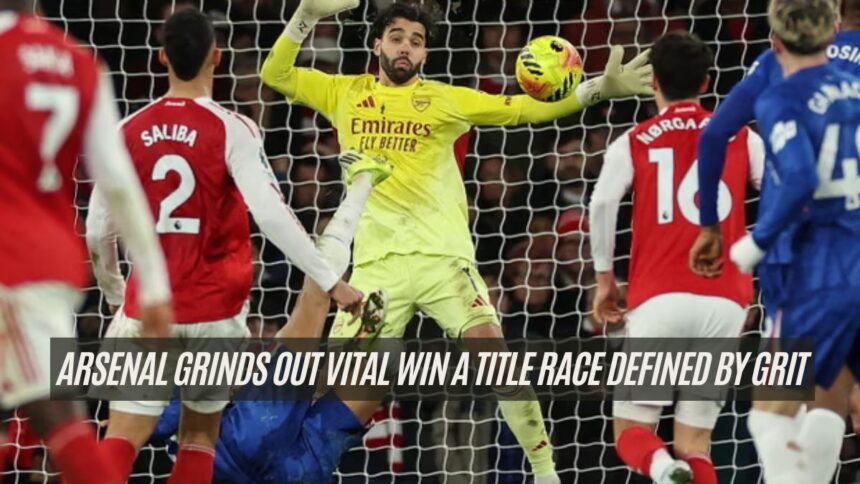
The grand vision for the Premier League, often articulated in luxurious settings, speaks of a ‘Premflix’ future, a direct-to-consumer model promising to deliver irresistible football to billions. This echoes earlier pronouncements about the league as a colossal tech platform, an engine of global reach. Yet, the reality unfolding on the pitch, particularly in the white-hot intensity of a title race, often presents a starkly different picture. It is a world of raw, unvarnished struggle, where every inch is fought for, and the ‘beautiful game’ can feel more like a relentless, physical contest. This recent crucial victory for Arsenal perfectly encapsulated that dichotomy, a testament to sheer will rather than fluid artistry, revealing the true, gripping nature of a championship pursuit.
The Grand Vision Meets Gritty Reality
At a recent opulent London gathering, the Premier League chief executive, Richard Masters, detailed the ambitious prospect of ‘Premflix’. He envisioned a future where this captivating footballing spectacle would be streamed directly into the homes of eight billion eager viewers. This grand, technologically driven vision mirrors the sentiments expressed a year prior by Todd Boehly, who spoke of the Premier League as a powerful force, a source of the next great tech platform, a tool for world domination. However, the football witnessed on the pitch frequently diverges from such polished commercial aspirations. The game often resembles a brutal, ancient contest, far removed from any sleek digital interface. One might even compare it to those centuries-old Derbyshire wrestle-ball events, where masses of men engage in a relentless, physical embrace within a village street. This particular match, for significant periods, felt exactly like that.
A Match Defined by Set Pieces
The afternoon’s action was marked by a peculiar tactical quandary. What does a team do when its primary avenue for scoring appears to be from corners, yet its attacking play is so blunt it struggles to win any? The answer, as Arsenal demonstrated, can be found in a moment of fortune. A free-kick, whipped in by Declan Rice, took a crucial deflection, earning a corner. From the ensuing scramble, Jurriën Timber decisively headed home Arsenal’s second goal, which ultimately proved to be the vital winner. Interestingly, Chelsea had also found the net from a corner, highlighting the game’s reliance on set-piece situations. This contest often felt like watching individuals condemned to play a dense, claustrophobic brand of ‘hate-football’ in some outer circle of purgatory, a sentiment that will undoubtedly draw significant criticism. This is not just because criticism is a constant companion in football, but also because there is a common misunderstanding of the sport’s true essence. Is football meant to be merely light entertainment, something easily consumed on a small screen app? Historically, it has rarely been so.
Arsenal’s Tactical Conundrum
Struggles in Open Play
For large stretches of the match, Arsenal exhibited a distinct lack of attacking fluidity. There was nothing spontaneous, no sense of daring, no attempts to pull apart the opposition’s defensive shape. This team, for all its defensive solidity and midfield supremacy, still lacks an obvious attacking identity. What constitutes a typical Arsenal outfield goal? What are the established patterns of play that lead to such goals? The match frequently felt like watching a cardio workout unfold, rather than a vibrant, creative football display. Risk, joy, and playfulness did not seem to be squeezed out of the spectacle. Instead, they seemed absent from the very beginning.
The Pressure Cooker Environment
The Emirates Stadium, under a drizzly sky, crackled with intensity from the outset. Arsenal knew they had to win. Yet, for the entire first half, they appeared devoid of a clear strategy for achieving victory, beyond simply hoping it would emerge as a byproduct of pressure and control. The effort and expertise invested in the spectacle were immense, but the football itself was guarded, cautious. The experience was likened to running the London marathon while wearing a Victorian diving suit, a testament to the sheer difficulty and pain involved in securing such a hard-fought win.
Chelsea’s Strategic Approach and Arsenal’s Response
Chelsea entered the match with a clear and defined plan, specifically targeting certain Arsenal players with their press. Worryingly for Arsenal fans, their team did not respond effectively to this tactical challenge. This raises a pertinent question: how often can a team continue to ‘inch home’ with such painful, hard-fought victories? On the other hand, the fact remains that Arsenal did inch home. If every remaining win in this title race is destined to be a painful ordeal, then perhaps simply embracing those painful wins is the only path forward. Football, at its core, has always been this way. The pursuit of victory often leads one to a fearful, dark place.
Arteta’s Philosophy Under the Microscope
Among those who wish to see him falter, Mikel Arteta’s perceived flaw lies in his obsession with systems, his rigid, ‘robot-brain’ approach. Critics suggest that emotion, or an inability to process it like a 1960s sci-fi automaton, will be his undoing. They might portray him as a HAL-like figure, focused solely on closing airlock doors or deploying a double pivot against a low block, talking of a ‘fun bus’ without any true concept of fun or buses. In reality, the unfolding drama is profoundly human. Arsenal’s chances of winning the league from this point are roughly 50-50. Whatever the outcome, it promises to be deeply gripping. And perhaps, the fact that some of this raw, unpolished football might look ‘terrible’ on a six-inch screen app, potentially turning off the global eyeball market, is a good thing. Let us have our wrestle-ball montages, our puzzled pundits struggling to refine the product. It is not meant to be easy. This match certainly was not easy, but it represented a huge, crucial step towards the finish line.
This dramatic encounter underscored the brutal beauty of the Premier League title race. It laid bare the contrast between the league’s grand commercial aspirations and the raw, unyielding struggle on the pitch. Arsenal’s hard-won victory, achieved through grit and set-piece prowess rather than free-flowing football, highlights the intense pressure and high stakes involved. The remaining nine games promise an utterly compelling spectacle, where every point shaved at the final whistle could redefine an entire season. This is not a journey for the faint of heart, but its deeply human drama, its unpredictable nature, and its sheer difficulty are precisely what make it so captivating for fans worldwide. The pursuit of the title will continue to be a gripping, painful, and ultimately unforgettable experience.