




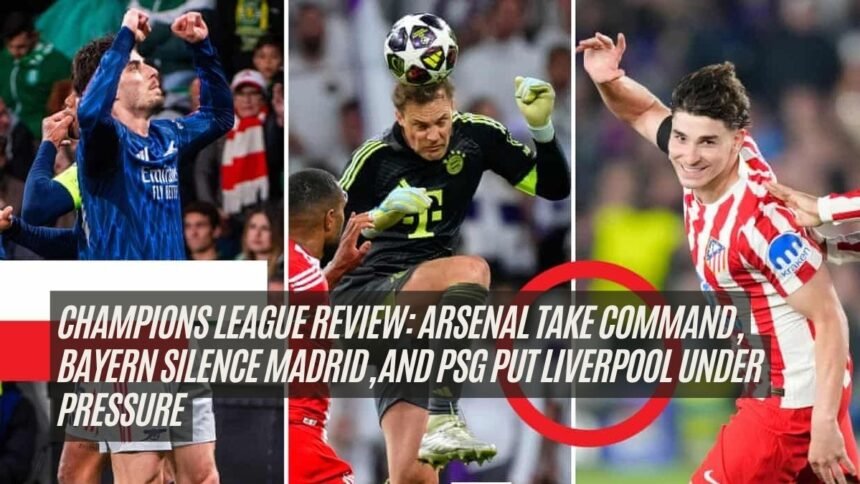
The first legs of the 2025/26 UEFA Champions League quarter-finals have redrawn the tournament with unusual clarity. Arsenal left Lisbon with a late 1-0 win over Sporting CP, Bayern München went to the Santiago Bernabéu and beat Real Madrid 2-1, Paris Saint-Germain overwhelmed Liverpool 2-0 in Paris, and Atlético de Madrid claimed a 2-0 victory at Barcelona.
Taken together, those results did more than shift the bracket: they exposed the current competitive order of Europe’s elite, where control, defensive authority, and ruthless execution mattered more than reputation.
Arsenal vs Sporting CP Review: Havertz Delivers, Raya Preserves, Arteta Rebuilds Momentum
We saw Arsenal produce the kind of away performance that wins knockout ties even when it does not dominate headlines for style.
Kai Havertz scored the stoppage-time winner in a 1-0 victory over Sporting CP on April 7, turning a tense, narrow contest into a decisive strategic success for Mikel Arteta’s side.
The result mattered not only because it gives Arsenal the edge before the return at the Emirates, but because it arrived after domestic setbacks that had threatened to deflate their season’s broader ambitions.
In Lisbon, Arsenal looked disciplined rather than expansive, patient rather than reckless, and that balance gave the win its value.
What elevated Arsenal’s performance was the reliability of their defensive spine. David Raya was named Player of the Match by UEFA, and that recognition was justified by the interventions that kept Sporting scoreless until Havertz struck.
Arsenal did create moments Noni Madueke hit the woodwork, Martin Zubimendi had an effort ruled out, and Gabriel Martinelli supplied the key assist but the more important point was structural.
We watched Arsenal survive the difficult phases of an away quarter-final without losing tactical order, then punish Sporting at the exact moment the game opened. That is the profile of a side built to progress deep into the competition.
Bayern Munich vs Real Madrid Review: Neuer, Kane, and Díaz Rewrite the Bernabéu Narrative
Bayern’s 2-1 win over Real Madrid was the most imposing result of the round because of where it happened and how completely it challenged the assumptions around this tie.
Luis Díaz and Harry Kane scored either side of halftime, Kylian Mbappé replied for Madrid, and Bayern left the Bernabéu with both the advantage and the stronger footballing case.
UEFA’s match summary described the tie as a narrow Bayern victory, but the wider reporting made the deeper point plain: Bayern were not simply opportunistic, they were authoritative. Reuters noted Bayern’s confidence under Vincent Kompany, and The Guardian’s review highlighted how significant the result was after such a long wait for a win in Madrid.
The defining image of the night, however, was Manuel Neuer refusing to let Madrid’s pressure distort the tie. UEFA named him Player of the Match, and subsequent reporting emphasized the scale of his work, including nine saves at the Bernabéu.
That matters because Bayern’s win was not built on sterile control; it was built on surviving elite pressure without panic and then using the ball with precision when the attacking moments arrived. We should read this first leg as proof that Bayern’s blend of experience, pace out wide, and composure in both boxes currently makes them one of the most complete sides left in the tournament.
Why Bayern Still Have a Reason for Regret Before the Second Leg
Yet Bayern also left Madrid with unfinished business. The scoreline gives them an advantage, not immunity, and that distinction matters profoundly against Real Madrid. Reuters reported Kompany’s insistence that the tie remains open, and that caution is more than managerial ritual.
Bayern created enough threat to leave with a wider margin, while Madrid still possess the kind of attacking talent that can reverse a tie in a single spell of play.
We should therefore view Bayern’s first-leg success as a statement of superiority in performance, but not as a guarantee of qualification. The value of the win lies in forcing Madrid to chase the tie in Munich, where Bayern’s recent form gives them a legitimate platform to finish the job.
PSG vs Liverpool Review: Kvaratskhelia and Doué Put Paris in Control
Paris Saint-Germain delivered the most one-sided first leg of the quarter-finals in every respect except the final score. Désiré Doué opened the scoring in the 11th minute and Khvicha Kvaratskhelia added a second after the break as PSG beat Liverpool 2-0 at Parc des Princes on April 8.
UEFA framed the match as revenge for last season’s home defeat to Liverpool in Europe, but the sharper interpretation is that Paris looked like the reigning European champion it is: composed in possession, fast in transition, and superior in individual quality across the front line. Kvaratskhelia’s goal was the standout moment of the round, and UEFA later recognized him as Player of the Match.
Liverpool’s problem was not just the deficit; it was the manner of the defeat. Reuters reported that Arne Slot’s side failed to register a shot on target, while The Guardian’s live coverage noted that Liverpool had only about 30% possession as PSG dictated the match.
Mohamed Salah did not start, the shape looked reactive, and the contest became an exercise in damage limitation rather than a serious attempt to impose Liverpool’s own strengths.
We can therefore describe this tie with precision: Liverpool are still alive mathematically, but PSG were the side that looked semifinal-ready. The 2-0 scoreline preserved suspense; the football itself suggested a larger gap.
Liverpool Face the Hardest Tactical Reset of the Quarter-Finals
The second leg at Anfield now demands a complete change of emotional and tactical posture from Liverpool. Virgil van Dijk acknowledged both the scale of the challenge and the poor standard of the season, while still insisting the comeback is possible.
That optimism is understandable given Anfield’s European history, but the first leg established the real issue: Liverpool were not merely beaten by PSG’s finishing, they were disarmed by PSG’s speed, spacing, and confidence.
Unless Liverpool can push the game into a higher-tempo, higher-chaos environment in the return leg, Paris will remain in control of the tie even if the atmosphere becomes ferocious.
Atlético Madrid vs Barcelona Review: The Other Result That Changed Arsenal’s Side of the Bracket
The quarter-final story is incomplete without Atlético’s 2-0 win at Barcelona. Pau Cubarsí’s red card shifted the match, Julián Alvarez scored a superb free-kick before halftime, and Alexander Sørloth added the second as Diego Simeone’s side left Camp Nou with a commanding advantage.
Reuters emphasized both the historical nature of the result and the tactical maturity behind it, and UEFA’s summary underscored how effectively Atlético converted game state into control.
This matters beyond the all-Spanish tie itself: it transformed the likely pathway on Arsenal’s side of the bracket and raised the possibility that the semifinal may be decided less by possession and more by transitional discipline and penalty-box efficiency.
Champions League Quarter-Final Bracket: Where the Race to Budapest Stands
The official UEFA bracket now sets up two clearly differentiated semifinal routes. On one side, Arsenal’s 1-0 lead over Sporting CP sits alongside Atlético’s 2-0 edge over Barcelona, with those winners due to meet in the semifinal.
On the other, Bayern take a 2-1 advantage over Real Madrid while PSG carry a 2-0 lead over Liverpool, creating the possibility of a heavyweight semifinal between the round’s two best first-leg performers.
UEFA has confirmed that the second legs of Atlético vs Barcelona and Liverpool vs Paris are on April 14, while Arsenal vs Sporting CP and Bayern München vs Real Madrid follow on April 15.
What the First Legs Tell Us About the Champions League Favorites
After the opening quarter-final matches, we can identify three truths with confidence. Arsenal have regained momentum and shown they can win difficult away ties without losing structural control.
Bayern have produced the round’s most authoritative result in the most difficult stadium, even if they should regret not building a larger cushion.
PSG, meanwhile, looked the most stylistically dominant side left in the competition, overwhelming Liverpool with a level of technical and tactical assurance that few teams in Europe can currently match.
Atlético’s victory belongs in that same conversation because it shifted the bracket and confirmed that knockout football still rewards discipline as much as glamour. The race to Budapest is now less about reputation and more about who can reproduce first-leg authority under second-leg pressure.