





The world of sport often prides itself on a unique detachment from the complex machinations of global politics. It is frequently hailed as a universal language, a unifying force capable of transcending borders and ideologies. Yet, recent developments suggest this cherished ideal has been profoundly compromised. Under the leadership of Gianni Infantino, FIFA, the international governing body of football, appears to have shed its long-held mantle of political neutrality. A disturbing narrative has emerged, one that places football squarely within the volatile landscape of international conflict and power dynamics. This entanglement, marked by a controversial relationship with a prominent global leader, raises profound questions about the sport’s integrity, its ethical compass, and its very soul.
The Shifting Sands of Sporting Neutrality
For decades, the world of sport has often presented itself as a sanctuary, a realm separate from the intricate and often brutal landscape of global politics. It is a space where rivalries are confined to the pitch, and nations unite under the banner of competition. Yet, recent events have starkly challenged this comforting illusion. The notion that sport remains an unimportant yet vital cultural element, distinct from the actual battles shaping our world, now seems increasingly untenable.
Consider the recent news of drone attacks on oil refineries in Saudi Arabia, a mere 250 miles from the residence of a global football icon. Such proximity to conflict might once have been dismissed as an unfortunate coincidence. However, the dynamics have profoundly shifted. Football, under its current administration, is no longer a mere observer. It has become an active, and some would argue, complicit participant in a geopolitical drama of immense proportions.
A World Cup Under a Cloud of Conflict
Unprecedented Entanglements
The core premise of the current situation is truly astonishing. One co-host of this summer’s FIFA World Cup finals is reportedly engaged in bombing one of its participating nations. Furthermore, the co-host is accused of orchestrating the killing of a high-ranking official from a third-ranked team within a World Cup group. This level of direct entanglement between a tournament host and active conflict involving participating teams is without modern precedent.
Historical parallels, though often invoked, fall short of capturing the gravity of the present moment. Britain hosted the 1966 World Cup while embroiled in conflicts in Borneo and Aden. Russia faced international sporting bans for its invasion of a sovereign state, yet it still hosted the World Cup in 2018 without issue. The critical distinction now lies in the perceived willingness, or rather unwillingness, to apply a consistent ethical standard, particularly when the United States is involved. FIFA’s silence and inaction in this regard speak volumes.
Infantino’s Alliances and FIFA’s Compromise
Abandoning Neutrality for Power
The heart of this ethical dilemma stems from FIFA President Gianni Infantino’s actions. Many observers contend that he has positioned FIFA as an unquestioning ally and a de facto propaganda instrument for a specific political administration. This alignment is profoundly troubling, especially given FIFA’s own statutes which explicitly mandate political neutrality. The organization has, with what appears to be unquestioning zeal, tied itself to a leader who has initiated multiple acts of overseas aggression during his tenure.
This was not an accidental misstep. It was a conscious choice. Infantino, fully aware of the potential consequences, has repeatedly placed FIFA in close proximity to the autocratic exercise of power. He has not acted as a mere guest or a passive bystander. Instead, he has seemingly embraced the role of an enabler, an active component of a powerful publicity machine. The image of FIFA, once an arbiter of global football, now appears deeply compromised by these strategic alliances.
The Spectacle of Manufactured Goodwill
The extent of this alignment has, for some, moved beyond the merely cartoonish to the outright grotesque. Consider the creation and awarding of a “peace prize” to a political figure, a prize seemingly invented from scratch for this specific purpose. This gesture, along with other symbolic offerings, portrays FIFA as an organization eager to curry favor, much like a star-struck admirer offering gifts. The imagery associated with some of these offerings, such as a bizarre Club World Cup trophy replica, only adds to the unsettling nature of these interactions.
Further unsettling is the widely publicized “Gaza mini-pitch construction project.” While framed as a benevolent initiative, its timing and manipulative background imagery, featuring rubble and displaced people, raise serious questions. Critics suggest it serves as a gruesome form of public conscience washing, a distraction from the broader geopolitical realities. This is particularly jarring given the continued participation in FIFA events by Israel, a nation actively involved in actions that impact Gaza’s infrastructure. The source of weapons used in these conflicts, partly funded by the World Cup hosts and Infantino’s allies, adds another layer of profound irony and moral ambiguity to the situation. Yet, the focus is continually redirected to these superficial gestures of peace.
The Unfolding Consequences and Future Outlook
A Costly Alliance
Such open doors, lavish hospitality, and access to power inevitably come at a significant cost. While FIFA may not be directly responsible for all geopolitical conflicts, its actions have decisively contributed to the image-making that empowers certain extreme executive actions. The organization, despite presenting itself as a dignified ambassador of hope, appears drawn to the nearest source of power and the grandest stage, led by a figure whose authenticity is increasingly questioned.
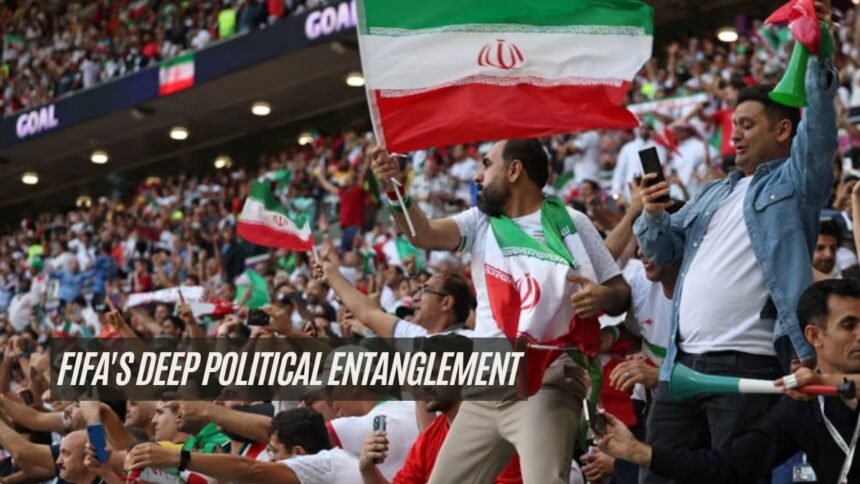
The immediate future for football, particularly regarding the World Cup, remains uncertain. With news of escalating tensions, the participation of nations like Iran becomes highly problematic. The Iranian FA has expressed its inability to look forward to the World Cup with hope. Its fans were already facing restrictions on entering the co-hosting nation. FIFA’s statutes offer no direct remedy if a nation withdraws under such circumstances. However, the executive committee possesses broad powers under force majeure clauses, potentially paving the way for unforeseen changes, perhaps even the inclusion of other nations from the same qualifying groups.
Ultimately, some form of compromise will likely be sought. The World Cup, a monumental global spectacle, is expected to proceed if there remains a world to contest it. The show, it seems, must continue, driven by powerful interests. This situation provides a stark lesson in the mechanics of power and propaganda. It illustrates how spectacle, particularly the unparalleled global reach of football, can be used to overshadow complex realities and gloss over controversial actions. While Gianni Infantino’s executive power within FIFA may shield him from immediate accountability, history will undoubtedly scrutinize his leadership and this particular era of FIFA governance. From this vantage point, it already appears to be a deeply problematic, post-truth, and fawningly complicit chapter in the history of big sport.
The trajectory of FIFA under Gianni Infantino presents a stark departure from the organization’s professed ideals of political neutrality and global unity. The deep entanglement with geopolitical power, the controversial alliances, and the perceived moral compromises have cast a long shadow over the beautiful game. While the immediate consequences for the upcoming World Cup remain fluid, the long-term impact on FIFA’s credibility and the sport’s ethical standing is undeniable. This era will undoubtedly be remembered as a period when football, instead of rising above political strife, became an active, and some argue, complicit player in it. The question now looms large. Can football reclaim its moral compass, or will it continue to be defined by the alliances of convenience and the spectacle of manufactured goodwill?