





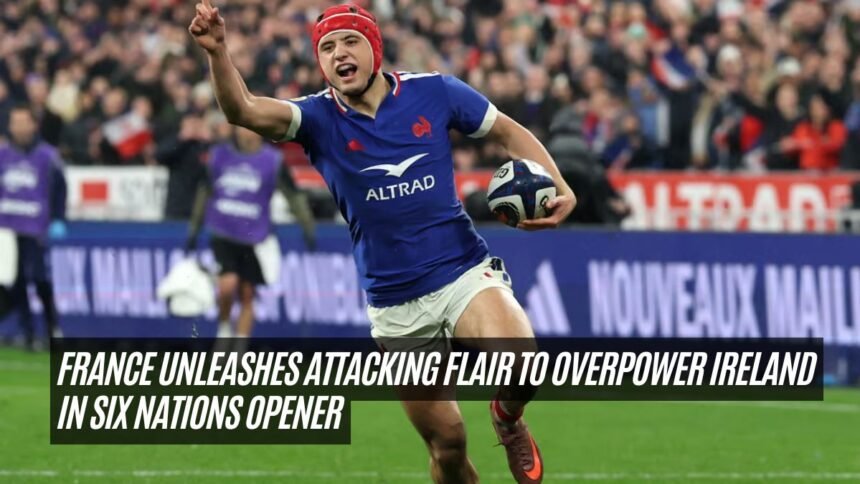
Rain fell on the Stade de France but it did nothing to dampen the French fire. The 2026 Six Nations championship ignited on a Thursday night in Paris with a commanding 36-14 victory for Fabien Galthié’s side over an Ireland team left searching for answers. From the first whistle, France looked sharper, faster, and utterly dominant, laying down a formidable marker for the tournament ahead.
The star of the show was winger Louis Bielle-Biarrey, whose electric pace yielded two tries. His first came in the 13th minute, capitalizing on a speculative Irish clearance. He gathered, stumbled, then regained his feet to sprint clear. His second, early in the second half, was a moment of pure spectacle. Antoine Dupont’s chip was met by a stunning outside-of-the-boot volley from fullback Thomas Ramos, sending Bielle-Biarrey racing away untouched. It was a try that broke Irish spirit and brought the soaked Parisian crowd to a roar.
France’s attack, so often mechanical in recent seasons, flowed with a joy that delighted their defensive coach Shaun Edwards. “Very happy, our attack in first half was great,” said Edwards after the match. “When we are on our attack it’s a joy to watch.” His counterpart, Ireland’s captain Caelan Doris, cut a frustrated figure. “We left ourselves too tall a mountain in first half,” Doris stated. “We weren’t strong enough in defence, too many soak tackles. A very disappointing way to start the tournament.”
The scoreboard told a grim story for the visitors by halftime, reading 22-0. Mathieu Jalibert had sniped over from close range and lock Charles Ollivon finished a sweeping move. Ireland’s new fly-half Sam Prendergast endured a difficult introduction to championship rugby, his errors compounded by a French defensive line that moved with alarming speed. Ireland’s much-discussed generational transition looked less like a rebuild and more a collapse under the Parisian lights.
A second-half rally offered the faintest glimmer. Replacements Nick Timoney and Michael Milne powered over for consolatory tries. But any hope of an improbable comeback was snuffed out in the final minute when French replacement winger Theo Attisogbe slid over in the corner. The 36-14 final score felt a truthful reflection of the gulf on the night.
The context made the result more significant. This was a France team reshaped, missing stalwarts like Gael Fickou and Damian Penaud, yet they played with a cohesive ferocity absent since the last World Cup. For Ireland, the absence of key leaders through injury was palpable, but the lack of pace and tactical clarity will concern Andy Farrell deeply. The selection gamble on youth in key positions backfired under the intense pressure.
This opening fixture, shifted to a Thursday night, was meant to launch a new cycle for both nations. France embraced it, their powerful pack and clinical backs signaling a return to top form. Ireland, champions two years prior, looked aged and out of ideas. The road to the 2027 World Cup is long, but France’s first steps were strides. Ireland’s were a stumble. All eyes now turn to Cardiff, where France face Wales next Saturday, while Ireland must find rapid solutions before hosting Italy.