






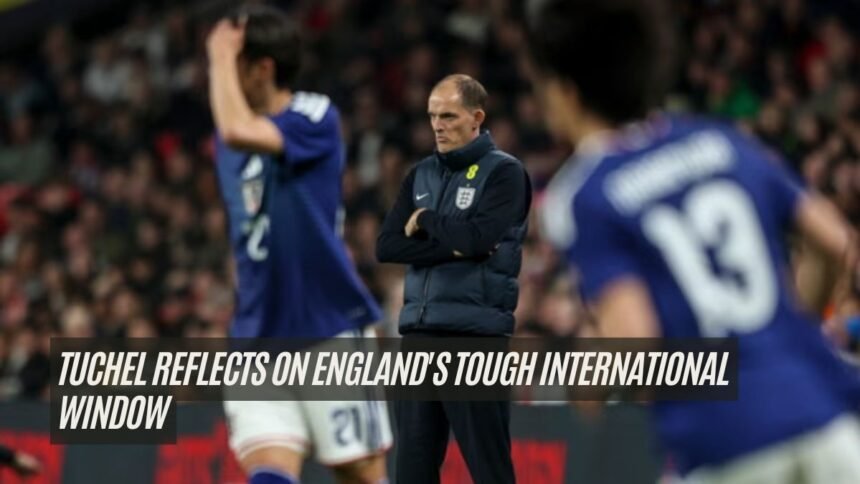
Thomas Tuchel, England’s head coach, recently found himself in a challenging position during the latest international break. He openly discussed the immense difficulties faced by his squad, particularly highlighting the 1-1 draw against Uruguay at Wembley and the subsequent 1-0 defeat to Japan, also at the national stadium. Tuchel’s perspective frames these results as a consequence of circumstances largely beyond his control, a narrative he often employs when plans go awry. However, an alternative viewpoint suggests that his approach to a demanding window might have been flawed, potentially inviting the very troubles encountered. Critics ponder if the relatively smooth World Cup qualification journey adequately prepared the team for encounters with top-20 FIFA ranked opponents. The recurring spectre of player fatigue, a significant threat to England’s aspirations, also remains a central concern for the coach.
A Familiar Pattern of Frustration
The recent international window drew striking parallels to Tuchel’s first difficult camp last June. That period saw the team grind out a slender 1-0 victory against Andorra in Barcelona before succumbing to a 3-1 defeat against Senegal in Nottingham. The historical significance of these losses cannot be overstated. Never before had an African nation triumphed over England, and similarly, Japan’s recent victory marked a historic first. The June window was awkwardly placed just a week or so after the domestic season concluded, forcing players to effectively return to duty immediately. Nine members of Tuchel’s squad then had to travel to the Club World Cup in the US, further compounding their workload. The lack of genuine competitive jeopardy, with Andorra being a relatively weaker opponent and the Senegal game merely a friendly, also contributed to the challenges. The usual array of injuries and withdrawals became a predictable fixture, all underscored by the pervasive issue of tired legs after an arduous club season.
Strategic Planning Meets Harsh Reality
Tuchel made no secret of his apprehension that this past camp could push his players too far, especially at such a pivotal stage of the club season. This concern informed his meticulous plan to work with a 24-man squad for the Uruguay fixture, subsequently adding eleven more established players for the Japan match while subtracting around eight from the initial group. The Uruguay game was essentially designed as an audition for those on the fringes, a chance to prove their worth. Tuchel demonstrated acute awareness of the minutes his players had accumulated throughout the season, with ‘load management’ becoming a key phrase in his planning. The absence of competitive stakes, given both matches were friendlies, also played a role. Had these been crucial qualification ties, Tuchel’s touch would undoubtedly have been far heavier. He sought clarity and common sense in his approach, and his initial explanations resonated logically. The on-field reality, however, unfolded quite differently.
A Barrage of Setbacks
The match against Uruguay ultimately proved flat, confused, and, in Tuchel’s own words, ridiculous. He had just four training sessions across three days, starting on Tuesday, to mold a completely new team to face streetwise opposition. He now candidly admits he was on a hiding to nothing from the outset. Thereafter, a series of further blows struck the squad. The loss of John Stones before the Uruguay game to yet another fitness niggle was bitterly frustrating. Reece James’s injury before Tuchel even named his squad was a similar setback. Jude Bellingham joined up but was immediately deemed unfit to play. Then, Declan Rice and Bukayo Saka withdrew for the Japan fixture, followed by Jordan Henderson and finally, Harry Kane. England’s key leaders were almost entirely absent, and their absence visibly impacted the team’s performance.
Tactical Experiments and Performance Woes
The resulting performances were often described as wishy-washy, displaying some neat touches and moves but utterly lacking punch in open play. Adding to the complexity, a failed new formation against Japan completed the full house of issues. Against Andorra in June, Tuchel had attempted a 3-1-5-1 system to break down a low defensive block, achieving minimal success. Against Japan, he deployed a 4-2-4 with Cole Palmer and Phil Foden operating as twin number 10s. England appeared blunt, raising concerns about whether Foden, in particular, will cement his place for the World Cup. Tuchel readily accepted responsibility for these tactical changes, stating, “I’m responsible for changing the structure because I wanted to get us a bit more security. I take responsibility for that.”
Glimmers of Hope and Lingering Concerns
Amidst the struggles, a few players did manage to press their claims. James Garner delivered a decent performance, and Harry Maguire displayed some good moments, although Tuchel suggested after the Uruguay game that Maguire remained a fair way down the central defensive pecking order. Tuchel reiterated his reliance on the foundations built in September, October, and November, stating, “We have built something in September, October and November and we will rely on that.” The general consensus was that Tuchel had been dealt a poor hand, leaving him with little choice but to fold and reflect wearily on the circumstances. When asked if he observed fatigue in the players against Japan, he unequivocally confirmed, “I see in general, I see… yeah, I see fatigue, clearly.”
A Shift in Managerial Approach
A notable difference from the June camp was Tuchel’s reaction. After the Andorra game, he had openly criticized his players’ attitude and body language. Following the Senegal defeat, he questioned their energy and, more significantly, their basic joy in wearing the England shirt, noting how much it meant to Senegal. This sentiment plainly stayed with him, as he reiterated it after the Japan game. However, this time, there was no public criticism of the players. Instead, he offered unwavering support and understanding. Tuchel firmly believes that the benefit of not pushing them too hard now will be reaped in the summer, when, he hopes, nobody will dwell on this challenging international window.
Tuchel remains resolute, asserting that the team will not succumb to doubt. He acknowledged his pre-camp awareness of the complexities and the high levels of player fatigue and minutes played. Despite the recent setbacks, the dream and the question ‘Why not?’ endure. He views these tough exams as potentially more beneficial than easy wins that might mask underlying issues. The hope is that this strategic management of player welfare now will pay dividends in the crucial summer tournaments, making this ‘broken window’ a distant memory.