





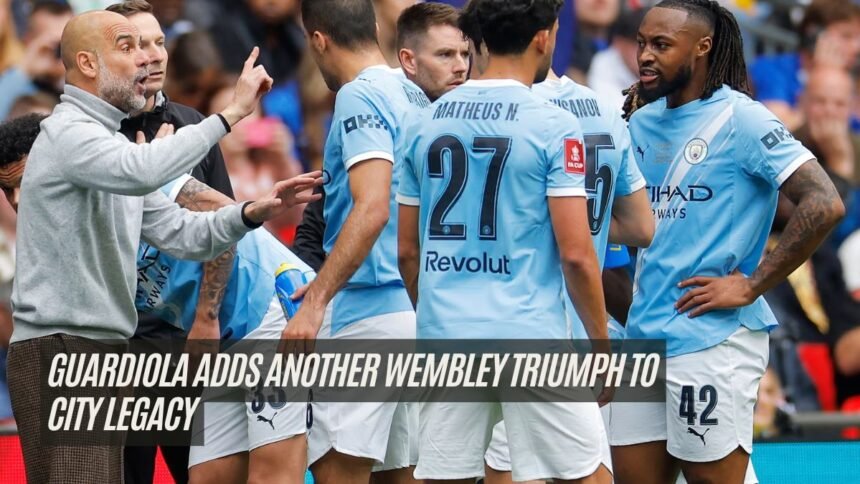
No matter how the occasion unfolded, the afternoon at Wembley always felt destined to revolve around Pep Guardiola.
When the final whistle confirmed Manchester City’s victory over Chelsea F.C., Guardiola did not explode into celebration. There was no dramatic sprint across the touchline or clenched-fist salute toward the stands. Instead, the City manager wandered calmly across the pitch before greeting match-winner Antoine Semenyo with an affectionate pat on the back. Around him, players and staff bounced inside jubilant clusters while Guardiola drifted quietly through the chaos.
That understated reaction will inevitably spark fresh discussion about his future. Speculation surrounding Guardiola’s long-term plans at Manchester City F.C. has continued throughout the campaign, with whispers about possible successors and coaching staff changes refusing to disappear. Contract drama is hardly unusual in elite football, although the uncertainty surrounding this particular situation has carried unusual weight.
Still, Guardiola’s reflective mood after major victories is nothing new. Even in triumph he often appears slightly reluctant to leave the contest behind, as though the emotional intensity of competition is something he never truly wants to end. After 591 matches in charge, 416 victories and 15 major honours, the obsession clearly remains untouched.
Guardiola’s Familiar Wembley Theatre
Throughout the FA Cup final, Guardiola cut the same animated figure football supporters have come to know so well. Wearing a cream roll-neck sweater and tailored trousers, he stalked the technical area relentlessly from the opening minutes. His arms carved through the air in frantic patterns as he barked instructions toward the pitch, resembling a conductor trying desperately to hold together a symphony threatening to spiral out of control.
If this eventually proves to be his final major domestic final at Wembley, it would provide a fitting stage for another chapter in his remarkable career. The trophy represented a third FA Cup success under Guardiola, adding to an already enormous collection of domestic silverware in England.
There has long been admiration for the seriousness with which Guardiola treats English cup competitions. Some view it as respect for football tradition. Others simply see a man incapable of approaching any contest without absolute commitment. Whether it is a Champions League semi-final or a harmless family board game during the holidays, Guardiola appears wired to compete with identical intensity.
Tactical Shift Turns the Final
City did not begin the match with much creativity flowing through midfield. Chelsea initially managed to restrict their rhythm, forcing the game into a slower pattern than Guardiola would have wanted. The momentum shifted after the break once Rayan Cherki entered the contest.
The winning moment arrived through a sequence built for decisive occasions. Erling Haaland drove forward powerfully before exchanging passes with Bernardo Silva near the edge of the area. Haaland then delivered a dangerous low cross that Semenyo cleverly redirected into the net using the inside of his heel. It was an unconventional finish part instinct, part improvisation but perfect for a cup final settled by fine margins.
Semenyo’s journey to this stage made the moment feel even more significant. His rise through clubs including Bristol, Bath, Newport and Sunderland reflected a career built steadily rather than spectacularly. Scoring the decisive goal at Wembley effectively validated City’s decision to bring him in.
Interestingly, Semenyo does not entirely fit the classic Guardiola blueprint. He lacks the polished technical elegance usually associated with Guardiola teams. His first touch can appear rough at times and he does not naturally play with the obsessive ball-retention style traditionally favoured by the City manager. A decade ago, Guardiola may never have targeted this type of footballer.
The Changing Face of Guardiola
Football evolves, and so do the people shaping it. Guardiola’s own transformation has become one of the more fascinating elements of his English career. Years ago, it would have seemed improbable that the architect of possession-heavy continental football would become so deeply connected to the traditions of the FA Cup.
Now Wembley feels almost inseparable from his story in England. Guardiola remains both an outsider and the defining tactical influence of the modern English game. He is simultaneously the intellectual coach accused of overcomplicating football and the dominant figure whose ideas reshaped how teams across the country approach possession, pressing and structure.
That tension was visible again during this final.
Wembley’s Old Traditions Still Matter
The FA Cup continues to carry a sense of nostalgia unlike any other domestic competition. Even amid modern football’s financial excess and political complications, certain traditions survive stubbornly.
The marching bands returned once more. Supporters unfurled homemade banners. Before kick-off, a choir from Bradford City A.F.C. performed “Abide With Me” beside the Wembley pitch, reinforcing the sense that the occasion still belongs to football’s communal roots as much as its commercial future.
The hymn remains powerful precisely because it is not centred on glory or domination. Instead, it speaks about loss, comfort and endurance themes that sit strangely but beautifully alongside the spectacle of elite sport.
Chelsea Struggle to Match City
The final itself often lacked intensity for long stretches, particularly from Chelsea’s side. The London club appeared uncertain and disconnected during the opening half, struggling to impose themselves on the contest.
Cole Palmer became more influential after the interval as Chelsea finally showed signs of urgency, but City always looked the more composed side. Guardiola’s substitutions strengthened the team further, while Chelsea never fully escaped the feeling of instability surrounding the club.
There were still individual positives. Calum McFarlane enjoyed a memorable day simply by being involved in the occasion, arriving with a relaxed appearance that contrasted sharply with the pressure surrounding the final itself.
Ultimately, City’s experience and depth proved decisive. Guardiola’s side may not have looked unstoppable throughout the season, yet their ability to peak during the closing months has once again placed them within reach of multiple trophies.
Guardiola Still Hungry for More
As has so often been the case during Guardiola’s reign, City’s late-season surge has been strengthened by significant investment and elite-level recruitment. Critics will continue debating the resources available to him, but those arguments often overlook the extraordinary coaching influence that accompanies the spending.
Even after another Wembley triumph, Guardiola remained characteristically grounded. He described the FA Cup success simply as “cool,” complained passionately about rail services in northern England, and insisted celebrations would remain limited for now.
The league title race may still contain twists, but few would be surprised if Guardiola and City return for another victory parade before the season finally ends.