





Cold air drifted across Berlin as anxious figures stood motionless beside the River Havel, watching through binoculars into the darkness. Steam rose from their breath while silence hung over the Glienicke Bridge. One officer steadied himself with a sip of schnapps, another nervously lit a cigarette. Then finally, a signal appeared from the eastern side. The exchange had begun.
It felt like the final act of a classic spy thriller the dangerous work complete, the secrets exposed, and only the consequences left to unfold.
Wembley on a blazing afternoon in May was a world away from a freezing Berlin night, yet the Championship playoff final carried a strangely similar atmosphere. Suspicion, controversy and tension surrounded the occasion long before kick-off. Southampton’s punishment had reshaped the playoff picture entirely, leaving arguments over fairness lingering over the final between Hull City and Middlesbrough.
Few names dominated the discussion more than Tonda Eckert, whose influence remained central even without being physically present.
Before the match, Hull owner Acun Ilicali openly threatened legal action if Middlesbrough secured promotion. His argument centred on the belief that Boro had benefited unfairly after Southampton’s removal, despite failing to progress normally through the semi-finals.
Speaking to Radio Humberside, Ilicali insisted Hull’s legal advisers believed the club had strong grounds to challenge the situation if events went against them.
There was some logic behind Hull’s frustration. Their coaching staff had been forced to prepare for two different possible opponents, while Middlesbrough and Southampton already knew exactly who they might face. Still, the public nature of the complaints created an awkward backdrop to English football’s richest match. The Football League, no doubt, will have been relieved no legal showdown became necessary.
When the final whistle arrived, emotion overwhelmed Ilicali. Tears poured from the Hull owner as celebration erupted around him.
His own rise to prominence has hardly been conventional. Long before football ownership, Ilicali worked as a sports journalist before becoming famous in Turkey through a travel television programme he hosted. Success in broadcasting and entertainment followed, transforming him into one of the country’s most influential media figures and a regular presence among Turkey’s highest taxpayers since 2008.
Hull’s Tactical Discipline Delivers
If the uncertainty surrounding the final disrupted Sergej Jakirovic’s planning, it certainly did not show on the pitch.
Middlesbrough entered the match as one of the Championship’s strongest possession teams, dominating the ball throughout much of the season. Hull, however, approached the game with a completely different strategy. Rather than chasing possession, they sat compactly and blocked passing lanes around the penalty area.
Boro managed 13 attempts during the contest, yet remarkably failed to register a single shot on target. Considering Hull conceded 66 league goals this season more than relegated Oxford that defensive display represented a dramatic shift.
Jakirovic, who frequently references Jürgen Klopp as a managerial inspiration because of his aggressive pressing philosophy, abandoned that approach entirely for Wembley. Pragmatism replaced intensity, and it paid off.
The Hull manager’s career path has been anything but ordinary. During his playing days as a centre-back, he represented 19 different clubs, returning to three of them for second spells. His managerial journey has been equally nomadic, with Hull becoming his eighth appointment before even reaching the age of 50. Promotion now means he will become the first Bosnian coach to manage in the Premier League.
From Survival Fight to Premier League Return
Hull’s rise over the last year makes the achievement even more extraordinary.
Only last season, the club narrowly escaped relegation to League One on goal difference after turbulent spells under Tim Walter, Rúben Selles and Liam Rosenior. Financial complications also created further instability, with Hull operating under a transfer embargo linked to delayed payments owed to Aston Villa for the loan signing of Louie Barry.
Despite all of that turmoil, Hull somehow clawed their way into the Premier League.
Significant spending will almost certainly be required if they are to follow the examples set by Sunderland and Leeds United by surviving in the top flight. Those concerns, though, can wait.
This occasion belonged entirely to celebration.
Heat, Fatigue and One Defining Moment
The oppressive temperature inside Wembley became one of the afternoon’s defining themes.
Players struggled physically throughout the contest as the heat drained energy and concentration. Long stretches drifted by at a sluggish pace, with every minor collision offering an excuse for hydration breaks. Sharp thinking disappeared. So did fluid football.
As a spectacle, the match lacked quality. Before the decisive goal arrived, the only effort on target came from Mohamed Belloumi, whose looping attempt caused little trouble. Yet despite the limited action, the tension never disappeared. Every misplaced touch felt dangerous because the stakes were enormous.
The match unfolded less like an action blockbuster and more like a slow-burning thriller, where unease builds quietly until the decisive climax finally arrives.
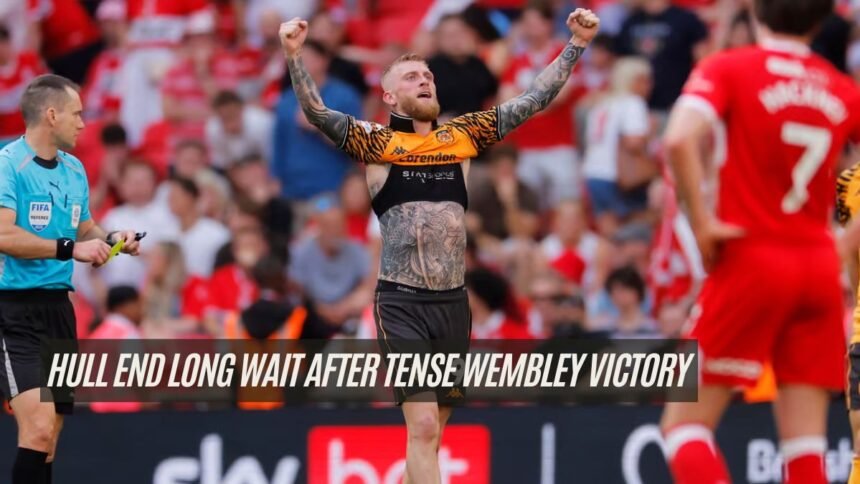
That moment belonged to Oli McBurnie.
Released by Sheffield United after their Premier League relegation in 2023-24, McBurnie rebuilt his career following a difficult spell with Las Palmas. Hull signed him on a free transfer, and at Wembley he delivered the goal that changed everything.
From uncertainty to redemption, McBurnie became the unlikely hero of Hull’s promotion story.
After months filled with controversy, pressure and anxiety, Hull finally had their ending. The mission was complete.