





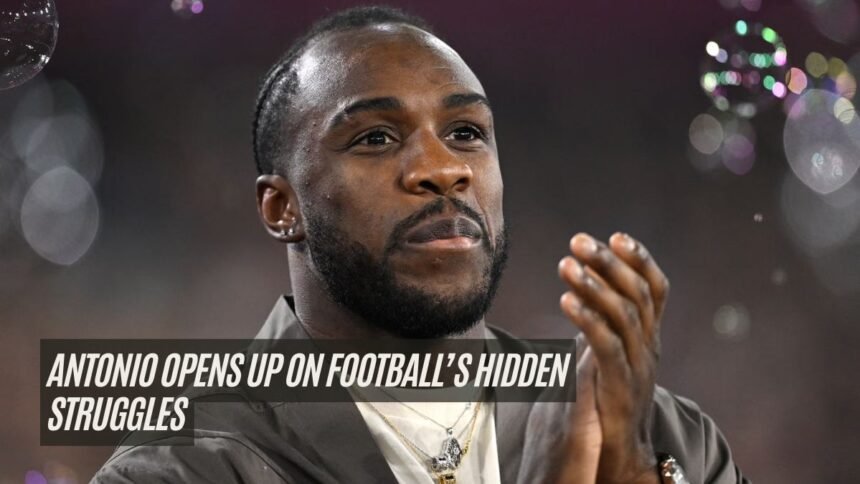
For much of his career, Michail Antonio considered himself someone who could handle anything life threw at him. The former West Ham United forward never imagined he would need professional psychological support, believing therapy was reserved for people facing far more serious issues.
That perspective eventually changed.
Speaking candidly about the emotional challenges he faced throughout his career, Antonio admitted that despite often appearing cheerful and energetic, he was carrying personal burdens that few people around him truly understood. Those experiences form a major part of Humans Not Robots, his autobiography, in which he discusses not only football but also mental health, relationships, and personal recovery.
Although many associate his story with the devastating Ferrari accident he survived in December 2024, Antonio insists that the crash was only one chapter in a much larger journey. The incident nearly claimed his life, yet he escaped with a broken leg and eventually worked his way back through rehabilitation.
A Trophy Night Overshadowed by Personal Turmoil
One of the most revealing moments in Antonio’s book centers on West Ham’s triumph over Fiorentina in the 2023 UEFA Europa Conference League final.
While supporters celebrated the club’s first major trophy in more than four decades, Antonio found himself unable to share fully in the joy. During the festivities in Prague, a disagreement with his former partner left him emotionally drained.
Instead of joining teammates for the celebrations, he returned to the team bus and withdrew into himself. What initially appeared to be simple exhaustion from the match was actually something much deeper.
Antonio later realized that the fatigue he felt had little to do with football. The emotional strain from events away from the game had become overwhelming. Despite being involved in one of the most memorable achievements of his career, he lacked the energy to enjoy the occasion.
Normally among the first to encourage celebrations, Antonio could not understand why he suddenly wanted to be alone. Although teammates were aware of some issues in his personal life, few appreciated the extent of the impact they were having on him.
According to Antonio, football dressing rooms can be unforgiving environments where performance often outweighs concern for a player’s emotional wellbeing.
The Decision to Seek Help
The turning point arrived thanks to encouragement from West Ham’s medical staff.
Antonio admitted that he once viewed therapy with skepticism. However, he began to fear that his mental state was deteriorating and that he was drifting toward depression.
Daily routines became increasingly difficult. Training sessions blurred together, motivation declined, and he felt trapped in a cycle he could not escape. Looking back, Antonio believes that without intervention, his situation might have worsened significantly.
Eventually, he agreed to speak with a therapist. The experience transformed his understanding of mental health and helped him process years of suppressed emotions.
Fighting for Recognition Throughout His Career
Antonio’s football journey was rarely straightforward.
Unlike many elite players, he did not emerge from a prestigious academy system. Instead, he climbed through non-league football and constantly faced questions about whether he belonged at the highest level.
After joining West Ham in 2015, he gradually established himself as one of the club’s most influential modern players. His record of 68 Premier League goals in 268 appearances made him the club’s leading scorer in the competition.
Yet even after proving himself repeatedly, Antonio often felt undervalued.
During Manuel Pellegrini’s spell as manager, there were moments when he considered walking away from football altogether. Despite earning a lucrative living, he struggled to find fulfillment and questioned whether continuing was worth the emotional toll.
There were times when the sport he loved no longer brought him happiness.
From Winger to Record-Breaking Striker
Antonio’s versatility became both a blessing and a challenge.
Initially signed as a winger, he later spent time operating at right-back under Slaven Bilic. His career took another turn when David Moyes converted him into a central striker, a move that ultimately transformed him into one of West Ham’s most effective attacking players.
Even then, doubts persisted.
The club continued to recruit new forwards, while Antonio felt his value was not properly reflected in contract negotiations. He believed incoming signings regularly received more lucrative deals despite his consistent contributions on the pitch.
Discussing negotiations with co-owner David Sullivan, Antonio said he often felt the club failed to appreciate the importance of his role. In his view, newer arrivals were rewarded more generously while he continued delivering results.
Why He Chose to Stay
Despite frustrations regarding contracts and recognition, Antonio never seriously lost his affection for West Ham.
The attachment he developed to the club played a significant role in his decision to remain. At one stage, he even proposed stepping away from international football with Jamaica if the club improved his contractual terms.
The proposal failed to produce an agreement.
Antonio believes football can sometimes reduce players to commodities rather than people. Once a player is no longer viewed as essential, clubs can move on quickly regardless of previous contributions.
While acknowledging the financial privileges that come with a professional career, he argues that wealth does not eliminate personal struggles.
A Difficult Departure After the Crash
Following months of rehabilitation after his accident, Antonio felt physically capable of returning to competition.
However, discussions surrounding a new contract became increasingly complicated.
The situation coincided with managerial changes at West Ham. Graham Potter replaced Julen Lopetegui in January 2025, and Antonio believes that shift played a major role in how events unfolded.
Frustrated by mixed messages during negotiations, Antonio described a process in which responsibility appeared to bounce between Potter and Sullivan. He believed assurances had initially been given that he would receive another year to rebuild his career after injury.
Instead, uncertainty persisted until his departure became inevitable.
Criticism of Potter’s Rebuild
Antonio remains highly critical of decisions made during Potter’s tenure.
He argues that West Ham weakened itself by allowing several experienced figures to leave. Among the players he referenced were Lukasz Fabianski, Vladimir Coufal, Edson Álvarez, Aaron Cresswell, and himself.
From Antonio’s perspective, removing so much leadership damaged the squad’s structure and contributed to the club’s subsequent decline.
Watching from a distance as West Ham slipped into a relegation battle, he questioned the direction Potter attempted to take with the team. Antonio felt the manager’s tactical approach failed to produce results and believes the club lost important voices in the dressing room.
When Potter later suggested the squad lacked leaders, Antonio pointed to the departures of senior players as evidence of a self-inflicted problem.
Life After West Ham
West Ham eventually suffered relegation despite the later appointment of Nuno Espírito Santo.
Antonio believes he could have contributed had circumstances been different. Opportunities with Brentford and Leicester were explored, but muscle injuries disrupted potential moves.
He also spent time in Qatar before returning to London.
Now 36, Antonio has begun considering what comes next. Retirement remains a possibility, though no final decision has been made. Television work has already provided him with experience as a pundit, and he would welcome a future in broadcasting.
One ambition stands out above the rest: hosting a television game show.
Lessons From Therapy and Fatherhood
Perhaps the biggest change in Antonio’s life has come away from football.
Growing up as the youngest member of a large family, he often suppressed his feelings and rarely expressed vulnerability. Therapy helped him understand how those habits carried into adulthood and affected his relationships.
The experience has also reshaped the way he parents his seven children.
Antonio admits he once encouraged emotional restraint, particularly with his eldest son. Today, he views those situations differently. Rather than dismissing tears, he recognizes them as a natural expression of emotion and believes children should be allowed space to process their feelings.
He hopes future generations will have greater access to mental health support and believes society would benefit from more open conversations around emotional wellbeing.
The Reality of Professional Football
Although Antonio still loves football, he is less enthusiastic about the environment surrounding it.
He describes dressing rooms as complex places where friendships coexist with fierce competition. With dozens of players competing for a limited number of starting positions, jealousy and resentment can easily emerge.
According to Antonio, trust is not always easy to find in the sport. While he built relationships during his career, he says only a handful of fellow footballers became genuine friends.
That reality influences his attitude toward his own children pursuing the game.
Rather than pushing them toward professional football, Antonio encourages them to make their own choices. He understands how demanding the industry can be, not only on the field but also when dealing with managers, owners, supporters, and the politics that surround the sport.
In his view, resilience is one of the most important qualities any aspiring footballer can possess.
Looking Forward
Nearly two years after the accident that almost ended his life, Antonio still finds people bringing up the subject in everyday conversations.
He understands why.
The crash was a defining moment, one that forced him to confront mortality and reevaluate his priorities. Yet he does not want the event to define him forever.
Having survived personal struggles, career setbacks, injury, and near tragedy, Antonio feels at peace with where he stands today. The desire to prove critics wrong has faded. What remains is a determination to move forward, embracing the future without bitterness and with a far greater understanding of himself than ever before.