





Just before kickoff in Los Angeles on Friday evening, millions of viewers around the globe are expected to watch actor Jason Sudeikis take part in the opening festivities of the World Cup. Best known for portraying Ted Lasso, the fictional coach whose optimistic outlook became a cultural phenomenon, Sudeikis is set to deliver a familiar message: football brings people together.
The timing, however, creates a striking contrast. While football’s biggest tournament celebrates international unity, the host nation finds itself at the center of geopolitical tensions. The United States is simultaneously involved in military action affecting Iran, a nation competing in Group G, while immigration restrictions continue to generate controversy.
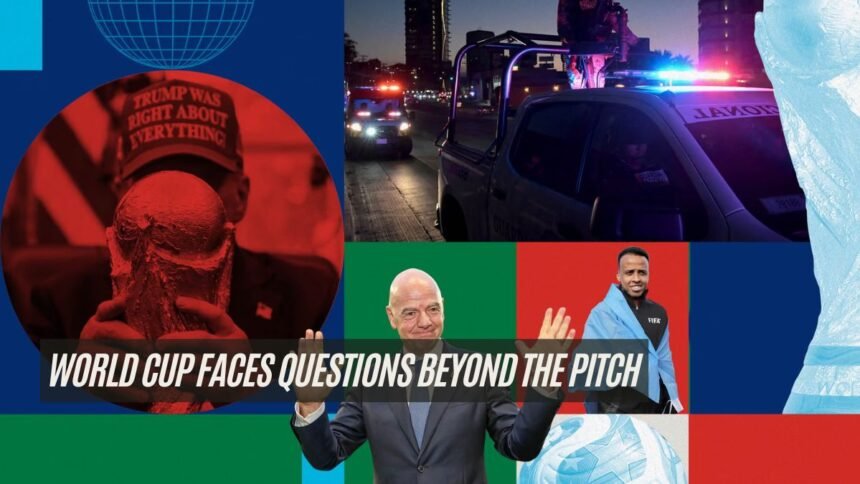
That message of togetherness may also reach President Donald Trump, whose second term has been defined by aggressive foreign policy decisions and divisive domestic measures. Among the consequences of those policies has been the exclusion of Omar Artan, the reigning African Referee of the Year, from participating in the tournament.
FIFA’s Familiar Slogan Faces Renewed Scrutiny
For years, FIFA president Gianni Infantino has repeated the idea that football can unite the world. It has become one of the central themes of his leadership and is even reflected in the Latin motto featured on the Club World Cup trophy.
Yet critics argue that the slogan sounds increasingly disconnected from reality. As the World Cup begins, attention is not only focused on the matches but also on FIFA’s willingness to align itself with political circumstances that many believe contradict the values it publicly promotes.
Infantino is expected to be present at the tournament opener, but his role has become a lightning rod for criticism. Detractors see him as someone willing to overlook controversial decisions in exchange for maintaining close relationships with powerful political figures. The exclusion of certain individuals and the travel restrictions affecting representatives from dozens of FIFA member nations have only intensified that debate.
Despite these concerns, football’s spectacle continues to attract enormous attention. Fans remain captivated by team selections, tactical battles, and player performances, even as broader political issues increasingly surround the event.
The Rise of a New Sportswashing Debate
As the expanded World Cup moves into its opening phase, discussions about sportswashing have taken on a different dimension.
Previous tournaments hosted by Qatar and Russia generated significant criticism over human rights concerns and political issues. This edition, however, presents a different challenge. Observers argue that the United States is receiving comparatively limited scrutiny despite major international controversies unfolding alongside the competition.
The tournament opener represents a unique moment in World Cup history. Never before has a host nation staged the event while simultaneously being accused by critics of contributing to both escalating global conflict and economic instability.
Many believe the contrast is particularly striking because the World Cup is traditionally promoted as a celebration of international cooperation and cultural exchange.
Comparisons With Previous Hosts
When Qatar organized the World Cup, criticism was immediate and relentless. Debates surrounding labor conditions and human rights dominated headlines long before the first match kicked off.
Russia’s tournament followed a different pattern. Although concerns existed before the competition, many observers felt the full scale of geopolitical tensions became clearer only later.
The current situation differs because events are unfolding in real time. Television audiences can switch from football coverage to news reports detailing military developments involving the tournament host itself.
For critics, that creates an uncomfortable contradiction that is difficult to ignore.
A Missed Opportunity for Unity
Many observers argue that the United States had a unique opportunity to use football as a bridge between communities.
The sport has experienced rapid growth across the country and enjoys particularly strong support among immigrant populations. With major FIFA events taking place across consecutive summers, there was potential for football to serve as a symbol of inclusion and shared identity.
Instead, critics contend that the political atmosphere has become increasingly polarized. Immigration policies, border enforcement measures, and divisive rhetoric have overshadowed what could have been a celebration of diversity.
From that perspective, the exclusion of figures such as Omar Artan is viewed not as an administrative mistake but as part of a broader political message. Supporters of this interpretation argue that the decision reflects a wider strategy aimed at reinforcing nationalist themes among domestic audiences.
Iran’s Presence Adds Another Layer
Perhaps no storyline captures the contradictions of this World Cup more clearly than Iran’s participation.
The Iranian national team is preparing to compete in Los Angeles while tensions between the United States and Iran remain exceptionally high. The image of Iranian players arriving for football’s premier event while military conflict involving one of the hosts dominates international headlines highlights the unusual circumstances surrounding the tournament.
Critics insist that the issue extends beyond visa complications or travel restrictions. Their concerns focus on the wider consequences of military action and its impact on global stability.
Economic Concerns Reach Beyond Football
The debate is not limited to politics.
Analysts have warned that instability in the Middle East could create significant economic consequences. Energy markets remain particularly vulnerable, and concerns over fuel supplies have already prompted discussion in various regions around the world.
Although severe shortages have so far been avoided, experts continue monitoring potential disruptions. Rising costs for aviation fuel and diesel could affect transportation networks, businesses, and consumers far beyond the countries directly involved in the conflict.
For those raising concerns, the World Cup is unfolding against a backdrop of uncertainty that extends well beyond the football field.
FIFA’s Leadership Under the Spotlight
Questions are also being asked about FIFA’s governance and the extent of its relationship with political power.
Some critics believe the organization has become too closely associated with specific leaders and political movements. They argue that FIFA’s neutrality has been weakened by decisions made under Infantino’s leadership.
The 2026 World Cup is widely regarded as the centerpiece of Infantino’s vision for the future of football. The expanded format and global scale of the competition reflect ambitions he has pursued for years.
However, what was intended to be a defining achievement could also become a source of criticism. Observers suggest that the tournament may test how far supporters, member associations, and stakeholders are willing to tolerate the growing overlap between football and politics.
Football’s Next Test
Despite the controversy, the World Cup itself will continue. Fans will fill stadiums, television audiences will reach into the hundreds of millions, and the focus will inevitably return to the action on the pitch.
Yet the questions surrounding the tournament are unlikely to disappear.
Football survived the controversies that surrounded World Cups in Qatar and Russia. It will almost certainly survive this one as well. The bigger uncertainty is whether trust in FIFA and belief in the sport’s unifying message can emerge unchanged after another tournament shaped as much by politics as by football.
As the competition begins, the world will once again discover how much pressure the game can absorb and whether the promise that football unites everyone still carries the same weight it once did.