






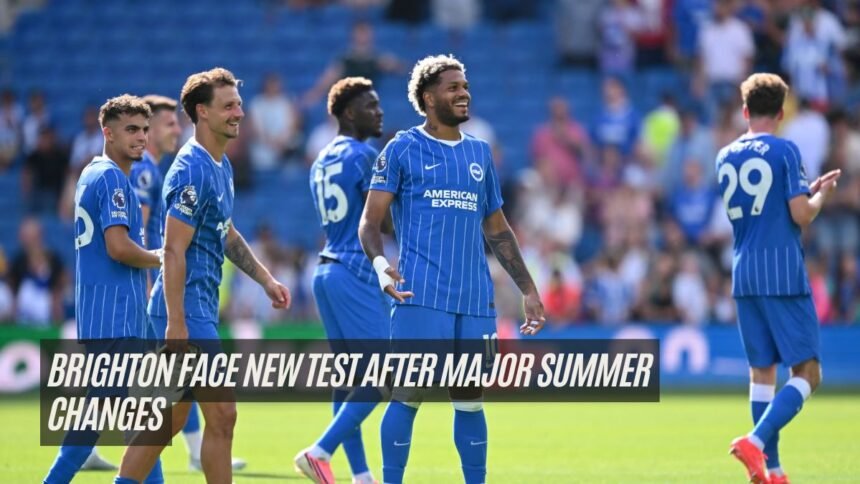
Brighton ended last season with a strange mixture of disappointment and celebration. A 3-0 defeat at Manchester United on the final day in May could not prevent supporters and players from celebrating their return to European competition through qualification for the Europa Conference League.
The achievement also creates an obvious ambition. West Ham and Crystal Palace have both lifted the trophy since the competition began, giving Brighton a clear example of what might be possible if they can navigate the demands of European football.
Yet repeating the success of recent seasons will not be straightforward. The additional Thursday-to-Sunday schedule will test the squad, while Brighton have also undergone significant changes during the summer.
A Squad Moving Into a New Era
James Milner was absent from the celebrations surrounding European qualification because he had already decided that his playing career was coming to an end. Danny Welbeck has also departed after producing an exceptional campaign as Brighton’s leading attacking figure.
Welbeck, who will turn 36 in November, has taken the increasingly familiar route from Brighton to Chelsea. His age makes the move particularly intriguing and leaves Brighton without one of the experienced figures who had helped anchor the squad.
That older generation is now considerably smaller. Pascal Gross, Lewis Dunk and reserve goalkeeper Jason Steele are the remaining veterans older than head coach Fabian Hürzeler, who is only 33.
Solly March has also been allowed to leave without a new contract. His departure marks another significant change for a player who had become a popular and familiar presence at the club, although persistent injury problems worked against him.
Brighton’s defensive structure has taken an even bigger blow with Jan Paul van Hecke moving to Tottenham for a reported £52m. In return, teenage Croatian defender Luka Vuskovic has arrived as part of the reshaping process.
The recruitment strategy will be closely examined not only by Brighton supporters but also throughout the Premier League. The club’s transfer operation has earned considerable admiration across the football industry. Tony Bloom’s Jamestown Analytics, the data operation associated with Brighton’s owner and financier, is widely regarded as an exceptional source of recruitment intelligence.
Even so, Brighton’s model has never been flawless. Several signings have failed to meet expectations, demonstrating that sophisticated analysis cannot eliminate the uncertainty inherent in player recruitment.
European Football Brings Its Own Challenge
Brighton supporters thoroughly enjoyed the club’s Europa League adventure three seasons ago. The Seagulls progressed to the last 16, providing one of the most memorable periods in their recent history.
There was, however, a cost domestically. The demands placed on the squad, combined with strained relations involving then-manager Roberto De Zerbi, contributed to a difficult campaign. Brighton eventually finished 11th, well below the level they had hoped to reach.
The expectation this time is that the club can balance its European commitments with a stronger Premier League performance.
Amex Set for Further Improvements
Changes are also taking place away from the pitch. Brighton are expanding safe-standing areas in the South Stand at the Amex as part of a wider £40m modernisation programme.
The work is scheduled for September’s extended international break and is intended to improve the atmosphere inside the stadium. Brighton’s ownership has consistently placed considerable emphasis on making matchdays more enjoyable for supporters.
A new option is also available for fans who want something between the traditional concourse experience and the stadium’s premium seating. The 1901 Pub has opened as a combination of a conventional pub and a premium matchday lounge, offering a more relaxed setting.
The venue can accommodate 660 people, while membership starts from £173 per month.
Bloom Remains Central to Brighton’s Rise
Brighton’s progress cannot be separated from Tony Bloom’s financial backing. Supporters understand the importance of the club’s owner, whose continued investment has played a fundamental role in establishing Brighton as a stable Premier League side.
Bloom’s interests extend beyond his hometown club. His involvement in Hearts’ pursuit of the Scottish title last season showed the breadth of his football interests, although Brighton remain his principal priority.
In January, Bloom increased his financial commitment to the Seagulls through a £107m loan. That took his overall lending to the club to £400m.
His support goes beyond simply providing money. Bloom’s enthusiasm and long-term commitment have been crucial to Brighton’s transformation into one of English football’s most respected modern clubs.
Hürzeler Enters a Crucial Season
Fabian Hürzeler has spent much of his first two seasons learning under intense public scrutiny. There have been periods when questions emerged over his position and whether the young coach could maintain the momentum expected at Brighton.
The club’s leadership has remained firmly behind him. Bloom and chief executive Paul Barber have continued to support the German-born manager, whose new three-year contract was confirmed in May.
At the time, Bloom highlighted the importance of establishing a “clear playing identity”, underlining the belief that Hürzeler’s approach remains central to Brighton’s long-term plans.
The manager’s personality is rarely difficult to spot. His animated behaviour on the touchline has occasionally irritated officials and opposing coaches, but he begins the new campaign as the fifth-longest-serving manager currently working in the Premier League.
He has also undergone a dramatic change to his hairstyle during pre-season. More importantly, another successful European campaign could provide Hürzeler with an opportunity to strengthen his growing reputation.
Vuskovic Carries Major Expectations
Luka Vuskovic arrives with considerable attention surrounding him. Tottenham signed the Croatian for £12m but never gave him a first-team appearance before his move to Brighton, and the Seagulls now hope that Spurs will eventually regret not making use of his potential.
His loan spell at Hamburg provided strong evidence of his ability. His tactical awareness, positioning and composure attracted widespread praise, suggesting he possesses qualities beyond those normally expected from a teenage centre-back.
Brighton have also brought in experienced defender Pascal Struijk from Leeds, allowing the club to avoid placing excessive pressure on Vuskovic immediately.
That patience could be important. Vuskovic’s ability to initiate attacks from deep has attracted particular attention, and Brighton may eventually view him as the natural long-term successor to captain Lewis Dunk.
Reports put the transfer value at £46m, a significant rise from the £12m Tottenham originally paid. Brighton will hope his eventual development makes that figure look modest.
Brighton’s Attack Should Still Create Plenty
The numbers from last season provide some encouragement despite Welbeck’s departure.
Only Manchester United and Manchester City scored more Premier League goals than Brighton from open play during the campaign. Their overall position slipped somewhat when counterattacking situations were factored into the analysis, but their open-play expected-goals figure per match was exactly the same as Arsenal’s during 2025-26.
That suggests the team should continue generating opportunities.
The immediate question is whether someone can consistently convert those chances now that Welbeck is no longer available. Brighton have created the conditions for another productive attack; they simply need a new player to take responsibility for the finishing.
Kostoulas Could Take a Bigger Role
One of Brighton’s long-established principles is to give new players time to adapt. Rather than demanding an immediate return, the club often allows recruits an entire season to settle into English football and the team’s tactical environment.
Charalampos Kostoulas offered glimpses of what he could provide during the 2025-26 season. With Welbeck now gone, however, the pathway into the starting XI is considerably clearer.
The Greek striker produced one of last season’s standout moments when he scored a spectacular overhead kick against Bournemouth in January. At just 19, he could now be given significantly more responsibility after making only two Premier League starts during his first campaign.
Kostoulas joined Brighton from Olympiakos last summer and should have a greater opportunity to establish himself. Another Greece international, Stefanos Tzimas, could complicate the selection picture once he is fully fit following an ACL injury.
Tzimas could either challenge Kostoulas directly for the position or provide Brighton with the possibility of using both forwards together.
Mixed Fortunes for Brighton’s World Cup Contingent
Brighton’s players experienced contrasting fortunes during the World Cup.
Jordan Henderson took on the role of England’s master of ceremonies during the celebrations after their third-place finish and made a point of ensuring Jason Steele received a medal for his valued contribution as part of the training setup.
For other Brighton players, the tournament produced different experiences.
Maxim De Cuyper progressed furthest, reaching the quarter-finals with Belgium. Diego Gómez missed Paraguay’s historic victory over Germany through suspension before appearing in their physically demanding defeat by France.
Yasin Ayari created a piece of Brighton history when he became the first player from the club to score twice in a World Cup match. His goals came during Sweden’s 5-1 victory over Tunisia.
Meanwhile, Michael Svoboda, Brighton’s summer defensive recruit from Venezia, did not feature for Austria during the tournament.
With a reshaped squad, a demanding European schedule and several young players ready for bigger roles, Brighton enter the new campaign facing another test of their recruitment model and their ability to compete on multiple fronts.