





There was something strangely addictive about the steady stream of Pep Guardiola footage appearing around the opening of the new Premier League campaign. Football moves on, managers leave and teams change, yet the four-part Amazon Prime documentary about Manchester City has ensured that Guardiola’s presence remains difficult to escape.
The old images continue to arrive: familiar arguments, carefully constructed dressing-room speeches, moments of tension and scenes involving players and a team that have already moved into another chapter. In many cases, those sequences have offered more drama than the everyday football world they were supposedly documenting.
It raises an unusual question. Has Guardiola become the Premier League’s answer to Tupac? Perhaps his influence will continue producing new material long after his era has ended, with old recordings constantly returning to the conversation. The comparison is obviously playful, but the central point is serious: an absence can become even more powerful once everyone starts noticing that it is there.
The opening weekend of the 2026-27 Premier League season represented more than the return of competitive football. It also marked the beginning of life after Guardiola’s decade-long spell at Manchester City.
That decade represented a genuine tactical era. Guardiola did not merely win trophies; his methods helped reshape the football culture around him. So it was perhaps inevitable that the first nine matches played between Friday and Sunday carried an unfamiliar atmosphere.
There seemed to be a strange freedom about the weekend. Old assumptions had been removed, established relationships had been broken and, metaphorically speaking, the parental figure had finally left the house. The empty chair was suddenly visible.
Possession No Longer Looked Like the Whole Story
That interpretation does depend on a somewhat outdated image of Guardiola football, particularly the version associated with his later years. Even so, the opening weekend produced a fascinating statistical pattern.
When people think of classic Guardiola football, possession is usually the first word that comes to mind. His teams have traditionally sought control through the ball, reducing the opponent’s opportunities by controlling where and when the game is played.
Guardiola once famously spoke about wanting complete possession after Bayern Munich demolished Arsenal 5-1, a match in which Thiago Alcântara completed 122 passes. His comments were partly born from frustration and were focused on the importance of not surrendering the ball in dangerous situations. Possession, in that sense, functioned as a form of defence.
That philosophy nevertheless had a significant influence on English football.
Across Guardiola’s Manchester City tenure, teams recording the lowest possession figures in the Premier League won only around 30% to 35% of their matches on average. The number dropped to just 28% during the 2021-22 campaign. Interestingly, that relationship had begun changing over the last two seasons, as City themselves moved towards a more varied interpretation of Guardiola’s football.
The first weekend of the new season offered an even more striking reversal.
In six of the nine matches played from Friday through Sunday, the side enjoying a clear possession advantage failed to win.
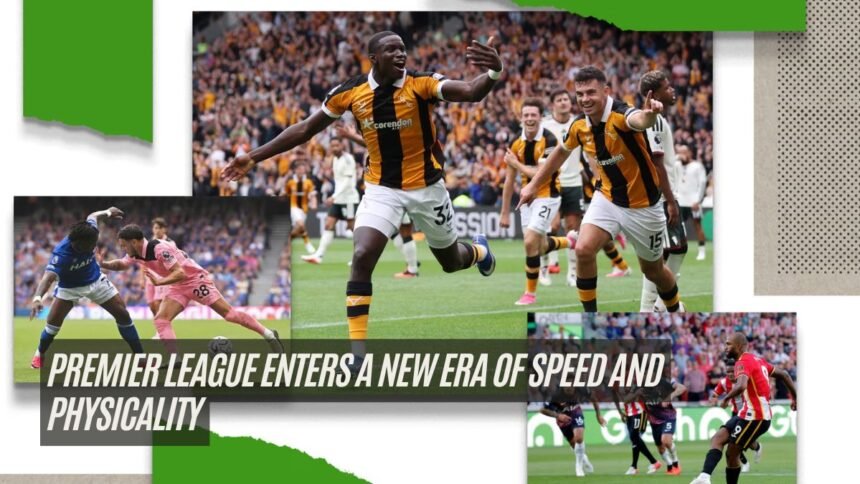
Liverpool controlled 60% of the ball and produced 27 shots, yet had to settle for a draw in a performance that appeared surprisingly chaotic. Manchester United enjoyed an even greater share, reaching 71%, but were comfortably beaten by Hull. Tottenham had 60% possession and suffered a 3-0 defeat.
Nottingham Forest also lost despite controlling 56% of the ball. Sunderland had 62% possession and Crystal Palace recorded 58%, with neither side turning that statistical advantage into victory.
Those numbers obviously come with plenty of qualifications. It was only one weekend, meaning the sample is far too small to establish a meaningful long-term trend. By September, the entire picture could look completely different.
Possession has never been a perfect predictor of results anyway. The strongest teams generally have more of the ball, which naturally influences the overall statistics. Other measurements, particularly expected goals, tend to provide a clearer indication of whether a team is actually creating the conditions required to win.
Simply retaining possession can sometimes reveal a team’s insecurity rather than its strength. Endless circulation without penetration can become football reduced to nervous self-protection, with players moving the ball around while the opposition waits for the one moment when everything suddenly opens up.
The Matches Were Played in Bursts
Possession was only one part of what made the weekend feel different.
The rhythm of the matches was arguably even more revealing. Sunday’s three fixtures all contained substantial waves of substitutions during roughly the final 40 minutes. Nine or 10 replacements appeared across those games, creating the impression that matches were being divided into distinct tactical chapters.
Fresh players entered specifically to change the character of the contest. The game repeatedly shifted in response to the scoreline, the physical condition of the players and the tactical problems emerging on the pitch.
It produced a stop-start, episodic quality that has also been visible at recent World Cups. Perhaps this is simply becoming the modern shape of elite football.
More noticeable still was the emphasis on carefully targeted physical power.
Several teams appeared prepared to launch rehearsed attacks the moment particular triggers appeared. Instead of relying entirely on spontaneous individual inspiration, players would suddenly accelerate forward together, attacking space as a coordinated unit.
Anthony Elanga’s goal for Newcastle provided perhaps the clearest example.
The move lasted only 12 seconds. Two passes were enough to carry the attack approximately 70 metres in a perfectly direct line. There was little of the traditional improvisation normally associated with the word creativity. Instead, the goal reflected collective preparation, timing, athleticism and a shared understanding of exactly when to attack.
Similar patterns emerged elsewhere.
The weekend repeatedly featured fast counter-attacks, powerful runners and players selected for their ability to win individual duels while carrying the ball at speed. Taken together, those performances suggested another step in the Premier League’s long evolution towards an increasingly physical form of football.
Is the League Moving Towards Blitz Football?
It is tempting to ask whether this is more than a random collection of opening-weekend results.
Several managers arriving in new positions have reputations built around speed, aggressive transitions and sprint-heavy football. Matthias Jaissle at Newcastle is one obvious example. Roberto De Zerbi at Tottenham is another, although Saturday’s Spurs looked almost like a distorted version of the football normally associated with him.
Tottenham appeared to have retained only the defensive instincts of the traditional cat-and-mouse approach: disappear, survive and wait.
There is, however, an important distinction to make. The developments of this weekend should not be interpreted as a straightforward rebellion against Guardiola’s principles or positional play.
Controlling possession was never simply about keeping the ball for its own sake. Guardiola’s philosophy has always placed enormous importance on what happens immediately after possession is lost. In fact, some of Manchester City’s most important victories during his later years came through direct attacks rather than endless passing sequences.
The problem comes when possession becomes overly cautious.
Football can lose its edge when every decision is designed primarily to eliminate risk. A team may control territory and the ball while simultaneously lacking the courage to attack the spaces that matter. At that point, possession becomes less a weapon than a symptom of collective hesitation.
The more compelling spectacle comes from what happens around the passing structures: the instant possession changes hands, the first forward run, the acceleration into space and the decision to commit numbers before the opposition has time to recover.
Maresca Faces a New Tactical Question
That could make the situation particularly intriguing for Enzo Maresca, Guardiola’s successor at Manchester City.
Maresca’s football remains rooted in Guardiola’s original principles. Ball control and strict positional structures are still central to his approach. His methods therefore represent one of the clearest continuations of the Guardiola tradition at the club.
But the opening weekend raises an important question: can that philosophy adapt quickly enough if the Premier League continues moving towards greater speed and physical intensity?
Maresca spoke during a televised interview about the difficult balance between control and risk, and between possession and creative freedom. He described players moving into unexpected positions as a form of “chaos”.
That word subsequently became a convenient description of the weekend.
Yet what happened across these matches did not really resemble chaos.
Chaos is something much less predictable: attackers moving without a clear structure, instinctive decisions, sudden individual inventions and football that feels almost impossible to control. The Premier League’s weekend offered something more sophisticated.
The attacks were explosive, but they were not necessarily improvised. The speed appeared deliberate. The physical demands were obvious, but the moments of aggression seemed selected rather than constant.
This was closer to controlled shock and awe.
Teams appeared to identify specific moments when risk was worth taking. Data, preparation, tactical instructions and physical capabilities all combined to create sudden bursts of attacking aggression.
The result was football that could be both highly structured and extremely fast.
A New Balance Between Control and Risk
That may be the most interesting development to emerge from the opening round.
Guardiola’s influence is not disappearing. Positional play remains deeply embedded in the Premier League, and the principles introduced during his Manchester City era will continue to shape coaches and players for years.
But the response to that influence may now be evolving.
If teams have become exceptionally good at controlling space through possession, their opponents have an obvious incentive to find another route to victory. Rather than attempting to dominate the ball for 90 minutes, they can wait for carefully selected moments to attack at maximum speed.
The result is not necessarily anti-possession football.
Instead, it is football in which possession and transition become two parts of the same calculation.
A team can spend long periods without the ball while remaining comfortable, provided it knows exactly what it wants to do once possession is recovered. Likewise, a side can dominate the ball without creating enough danger if its circulation lacks penetration or urgency.
The most effective teams may therefore be those capable of switching between both extremes.
That makes physicality increasingly important. Players must be able to win duels, carry the ball over distance, sprint repeatedly and execute tactical instructions under pressure. The modern Premier League leaves very little room for players who can perform only one part of the job.
The Premier League May Be Entering Another Phase
There is no guarantee that the opening weekend represents a permanent shift.
August can produce strange results. New managers are still establishing their ideas, players are adapting to new systems and the season’s rhythms have yet to settle. The unusual conditions surrounding a World Cup summer can make the early weeks even harder to interpret.
There will also be responses.
If aggressive transitions become increasingly effective, opponents will adjust. Teams will refine their defensive structures, reduce the available space and develop new ways to stop these attacks. Once that happens, another tactical reaction will inevitably follow.
That process is part of the Premier League’s identity.
For now, however, the opening weekend offered a glimpse of something that felt different. Possession did not disappear, but it appeared less decisive. Physical strength became more prominent. Matches seemed to unfold through tactical episodes rather than a single continuous pattern. Most importantly, the moments that produced danger often came from sudden, highly coordinated changes of pace.
Perhaps that is what comes after Guardiola’s defining era.
His influence remains impossible to escape, and the tactical ideas associated with him will continue to appear in different forms. Like an archive containing countless recordings, there is still plenty of Guardiola material left to shape the conversation.
But the Premier League may already be searching for its next answer.
The early signs point towards a game built around calculated aggression, selective risk and explosive transitions — not a rejection of control, but a new interpretation of what control can mean.
After a decade in which possession often felt like football’s central language, the opening weekend suggested that speed, timing and physical force may be preparing to speak a little louder.