





The withdrawal symptoms are coming. After a concentrated burst of Premier League football, autumn is about to deliver an unwelcome stretch of empty domestic weekends. By the end of Sunday, the previous 17 days had produced 30 matches and 79 goals, enough to leave supporters accustomed to a steady supply of incident, argument and entertainment.
That scoring total becomes even more impressive once Tottenham are considered separately. Spurs increasingly seem to inhabit their own category of spectacle, one in which goals, and occasionally recognisable football, appear almost incidental to the experience.
Now comes the interruption: 19 days without the competition before its October return. Anyone whose evenings have been organised around the next match, controversy or highlight must suddenly find another source of stimulation. The temptation to investigate dubious internet supplements may never be greater.
An International Interlude Cannot Replace the Habit
There will, of course, be international football. England alone should provide enough discussion to occupy the space, even if it cannot reproduce the particular pull of the league.
Thomas Tuchel will face another examination of how much responsibility he should carry for problems embedded in English football long before his appointment. His limited access to the squad will do little to discourage demands that he transform their ability to retain possession during a handful of training sessions.
Some of the indignation will inevitably drift away from coaching altogether. Beneath the tactical complaints sits the enduring offence of his nationality, accompanied by his faint resemblance to an underfed officer from a Napoleonic warship, surviving on hard biscuits and powerful painkillers.
None of this quite compensates for the missing club fixtures. The more intense the preceding entertainment, the flatter the pause feels. Fortunately, the calendar supplies another established diversion: an early assessment of what sort of Premier League season is taking shape.
After five matchweeks, that assessment requires surprisingly little invention. Plenty has happened. Very little has fundamentally altered.
Another Season With Recognisable Characters
Consider the equivalent stage a year earlier. A formidable side, directed by a combustible manager without much hair, had collected five victories from five attempts while still looking vulnerable defensively. Arsenal occupied second position and would eventually become champions.
The outlines remain strikingly familiar. The most intriguing developments emerge among the efficiently organised clubs beneath the traditional elite, particularly those whose names begin with B. Brighton and Bournemouth could almost be combined into one representative institution: the smartly managed challenger unsettling richer opponents.
Elsewhere, Erling Haaland continues to supply goals. Bruno Fernandes continues to provoke extremes of emotion, generating something approaching the hysteria once associated with a youthful Elvis. In Fernandes’s case, however, the ingredients are provocative gamesmanship and adventurous passes that can either unlock a defence or exasperate everyone watching.
Even the supposedly urgent questions surrounding the major clubs feel well rehearsed.
Can Michael Carrick carry Manchester United somewhere significantly better? There is little reason to expect it. Is Carrick himself responsible for the circumstances that have left United relying on him? That explanation is equally unconvincing.
The deeper issue is the assumption that a higher setting remains available if only the correct manager can locate the switch. United’s current condition may simply be their condition.
They resemble a footballing expression of contemporary Britain: grand, anxious and increasingly dependent on selling reminders of former importance. Temporary custodians and opportunists oversee an institution sustained by visitors, inherited prestige and memories that remain more marketable than the present.
Familiar Anxiety at Tottenham and Liverpool
Tottenham offer their own version of recurring disappointment. Following two miserable seasons, the current spectacle invites another discussion about how far the club might fall.
Relegation still seems unlikely. There should be sufficient ability, even among players whose enthusiasm appears intermittent, to secure something as unglamorous as 17th.
Yet repetition has weakened the drama. For an audience constantly consuming Premier League stories, Tottenham’s troubles no longer deliver much surprise. Even an actual relegation could struggle to interrupt the scrolling for very long. What once looked extraordinary has become another instalment of an established series.
Liverpool’s situation inspires a different question, but not necessarily a more optimistic answer. Is a great revival imminent? The evidence hardly demands that conclusion.
The exceptional years under Jürgen Klopp are beginning to feel further removed, an outstanding period surrounded by football that looks rather more like the present. Remembering those heights does not make their immediate return more likely.
Florian Wirtz, meanwhile, is plainly talented. The reservation concerns his ability to withstand physical pressure, an attribute that English top-flight football treats as essential rather than optional.
It is easy to imagine him excelling at PSG, Bayern or Inter. That imagined future is a comment on the demands of his current environment, not a denial of his quality.
Across these clubs, the details differ while the wider impression persists: abundant noise, dependable entertainment and remarkably little movement in the underlying story.
Tactical Refinement Within a Narrow Framework
There are still changes worth examining on the pitch, although many are modest enough to require close attention.
Perhaps teams counterattack a little more frequently. Perhaps Anthony Elanga’s pace becomes a particularly effective weapon. Perhaps a winger operating on the opposite flank from his preferred foot discovers that he can deliver a cross without first turning back inside.
Such developments can be enjoyable. Their elevation into major tactical talking points also reveals how uniform elite football has become.
The dominant approach continues to draw from the same broad inheritance: Cruyff and Michels, Guardiola’s positional ideas, and the pressing principles associated with gegenpressing. Different coaches adjust the balance, but the underlying footballing language is widely shared.
In England, the emphasis has shifted further towards athletic force and away from pure control. Even so, the experience can resemble driving an expensive new electric vehicle. Everything is responsive, polished and impressive; much of it also feels reproducible.
Follow that logic far enough and an absurd possibility emerges. One meticulously programmed team waits for an opponent to press. The other, equally well drilled, refuses the invitation. Both remain in position, watching an unoccupied stretch of turf while the game’s operating instructions cancel each other out.
Football has not reached that point. But the image captures the danger of endless refinement within an increasingly restricted range of ideas.
Physical Battles Offer a Genuine Distinction
With 87% of the campaign still ahead, two developments would help give the competition a less familiar shape.
The first is already visible. Greater physical confrontation has brought a distinctive edge to matches, allowing strength, aggression and the determination to win individual contests to become decisive.
A striking number of results have turned on duels and collisions, or on one side appearing more committed to imposing itself. That can sound like an old-fashioned explanation, but there is a reasonable footballing basis for it.
When opposing players possess broadly comparable technical ability, separation must come from somewhere. Repeated bursts of power, the capacity to maintain intensity and the willingness to compete can become the clearest advantages available.
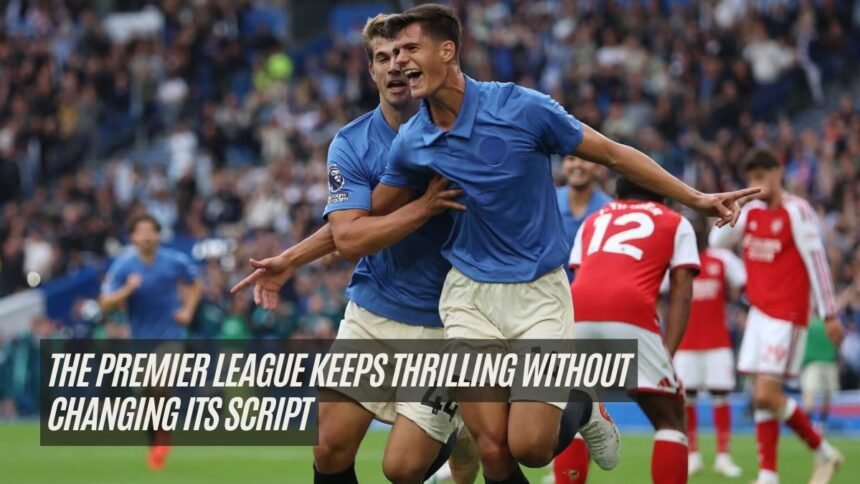
Brighton’s Saturday victory against Arsenal was compelling for precisely this reason. The champions did not merely suffer a defeat. They were surpassed both technically and physically.
Throughout those 90 minutes, the impression was of one team equipped to challenge across every competition available to it. That team was Brighton.
The performance supplied something more interesting than another argument about the shortcomings of a famous club. It briefly suggested that the established order might face a challenger capable of doing more than causing an occasional inconvenience.
Brighton Raise the Question Everyone Wants Answered
That possibility leads to the second development the league would welcome: a club from its well-managed middle ranks sustaining an exceptional standard long enough to become a serious threat.
Could another Leicester-like story emerge, even without following exactly the same path? Could Brighton reproduce their display against Arsenal often enough to turn admiration into a genuine season-long challenge?
There are substantial reasons for caution. Catching Arsenal unprepared on one afternoon is very different from negotiating an entire 38-match programme.
Brighton have a strong squad, but they also face regular fixtures during the week. Opponents will study what makes them effective, adjust their approach and attempt to remove the advantages that looked so decisive against the champions.
Then there is the wider position the club occupies within football’s hierarchy.
Fabian Hürzeler is scheduled to spend an hour discussing football on TalkSport on Tuesday. Inevitably, the conversation will now involve his victory over Arsenal and Brighton’s position in third.
There is nothing objectionable about that appearance. It nevertheless offers a revealing glimpse of the environment surrounding successful clubs outside the wealthiest group.
At 33, Hürzeler is continually developing his professional identity. The same applies to the outstanding players employed by clubs of Brighton’s standing. Their performances can function as auditions for richer institutions as much as contributions to a collective attempt to overtake them.
The prospect of transformative earnings at a Champions League-calibre club is a powerful incentive. Individual ambition and team performance can reinforce each other, even when the ultimate destination lies elsewhere.
Ambition Keeps the Entertainment Moving
This may help explain a recurring complaint among supporters of the biggest clubs. When their team is outrun or outfought, they suspect the players lack desire, or that something has gone fundamentally wrong with the culture and leadership around them.
Sometimes, however, the opposition’s intensity reflects the opportunities its players are pursuing. They have compelling personal reasons to make every contest count.
That restless ambition contributes to the league’s extraordinary strength. It keeps standards high, competition unforgiving and the football difficult to leave alone, even when its central narratives become predictable.
The Premier League can feel tactically standardised and structurally resistant to change while remaining thoroughly absorbing. Its contradictions are part of the attraction: familiar disappointments, occasional disruption, relentless quality and just enough possibility to encourage another viewing.
For now, Brighton have offered a glimpse of what a different story might look like. Whether they can sustain it is a question for the months ahead.
First, the competition has to return. The break has barely begun, and its absence is already being felt.