






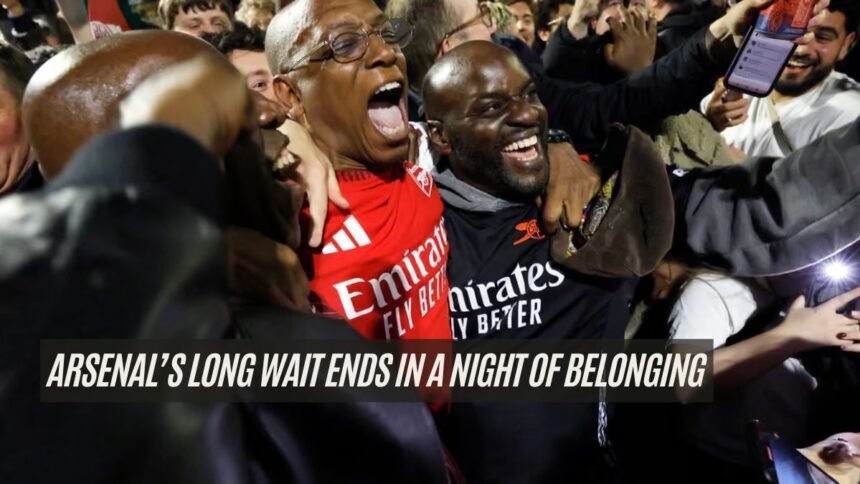
Outside Finsbury Park station, rubbish bags, takeaway boxes and discarded Lime bikes formed chaotic heaps along the pavement, as though north London itself had surrendered to the madness of the night. After more than two decades of waiting, Arsenal supporters were no longer interested in order or restraint. The city had given itself over to celebration.
Fans poured in through the familiar roads surrounding the stadium Gillespie Road, Benwell Road, Hornsey Road while others slipped through the narrow passage beside The Plimsoll. The evening air carried a strange mix of calm and electricity, a feeling that something long trapped had finally broken loose.
By the time supporters reached the Emirates Stadium, strangers were embracing each other like lifelong friends. Shared suffering had erased every social barrier. Chants rolled through the streets, fireworks cracked above the rooftops, and phones were lifted skyward as people called relatives to share the moment live. Others stopped for photographs with Ian Wright while the crowds swelled deeper into the night.
The scenes carried the familiar chaos of an Arteta side: plenty of pushing, movement and emotion, yet somehow still under control. Even online, where Arsenal are often met with mockery and ridicule, there was a temporary ceasefire. For one evening at least, nobody wanted to spoil the mood.
Modern football often thrives on separation. Membership levels, hospitality packages, premium experiences and endless distinctions between supporters all reinforce the idea that fandom exists in layers. Yet around the Emirates that night, those divisions disappeared. Local supporters stood shoulder-to-shoulder with visitors who had travelled from across the world. Everyone wanted the same thing: confirmation that this feeling was real and shared.
Trying to define Arsenal has never been simple. The club’s identity stretches far beyond geography. Even the Underground station takes its name from the team itself rather than the surrounding district, a decision dating back to the era of Herbert Chapman in the 1930s. Arsenal’s support reaches from Islington to distant cities overseas, from north London estates to international fan communities thousands of miles away.
Nor has the club ever belonged to a single footballing philosophy. The disciplined pragmatism of George Graham looked nothing like the flowing football associated with Arsène Wenger, and yet both eras remain unmistakably Arsenal. The current side under Mikel Arteta carries elements of each. Arsenal teams have often blended elegance with aggression, style with ruthlessness. The same club that celebrated the brilliance of Thierry Henry also revered figures such as Tony Adams. From Liam Brady to Katie McCabe, from Pat Rice to Declan Rice, different generations have all contributed to the same broader identity.
Yet clubs of Arsenal’s stature become larger than football alone. They evolve into symbols, reflections of the places and people attached to them. In many ways Arsenal mirrors London itself: constantly changing, endlessly layered and permanently shaped by outsiders becoming insiders. It is a club tied to movement, reinvention and contradiction. Confidence and anxiety existing side by side.
For many supporters, that emotional attachment has only intensified as London itself has become harder to recognise. Wealth floods through the city while ordinary communities struggle to remain intact. Luxury developments rise with empty windows while independent businesses disappear. Families are pushed out by rising costs. Schools in Islington operate below capacity, with some forced to close altogether in recent years.
Of course, these are not problems unique to one borough. Much of Britain has experienced similar decline and dislocation during years of austerity. But Islington, like Arsenal, has long attracted a particular kind of sneering resentment from elsewhere. Politicians and commentators often use the area as shorthand for elitism and detachment, despite the reality that poverty remains deeply embedded across the borough. Even Boris Johnson frequently deployed “Islington” as an insult toward Keir Starmer, despite having once lived there himself.
Arsenal have spent years dealing with a similar hostility. Rival fans accuse them simultaneously of being weak and overly aggressive, boring yet theatrical, arrogant yet fragile. Their celebrations are mocked, their online presence criticised, their confidence framed as self-importance. The club often seems to attract backlash simply for existing loudly.
That atmosphere shaped the last 22 years. Arsenal supporters became familiar with disappointment, ridicule and endless comparisons to richer or more dominant rivals. Repeated defeats to sides like Manchester City and Bayern Munich only deepened the sense of frustration.
Perhaps that explains why nostalgia now runs so strongly through the fanbase. Young supporters regularly wear shirts from the 1990s carrying the old JVC sponsor logo, celebrating an era they never personally experienced. The connection is emotional rather than historical: a longing for certainty, for belonging, for memories inherited second-hand.
That same feeling echoes through “The Angel (North London Forever)” by Louis Dunford, the anthem Arteta introduced at home matches in 2022. Beneath the soaring chorus sits a far sadder portrait of disappearing neighbourhoods, demolished homes and changing streets. The song mourns a version of London many younger supporters know only through stories.
On the pitch, that emotional landscape perhaps explains Arsenal’s recent footballing identity. In a world where collapse constantly threatens and criticism waits around every corner, Arteta’s team has learned to protect itself fiercely. Defensive structure, control of possession and narrow victories became forms of self-preservation. A set-piece goal from Gabriel. Declan Rice closing spaces in midfield. Arsenal securing territory and refusing to surrender it.
That approach does not mean ambition disappears. Arsenal have still spent heavily in pursuit of success, investing vast sums into rebuilding the squad. But the mentality underneath it feels rooted in older traditions: resilience, defiance and a willingness to be disliked.
None of it guarantees happiness, of course. Football rarely offers protection from humiliation or doubt. There is always the fear of another collapse, another late goal, another avalanche of mocking messages flooding group chats. Arsenal supporters understand better than most how quickly confidence can evaporate.
There are also unavoidable contradictions. The modern game forces supporters to wrestle with uncomfortable realities commercial partnerships, corporate branding and controversies surrounding players or ownership. At times, the emotional attachment clashes with the knowledge that elite football is also an enormous business.
Yet nights like this explain why people continue to care so deeply.
For Arsenal supporters gathered outside the Emirates, the club represented more than trophies or league tables. It became a community, a ritual and a form of belonging inside a city that can often feel isolating and unforgiving.
London is crowded but frequently lonely. Fast-moving, expensive and emotionally exhausting. Yet for a few unforgettable hours, thousands of people felt connected again. Some had travelled across continents. Others had simply wandered down the street wearing slippers and pyjamas. It made no difference.
The songs kept coming. Fireworks burst overhead. The night stretched on beneath north London skies. And for once, everyone underneath them felt at home.