





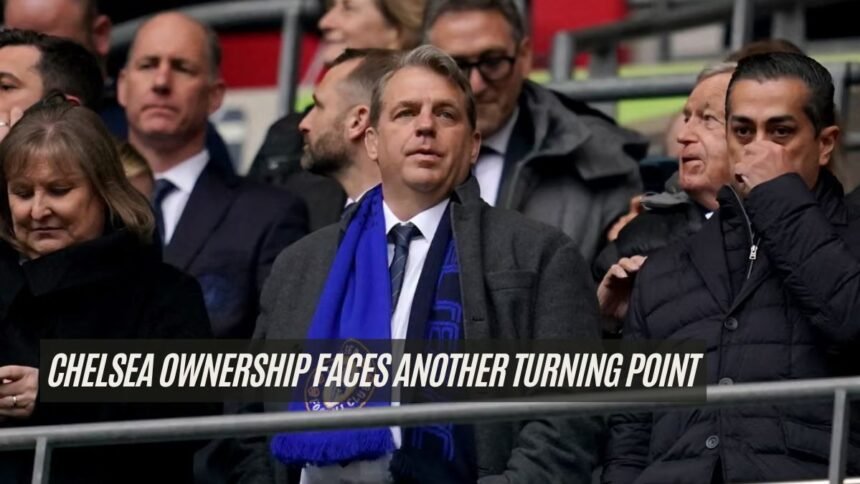
The current uncertainty surrounding Chelsea’s ownership may now look like the inevitable consequence of a partnership that was never entirely straightforward. Roman Abramovich’s forced departure following Russia’s invasion of Ukraine created an unusual alliance among wealthy investors, bringing together figures from American sports, Swiss business and the technology investment world.
Todd Boehly emerged as the leading figure behind the successful takeover bid. He persuaded US sports executive Mark Walter and Swiss businessman Hansjörg Wyss to participate as minority shareholders, each holding 12.8%. Private equity company Clearlake Capital, meanwhile, committed 61.6% of the investment. Its principals, Behdad Eghbali and José E Feliciano, subsequently became influential figures in Chelsea’s ownership structure.
Winning the club was only the beginning. The consortium had defeated 11 credible bidders during an accelerated process overseen by the Raine Group, but the celebrations quickly gave way to much more difficult questions. Chelsea needed a clear sporting direction, a sustainable operating model and a solution to a stadium situation in which several Premier League competitors had already moved ahead.
The contrast with the Abramovich era has been particularly striking. Chelsea had avoided finishing below fifth for six consecutive seasons before the takeover. Since then, however, the club’s average Premier League position over four campaigns has fallen to eighth. Their best finish during that period was fourth, while their lowest was 12th. The competing views within an ownership group filled with wealthy individuals accustomed to making their own decisions have frequently appeared difficult to reconcile.
Different voices inside the ownership group
The original agreement gave Boehly, acting on behalf of Walter and Wyss, the final say on major decisions alongside Eghbali and Feliciano. As the years passed, Boehly and Eghbali became the principal figures involved in Chelsea’s daily affairs. The other investors largely operated in the background, avoiding much of the criticism directed at the club whenever performances or decisions disappointed supporters.
Although some people familiar with the situation have described the relationship between Boehly and Eghbali as professional, tensions had become increasingly visible. Those concerns surfaced publicly well before reports emerged this week that Boehly and Walter were prepared to consider selling their interests to Clearlake. Such a transaction would reportedly put Chelsea’s valuation at roughly £5 billion.
Boehly himself stressed the importance of giving the project time when he spoke at the Qatar Economic Forum in May 2024. At that point, Mauricio Pochettino had guided Chelsea to the EFL Cup final and FA Cup semi-final, while the team had recovered from a difficult opening period to secure sixth place in the Premier League. Cole Palmer had established himself as one of the club’s brightest young stars, Reece James had been appointed captain, and Chelsea entered the summer having won their final five matches.
Yet only six days after Boehly called for patience, Pochettino was dismissed. His departure followed an 18-page assessment of the season prepared by co-sporting directors Paul Winstanley and Laurence Stewart.
Stadium plans exposed deeper disagreements
Another indication of the uncertainty within the ownership structure appeared during an interview Boehly gave to Bloomberg in March last year. The discussion focused on Chelsea’s slow progress regarding its stadium plans, which had originally been announced four years earlier.
Boehly argued at the time that the owners needed to take a long-range view of their ambitions for the club. He also acknowledged that the proposed stadium development could ultimately become a major dividing point if the ownership group could not agree on the direction.
That was notable because Boehly’s own early approach had been considerably more hands-on. Shortly after the takeover, he effectively assumed sporting director responsibilities and oversaw a spending spree worth around £250 million. The strategy initially focused on established names, including Raheem Sterling and Pierre-Emerick Aubameyang. Chelsea ended that season in 12th place.
Boehly subsequently reduced his direct involvement in football operations as Eghbali became more prominent. The club conducted roughly 70 interviews as it sought to establish a new football structure. That process eventually produced the appointments of Winstanley and Stewart, who later became co-sporting directors, alongside Joe Shields, who is now a co-director of recruitment.
A radical transfer strategy
The new leadership attempted to reshape the traditional approach to running a football club. Chelsea concentrated heavily on younger players while offering contracts that were unusually long by conventional football standards. The model attracted plenty of attention across the sport, although it also generated considerable confusion and criticism.
Supporters’ frustration became increasingly difficult to ignore. In 2024, stickers depicting Chelsea’s three owners as clowns appeared around Stamford Bridge. The Chelsea Supporters’ Trust went even further, describing the club as a “laughing stock”.
The financial scale of the project has also been extraordinary. Chelsea recorded a pre-tax loss of £262.4 million for the year ending June 2025, a Premier League record. That figure would have been difficult to reconcile with Boehly’s early declaration that the owners wanted to make supporters proud of their club.
Chelsea also faced scrutiny over the way it complied with Premier League financial restrictions. The club effectively sold its women’s team to another entity within the wider ownership structure in order to help meet the spending requirements. That maneuver did not prevent a substantial UEFA penalty, because European financial regulations did not allow the transaction to be treated as income in the same way.
Signs that the sporting project could work
Despite the turmoil, there have been periods when Chelsea’s broader plan appeared to be gaining traction. Under Enzo Maresca, the team developed significant momentum, secured Champions League qualification and won the Club World Cup.
That progress made Maresca’s sudden departure in January particularly frustrating. Chelsea had been competing for a Champions League place before the disruption, but their form deteriorated sharply afterward and they ultimately dropped to 10th.
The club is now entering another phase of reconstruction under Xabi Alonso. The sporting approach is also being adjusted, with Chelsea seemingly moving toward a greater emphasis on older and more experienced players rather than relying so heavily on youth and potential.
However, changes on the pitch have not brought an end to the uncertainty at board level.
Boehly and Walter could be on the way out
The two sides within the ownership group have reportedly examined the possibility of buying one another out on several occasions. The latest circumstances, however, appear to have increased the pressure on Boehly and Walter to consider an exit.
Walter, who has been a longtime friend and business associate of Boehly, is reportedly under investigation by the US Department of Justice over alleged tax fraud. He is also understood to be selling assets to address loans that have attracted federal scrutiny.
His unexpected sale of the Los Angeles Lakers to Josh Kushner and Bob Iger for $12.5 billion (£9.2 billion) last week has added to speculation that his Chelsea investment could be next.
The timing could prove significant for Boehly as well. His five-year period as Chelsea chairman is due to conclude at the end of the current season, while Clearlake is reportedly prepared to install one of its representatives as his replacement.
If the proposed ownership changes go through, Eghbali and Feliciano would gain complete control of Chelsea. That would mark a major shift from the divided structure that has characterized the club since the takeover.
It would also leave the pair with far less room to deflect responsibility. With full control would come full accountability, meaning the next chapter of Chelsea’s ambitious project would rest squarely on their decisions and, ultimately, on whether they can finally turn years of spending, restructuring and internal disagreement into sustained success.