





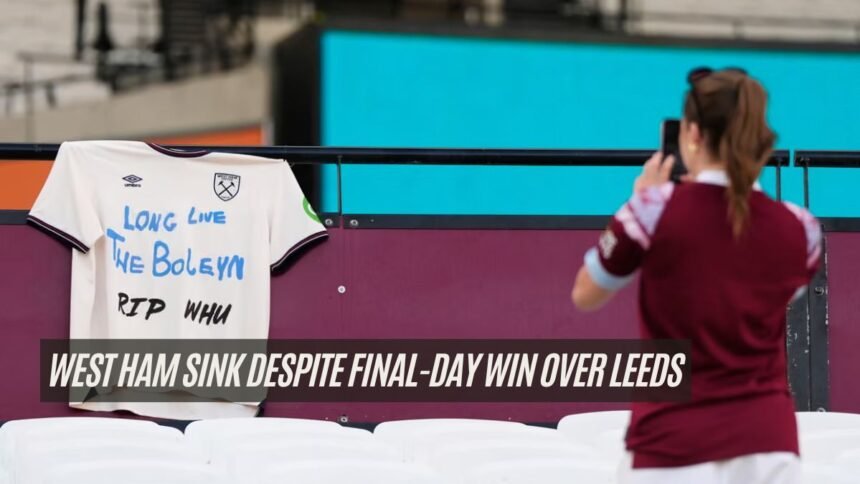
West Ham’s fight arrived far too late. Even a convincing 3-0 victory against Leeds United could not prevent relegation from the Premier League, as Tottenham Hotspur’s result against Everton sealed the club’s fate elsewhere.
For a brief moment inside the London Stadium, supporters were allowed to believe again. Jarrod Bowen’s second-half strike brought noise, celebration and flashes of the intensity that once defined this club. Yet the wider reality could not be escaped. While West Ham delivered one of their better performances of the campaign, events beyond east London ensured the afternoon would still end in disappointment.
The victory itself almost felt secondary. Relegation had been hanging over the club for weeks, and by full-time the atmosphere reflected something deeper than frustration over one season alone. Anger toward the ownership continued to dominate the mood around the stadium, with supporters again directing criticism toward the board and chairman David Sullivan.
Bowen Provides a Rare Bright Moment
Bowen’s goal in the 78th minute briefly changed the emotional temperature inside the ground. Leeds’ defence had already collapsed by that stage, allowing the England international to burst through and finish comfortably. It was one of the few passages during the afternoon that resembled a functional, confident West Ham side.
Those moments have been scarce throughout the season. Instead, the campaign has largely been shaped by confusion, inconsistency and poor decision-making at executive level. Even during a comfortable win, the sense remained that the club had drifted too far from its identity.
The disconnect between supporters and ownership was impossible to ignore. Chants aimed at the hierarchy echoed around the stadium during the closing stages, underlining how deeply many fans feel the club has lost its direction since moving to the London Stadium.
A Club Drained of Energy
There was an unusual atmosphere throughout the afternoon. At kick-off, the stadium carried tension mixed with reluctant hope, but everything changed when news spread that Tottenham had scored. The reaction inside the stands was immediate. Energy disappeared almost instantly, replaced by resignation.
Even the hostility felt tired by half-time. Boos arrived more out of routine than genuine fury, as though supporters had exhausted themselves emotionally long before the final whistle.
The London Stadium itself continues to feel detached from the football taking place on the pitch. A decade after the move from Upton Park, many supporters still struggle to connect with the venue. The physical distance from the field and the overall environment remain symbols of a wider sense of alienation around the club.
Nuno Left Facing the Fallout
Manager Nuno Espírito Santo spent the entire match pacing the technical area, fully aware of what was unfolding elsewhere. His programme notes before kick-off had already hinted at the scale of the problems surrounding the club, admitting there was little positive to say about recent performances.
Now the focus turns toward rebuilding after relegation to the Championship. Financially, the consequences are expected to be severe. Estimates suggest West Ham could lose around £100m during the first season outside the Premier League, creating uncertainty throughout the organisation.
The damage may stretch beyond football. London mayor Sadiq Khan has warned that relegation could increase public costs connected to the stadium agreement, a long-running issue tied to the controversial deal originally negotiated during Boris Johnson’s time as mayor.
Executive Failure at the Heart of Collapse
The reasons behind West Ham’s downfall are neither complicated nor sudden. Years of poor leadership, questionable recruitment and weak long-term planning gradually pushed the club backward while rivals improved.
Other mid-sized Premier League sides modernised their football operations, sharpened recruitment structures and developed clearer identities. West Ham failed to keep pace. Instead, the club drifted through repeated managerial changes and uneven transfer strategies without establishing stability.
Responsibility now falls heavily on Sullivan and the club’s senior leadership team. Critics have accused the ownership of allowing mediocrity to spread through every level of the organisation, from recruitment to player development and managerial appointments.
There is also growing expectation that Czech investor Daniel Kretinsky could take on a more influential role in the future as pressure intensifies around the current structure.
Uncertain Future Ahead
Relegation is likely to trigger major changes this summer. Bowen’s future immediately becomes a talking point, while midfielder Mateus Fernandes is also expected to attract attention from clubs in the top flight.
A new manager may arrive to oversee the rebuild, tasked with restoring both competitiveness and trust around the club.
For many supporters, however, the only things still worth preserving are the emotions that survived even during failure the noise from the stands, the anger, the applause at full-time and the sense of belonging that ownership and results have struggled to erase.