






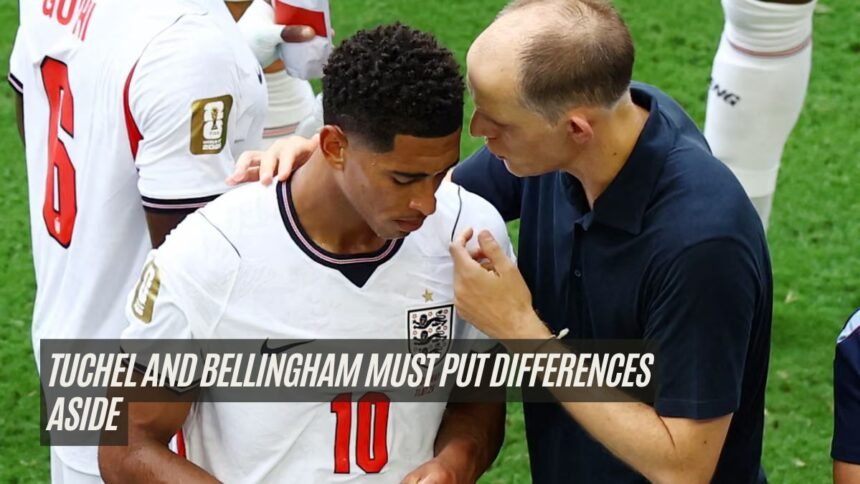
England’s march toward the latter stages of the World Cup has suddenly been overshadowed by an unexpected war of words between Thomas Tuchel and Jude Bellingham. What should have been a moment to celebrate progression has instead become a discussion about internal harmony, with emotions running high after a physically demanding night in Miami.
The intense heat created difficult conditions for everyone involved, but the conversation afterward proved even hotter. England are now just one victory away from reaching their first men’s World Cup final played outside home soil, making unity within the squad more important than ever.
Tuchel Refused to Sugarcoat England’s Display
Following England’s quarter-final victory over Norway, Tuchel delivered a remarkably honest assessment. While acknowledging the team’s determination, he made little effort to disguise his disappointment with the overall standard of football.
According to the England manager, the performance lacked tempo, contained too many technical errors, and failed to reach the level he expects from a side with ambitions of lifting the trophy. His praise for the players’ resilience was largely overshadowed by the blunt criticism that followed.
Those comments quickly became the focus of post-match interviews, placing Bellingham in a difficult position.
Bellingham Hit Back After the Final Whistle
The Real Madrid midfielder showed visible frustration when asked about Tuchel’s remarks. Initially dismissing the subject with a brief response, Bellingham later expanded on his feelings, suggesting that the circumstances on the pitch deserved greater consideration.
He pointed to the exhausting weather and the quality of Norway’s squad, referencing opponents such as Erling Haaland, Martin Ødegaard, Antonio Nusa and Alexander Sørloth as evidence that England had been tested by elite talent under extremely demanding conditions.
Some observers interpreted his comments as an indirect reference to Tuchel’s own playing career, creating the impression that the midfielder had questioned whether the manager fully understood those challenges from personal experience.
Attention Shifted Away From England’s Achievement
Instead of celebrating qualification for a blockbuster semi-final against Argentina in Atlanta, discussion rapidly moved toward the relationship between England’s head coach and one of its biggest stars.
The concern is not simply about one exchange with the media. Rather, it raises fresh questions about whether previous tensions between the pair have truly disappeared.
Last autumn, Tuchel made one of his boldest decisions by leaving Bellingham out of the England squad. The manager prioritised dressing-room balance and collective standards, making it clear that no individual would receive special treatment.
Bellingham responded exactly as required. He adapted, regained Tuchel’s trust, earned his place back in the starting lineup, and has since become arguably England’s most influential player during this tournament.
Tuchel’s Approach Has Always Been Direct
Although his comments sparked debate, Tuchel’s post-match analysis was consistent with the personality he has shown throughout his coaching career.
He rarely softens his opinions in public and has long believed that high standards demand absolute honesty. His criticism after defeating Norway can easily be viewed as a calculated attempt to ensure complacency never enters the dressing room.
For Tuchel, reaching the semi-finals represents only part of the objective. His ambition is to guide England to another World Cup title, meaning satisfactory results alone are not enough if the overall performance falls below expectation.
His approach resembles the confrontational motivational style once associated with José Mourinho during his most successful years.
Football’s Elite Managers Often Use Similar Methods
Modern coaching often emphasises protecting players publicly, but Tuchel has never fully embraced that philosophy.
Many of football’s greatest managers have used public criticism as a motivational tool. Pep Guardiola has frequently challenged suggestions that Manchester City deserved excessive praise after victories, while Sir Alex Ferguson was equally capable of highlighting flaws despite winning major matches, even during his Aberdeen days.
From that perspective, Tuchel’s remarks were less surprising than they initially appeared.
Different Personalities Create Different Challenges
One reason the situation attracted so much attention is the contrast between Tuchel’s communication style and what England supporters have become accustomed to.
A manager such as Gareth Southgate would likely have focused on the achievement itself, praising another historic step forward while delivering his message with diplomacy.
Tuchel operates differently. He values blunt honesty over reassurance and is willing to risk upsetting people if he believes it ultimately improves performances.
That philosophy now meets another powerful personality in Bellingham.
Confidence Is One of Bellingham’s Greatest Strengths
At only 23 years old, Bellingham had just scored in consecutive knockout matches before facing the media in Miami.
Given his confidence and competitive mentality, it was hardly surprising that he resisted criticism immediately after helping England progress. His self-belief has become one of the qualities that repeatedly allows him to inspire the national team during difficult moments.
However, there is also a line that can be crossed.
His apparent reference to Tuchel’s playing background could easily be interpreted as challenging the authority of the England manager, something that inevitably attracts attention inside and outside the dressing room.
Both Sides Should Quickly Move On
Despite the headlines, this disagreement does not need to become a long-term problem.
From Tuchel’s perspective, there is little value in responding aggressively. If he has encouraged an environment where honesty is welcomed, he should also be prepared to receive honest opinions from his players.
Likewise, Bellingham deserves some understanding considering the circumstances. He spoke shortly after an exhausting match played in suffocating Miami conditions, where both physical fatigue and emotional intensity were likely at their highest.
Players are not always able to measure every word perfectly in those moments.
The Focus Must Return to Argentina
England have far more to gain from ending the discussion than allowing it to grow.
When Tuchel next addresses the media, reducing the significance of the exchange perhaps even with a touch of humour would help remove unnecessary pressure. Keeping the spotlight on football rather than personal disagreements should be the priority.
Inside the camp, maintaining the sense of togetherness that has carried England this far is essential before facing Argentina in one of the most significant matches in the nation’s recent football history.
There is optimism that the disagreement will quickly fade. If that proves true, England can return its full attention to chasing history. Achieving that goal will depend not only on tactical preparation and individual quality, but also on Tuchel and Bellingham pulling in exactly the same direction.