





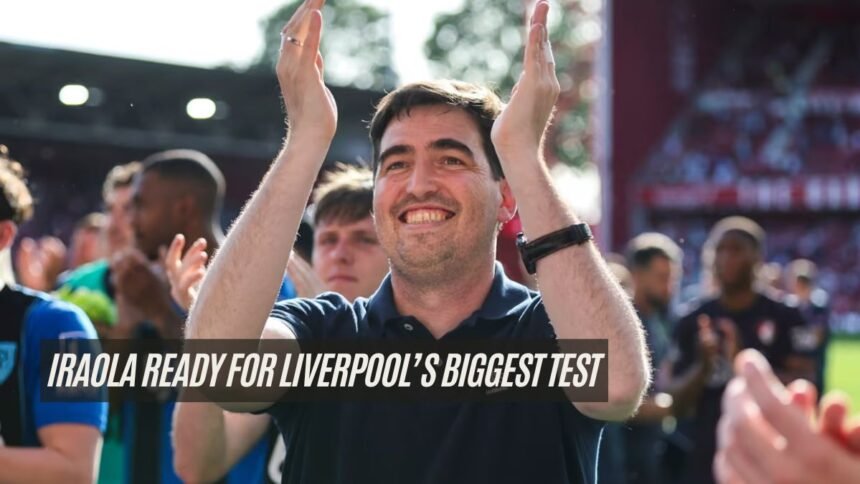
Those who have worked closely with Andoni Iraola often point to one characteristic above all others: courage. It is a quality that has become synonymous with the Spanish coach and was clearly reflected in the football Bournemouth produced during his time in the Premier League.
Now, Iraola faces the most demanding assignment of his managerial career. Having impressed on the south coast, he is preparing to take charge of one of football’s biggest institutions. Liverpool’s sporting director, Richard Hughes, previously persuaded him to take on a Bournemouth side that had narrowly avoided relegation. This time, the objective is much greater rebuilding confidence and restoring the identity that once made Liverpool champions.
The challenge comes after Arne Slot’s disappointing title defence campaign. While Liverpool struggled to maintain their dominance, Bournemouth under Iraola consistently demonstrated ambition and resilience. Yet the beginning of his reign was anything but smooth. His first nine league matches brought no victories, a difficult period that now feels almost unimaginable considering what followed. Such patience, however, may be harder to find at Anfield if similar struggles emerge.
From Doubt to Admiration
When Bournemouth secured European qualification for the first time in club history, Iraola reflected on the journey with supporters.
He joked about the difficult early months, recalling how fans may have questioned the club’s decision to appoint him as results failed to arrive. Those doubts have long disappeared.
Today, the 43-year-old is regarded as one of the most sought-after coaches in European football. His achievements over the last three seasons have elevated both his own reputation and the standing of Bournemouth. Much of that success has stemmed from his ability to improve players individually while embedding a collective style built around intensity, pressing and relentless work without possession.
Few examples illustrate this better than Antoine Semenyo. Arriving from Bristol City with clear potential but limited Premier League experience, the forward developed significantly under Iraola’s guidance. Marcos Senesi also flourished during this period, while James Hill has recently emerged as another player attracting wider attention, including from England’s coaching staff.
The Vision That Changed Bournemouth
Hughes had already been impressed by Iraola’s work at Rayo Vallecano before bringing him to Bournemouth. The Spanish coach had earned admiration in La Liga after guiding Rayo following promotion and establishing them as a highly competitive side.
When he arrived in England, Bournemouth’s leadership wanted more than survival. The club sought a transformation in style and mentality. Iraola embraced that mission, introducing a more adventurous brand of football designed to play on the front foot rather than react to opponents.
That philosophy quickly became the foundation of Bournemouth’s rise.
Attack as the Best Form of Defence
Throughout his managerial career, Iraola has shown little interest in passive football. Deep defensive blocks have never appealed to him, and his Bournemouth teams consistently reflected that belief.
One memorable example came against Fulham in October. Bournemouth trailed entering the final stages, but Iraola responded by removing central defender Marcos Senesi and defensive midfielder Tyler Adams. In their place came attack-minded options Ryan Christie and Ben Gannon-Doak.
The gamble paid off almost immediately. Bournemouth equalised shortly afterwards before scoring twice more to complete a 3-1 comeback victory.
A similar mentality was evident a week earlier at Elland Road when Eli Junior Kroupi rescued a draw deep into stoppage time. By the final whistle, Bournemouth had only two natural defenders remaining on the pitch.
Comebacks became a recurring feature of Iraola’s reign. During his first season, Bournemouth overturned a three-goal halftime deficit to beat Luton 4-3. In another remarkable turnaround against Everton, they scored three times after the 86th minute to secure a dramatic 3-2 win. Even positional discipline could become secondary when chasing victory. As Iraola once admitted, Dango Ouattara was deployed at left-back but spent much of the match operating virtually everywhere else.
Relentless Pursuit of Victory
According to senior figures within Bournemouth, the team’s identity under Iraola was built around an unwavering desire to win.
His substitutions frequently reflected that mindset. Rather than protecting results, he often introduced every available attacking option while there was still enough time for those players to influence the contest. Maintaining tempo and intensity remained a priority regardless of the scoreline.
The approach also made Bournemouth one of the league’s most entertaining teams. Supporters could never accuse Iraola of settling for caution. Every tactical decision appeared geared toward securing three points.
Learning When to Accelerate
Although aggression remained central to Bournemouth’s game, Iraola gradually added another layer to his team’s development.
Following a dramatic 3-2 victory over Liverpool in January, a match Bournemouth won despite surrendering a two-goal advantage, the coach acknowledged that his players had become better at recognising key moments within matches.
Traditionally, his teams attacked with maximum intensity from the opening whistle until the final seconds. Over time, however, Bournemouth learned to manage games more intelligently while still retaining their attacking instincts.
That maturity contributed to an impressive achievement as the club completed an entire second round of league fixtures without suffering defeat. During a sequence featuring six draws in seven matches, Iraola repeatedly stressed the importance of valuing every point earned.
Thriving Amid Constant Change
One factor likely to help Iraola at Liverpool is his ability to adapt to squad turnover.
During the previous season, Bournemouth generated more than £250 million through player sales. Despite losing key performers, the team continued to compete at a high level.
The departures of Illia Zabarnyi, Dean Huijsen and Milos Kerkez to Paris Saint-Germain, Real Madrid and Liverpool respectively did not derail progress. Earlier in Iraola’s tenure, Dominic Solanke left for a then club-record fee of £65 million. Even the January sale of Semenyo to Manchester City failed to trigger a collapse in results.
At the same time, new talents continued to emerge. Alex Scott, Eli Junior Kroupi and Rayan all enhanced their reputations under Iraola’s guidance, increasing their market value considerably.
More Than a Friendly Face
Iraola’s approachable personality can sometimes disguise the intensity that drives him.
He once brushed aside speculation linking him with Real Madrid, suggesting that managing global superstars was not especially appealing. Yet behind his relaxed public image lies a highly demanding coach.
Away from football, he enjoys travel, culture and even football trivia competitions with members of his analysis department. Last season, he volunteered as a linesman during one of his daughter’s under-11 matches in Dorset.
On the training ground, however, standards are non-negotiable. Days off are limited, expectations are high and commitment is essential.
Those values were shaped during a distinguished playing career. Iraola spent 16 years at his hometown club, Athletic Bilbao, before finishing his playing days alongside Frank Lampard and Andrea Pirlo at New York City FC.
Now the Basque coach is preparing for the next chapter. If his previous managerial stops are any indication, Liverpool supporters should expect a team that plays boldly, attacks relentlessly and refuses to back down.