





Jürgen Klopp had warned that his first match in charge of Germany might become chaotic. What mattered to him was seeing energy from his new side, even if their football was not yet polished.
That prediction proved remarkably accurate.
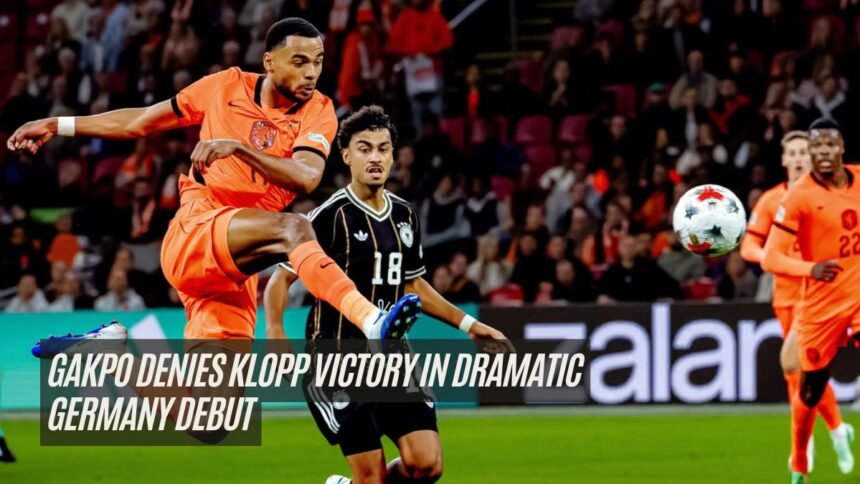
Germany’s new era began with a frantic 1-1 draw against the Netherlands, a match packed with disputed incidents, missed opportunities, injuries and defensive uncertainty. Felix Nmecha put Klopp’s team ahead before the interval, but Cody Gakpo struck deep into added time to prevent Germany from leaving with victory.
The Liverpool forward produced the decisive moment with an excellent volley after Ruben van Bommel supplied an inviting cross, giving the Netherlands a deserved reward for the pressure they had applied.
For Klopp, however, the final score may not be the most significant concern to emerge from his first night in the job. Germany also had to deal with fitness problems involving Jamal Musiala and Kai Havertz, adding an unwelcome complication for both the national team and their respective clubs.
A Rivalry Enters a Different Era
Meetings between the Netherlands and Germany have historically carried considerable hostility, but this encounter had a noticeably different atmosphere. Rather than old grievances dominating the occasion, both teams arrived focused primarily on their own transitions.
Each country was beginning a new chapter.
Dutch supporters welcomed their new head coach with a banner reading “Welkom Xavi”, while Germany’s travelling contingent responded enthusiastically when Klopp’s name was announced before the match.
The Nations League window had given Klopp an unusual opportunity to assess a huge group of players. He selected a 44-man squad, effectively dividing it between Germany’s opening two fixtures and the following pair of matches.
Several selections were unfamiliar enough to attract attention even among regular Bundesliga observers.
Freiburg full-back Philipp Treu was the only debutant named in Germany’s starting XI against the Netherlands, while Brentford attacker Kevin Schade was also given a place from the beginning.
Klopp was forced into one change before the contest had even started. Musiala experienced discomfort in his thigh during the warm-up and was withdrawn, with Nadiem Amiri taking his position.
It was the first fitness setback on what would become a difficult evening in that respect.
Van Dijk Celebration Cut Short
Xavi did not possess quite the same depth of options as his opposite number, but his Netherlands side made an encouraging start.
The hosts enjoyed their first sustained spell of pressure and believed they had taken the lead after 13 minutes.
Tijjani Reijnders delivered a corner into the penalty area and Virgil van Dijk directed the ball beyond Marc-André ter Stegen. Xavi immediately celebrated on the touchline as the Dutch captain appeared to have provided the breakthrough.
There was an additional layer to the moment because of Van Dijk’s connection with Klopp, having previously been such an important player under the German coach. On this occasion, though, the defender was playing for the manager who had convinced him to continue wearing the Netherlands captain’s armband.
The celebration did not last.
A VAR review concluded that Brian Brobbey had interfered with Ter Stegen while the goalkeeper attempted to deal with the delivery. The goal was therefore disallowed, although the decision appeared generous to Germany’s recalled goalkeeper, who is now playing his club football for Ajax.
Havertz Adds to Germany’s Injury Problems
Klopp had spoken beforehand about wanting his team to play with intensity, but Germany struggled to establish any rhythm during the opening stages.
Their situation became more complicated when Havertz went down around the halfway line.
The forward could not continue and was replaced after half an hour by Eintracht Frankfurt attacker Younes Ebnoutalib. The substitute wasted little time making an impression, quickly forcing Bart Verbruggen into action with an effort that tested the Dutch goalkeeper.
It meant Klopp was required to examine some of the newer members of his squad much earlier than anticipated.
As the match became increasingly physical, Jan Paul van Hecke was booked following a forceful challenge on Schade.
The tension then increased considerably.
Nmecha Strikes Amid Dutch Anger
Germany’s opening goal arrived in controversial circumstances.
With Brobbey needing attention, there initially appeared to be an expectation that Germany might put the ball out of play. Joshua Kimmich instead allowed the attack to continue.
The move eventually reached Karim Adeyemi, whose attempt from close range was stopped. Nmecha reacted quickest to the loose ball and converted the rebound to put Germany ahead.
The Netherlands were furious that the attack had been allowed to develop while Brobbey required treatment.
Their frustration spilled over after the goal, with players confronting their opponents and a brief scuffle developing near the touchline.
Whatever the controversy surrounding it, Nmecha’s finish meant Klopp had his first Germany goal as head coach.
His team then had an excellent opportunity to increase the advantage.
Nathaniel Brown found Adeyemi completely free with a pass across goal, but the forward somehow lifted his attempt over the crossbar from an extremely promising position.
Brobbey subsequently joined Havertz among the players unable to continue, although the Netherlands remained dangerous without their starting striker.
Crysencio Summerville and Gakpo both forced Ter Stegen into saves before half-time, leaving Germany under pressure despite carrying a one-goal advantage into the interval.
Netherlands Increase the Pressure
The home side returned after the break with obvious urgency.
Their football had pace and aggression, although the quality of the final action was frequently missing. Germany were similarly energetic without showing enough precision, resulting in a match that became increasingly loose.
Adeyemi provided another example when Schade intercepted a poor Dutch pass and helped create an opening. From an angle, however, Adeyemi sent another attempt well away from the target.
Neither team was producing particularly controlled football, but the disorder ensured there was rarely a quiet period.
The Netherlands began creating the clearer opportunities as the second half progressed.
Mexx Meerdink, introduced for the injured Brobbey, produced an inventive backheel around the hour mark that released Denzel Dumfries into the penalty area.
Ter Stegen responded brilliantly, stopping Dumfries with his foot.
Set pieces continued to cause Germany serious problems. Another Dutch corner generated chaos inside the penalty area, with Ter Stegen again preventing Meerdink from scoring.
The striker subsequently fired the ball into the net, only to discover that play had already been stopped for a foul. It was another decision that left the home side frustrated.
Meerdink Misses a Golden Chance
The Netherlands continued to find routes through Germany’s defence and should have equalised before the closing stages.
Dumfries delivered a ball across goal towards Meerdink, who stretched to make contact from a highly inviting position.
Instead of directing it into the net, the substitute somehow sent the ball wide.
By that stage, an equaliser increasingly looked warranted.
The match statistics reflected the amount of pressure Germany were facing. Possession was divided evenly at 50% each, yet the Netherlands created far more shooting opportunities.
The hosts registered 22 attempts in total, with 10 on target and 12 missing the target. Germany managed 10 efforts, but only two required saves from Verbruggen.
The difference was even more pronounced from corners. The Netherlands earned 12 compared with only one for Germany.
Klopp’s team also committed more fouls, with Germany penalised 15 times compared with 10 infringements by the hosts.
Gakpo Delivers the Late Equaliser
For all of the Netherlands’ pressure, Germany appeared to have survived.
Then came Gakpo.
With the contest already into added time, Van Bommel produced a superb delivery using the outside of his boot. The cross fell perfectly for Gakpo, who met it with a powerful volley and finally beat Ter Stegen.
The late goal transformed the mood inside the stadium and gave Xavi a draw in his first match as Netherlands coach.
For Klopp, it meant his own debut ended without victory despite Germany having led for much of the evening.
The result nevertheless told only part of the story.
Germany had displayed the energy Klopp wanted, but they also showed significant vulnerability when defending sustained Dutch pressure. Their opponents generated considerably more chances and repeatedly threatened from corners.
There were positive moments too, including Nmecha’s goal and the immediate impact of Ebnoutalib after being unexpectedly introduced.
Yet the fitness situation surrounding Musiala and Havertz may prove more important than any tactical conclusions drawn from a frantic opening match.
Netherlands Starting XI
Bart Verbruggen started in goal behind Denzel Dumfries, Jan Paul van Hecke, Virgil van Dijk and Micky van de Ven.
Ryan Gravenberch and Quinten Timber operated in midfield, while Crysencio Summerville, Tijjani Reijnders and Cody Gakpo supported Brian Brobbey in attack.
Brobbey’s injury forced Meerdink into the game after 35 minutes. Joey Veerman replaced Timber in the 57th minute, while Van Bommel and Guus Til were introduced for Summerville and Reijnders respectively after 83 minutes.
The unused Dutch substitutes were Robin Roefs, Mark Flekken, Lutsharel Geertruida, Jorrel Hato, Nathan Aké, Noa Lang, Jeremie Frimpong and Teun Koopmeiners.
Germany Starting XI
Ter Stegen was selected in goal, with Treu, Jonathan Tah, Nico Schlotterbeck and Brown forming the defensive unit.
Nmecha partnered Kimmich in midfield, while Adeyemi, Amiri and Schade operated behind Havertz.
Havertz’s injury resulted in Ebnoutalib entering after 30 minutes. Anton Stach and Chris Führich replaced Nmecha and Schade in the 64th minute, before Serge Gnabry and Yannick Engelhardt came on for Adeyemi and Amiri with 10 minutes remaining.
Germany’s unused substitutes were Finn Dahmen, Alexander Nübel, Yann Bisseck, Max Rosenfelder, Josha Vagnoman and Hannes Behrens.
In the end, neither new coach began with a victory. Xavi could take encouragement from the persistence that eventually brought the Netherlands level, while Klopp saw flashes of the energetic Germany he wants to build.
The German coach also received exactly the kind of unpredictable opening he had anticipated.
What he could not have wanted were the injuries, defensive uncertainty and last-gasp Dutch equaliser that ensured his first night in charge ended with far more questions than a routine victory would have produced.