





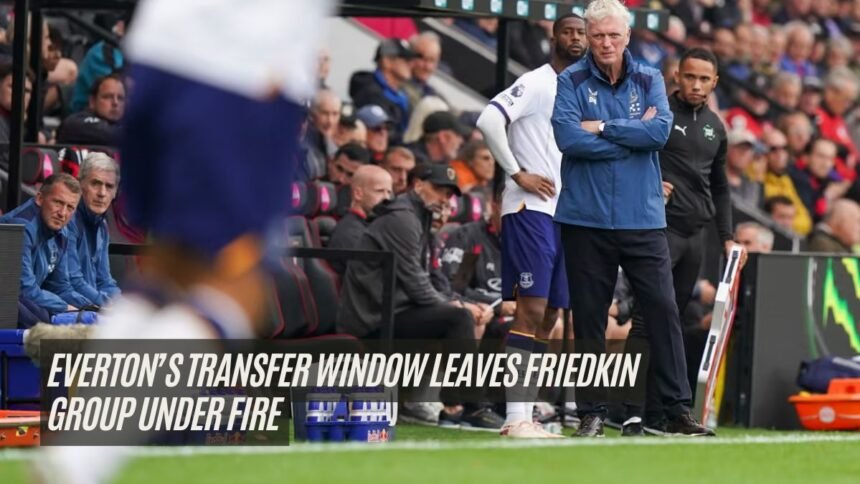
Everton’s summer transfer window has left the Friedkin Group facing uncomfortable questions about its ambition, financial strategy and ability to take the club forward.
The American ownership group arrived at Everton in December 2024 promising a new era after the financial turmoil of Farhad Moshiri’s reign. Since then, it has helped refinance damaging loans and dealt with the long-term repayment burden attached to Hill Dickinson Stadium. Yet four days of extraordinary transfer-market developments have severely damaged the goodwill that accompanied its arrival.
Everton’s supporters have endured the longest trophy drought in the club’s history, and the current ownership now finds itself under growing scrutiny. After all, this is a club that has moved into a new stadium while achieving greater financial stability. Expectations were rising that those developments would eventually be matched by greater ambition on the pitch.
Instead, the final stages of the transfer window produced a sequence of decisions that have left supporters questioning whether the Friedkin Group is genuinely prepared to unlock Everton’s potential.
A New Ownership Already Facing Old Questions
Everton’s chief executive, Angus Kinnear, previously described the Friedkin Group as “winners”. That reputation has taken a considerable hit in a matter of days.
The criticism intensified on Saturday morning when Everton accepted Nottingham Forest’s £35m offer for Harrison Armstrong. It continued when Folarin Balogun ultimately abandoned a proposed £40m move from Monaco on Tuesday night. Between those two incidents came a series of other developments that reinforced the impression of an ownership unwilling or unable to provide the squad with the investment required.
The situation is particularly frustrating because supporters had expected the change of ownership to represent a clean break from the problems of the Moshiri years. Moshiri’s tenure had become synonymous with financial instability, while his attempted sale of Everton to 777 Partners descended into further uncertainty.
There was therefore hope that the Friedkin Group would bring discipline without sacrificing ambition. Instead, deadline day ended with many fans feeling that the club had simply returned to familiar territory.
Moyes Asked for More and Received Less
David Moyes largely avoided making public complaints during pre-season as Everton went about their recruitment. The club spent £16.5m on Hayden Hackney, with the figure potentially reaching £25m after the midfielder’s impressive Championship campaign in which he was named player of the year.
Merlin Röhl and Tyrique George each arrived for £18m, while Christian Nørgaard cost £7m. Everton also completed a swap involving Dwight McNeil and Brennan Johnson. Despite those deals, the club never paid more than £18m up front for any player during the summer.
Moyes eventually made his position clear. He repeatedly emphasized that Everton needed additional players, greater quality and, crucially, to retain the strongest members of his squad.
The numbers demonstrated why.
At the conclusion of last season, Moyes had 22 outfield players available. Deadline day began with that number reduced to 20. When the window finally closed, only 18 remained.
That reduction has left Everton with serious shortcomings in several positions. Thierno Barry is the only recognised striker, there is no obvious reserve option at either full-back position and, in strict positional terms, the squad does not contain a natural right-back because Ainsley Maitland-Niles did not originally play there.
Selling Ndiaye Created Another Problem
One of Everton’s biggest decisions was the sale of Iliman Ndiaye to Manchester City for £65m. The figure was considered below market value, particularly because the Senegal international still had three years remaining on his contract.
Ndiaye had established himself as Everton’s most creative attacking player, making his departure difficult to justify from a footballing perspective unless an adequate replacement was secured.
That replacement never arrived.
Everton also allowed Beto to leave. His importance was obvious because he was the only alternative to Barry in the striker position. Rather than having a new forward ready to step in, the club was left scrambling for another striker after the Balogun deal collapsed.
The pursuit of Balogun itself became increasingly complicated. Manchester United rejected a loan approach for Joshua Zirkzee only hours before the deadline, while Tammy Abraham also declined the opportunity to leave Aston Villa.
Balogun’s situation then added another layer to the drama. He arrived later than Everton had expected for his medical, after which the club renegotiated the financial terms of the transfer with Monaco. Although a deal sheet was signed shortly before 11pm, the striker eventually decided against completing the move.
The consequence is a huge amount of pressure on Barry. The French striker struggled for long periods during his first Premier League campaign and now enters the season as a player Everton can scarcely afford to lose.
Kinnear’s Earlier Optimism Now Looks Different
The club’s transfer strategy had been defended publicly by Kinnear. Two weeks before the deadline, the chief executive gave several interviews to local media in which he offered an optimistic assessment of Everton’s finances, recruitment plans and ambitions.
Events since then have undermined those assurances.
Kinnear also raised expectations by saying that the Friedkin Group considered Everton’s failure to qualify for European competition last season to be “a failure”. He suggested the squad was now in a stronger position to compete for Europe while simultaneously attempting to end the club’s 31-year wait for a major trophy.
Moyes’ team, however, collapsed during the closing weeks of last season. Everton failed to win any of their final seven matches despite having a realistic opportunity to secure European football.
The manager is now being asked to improve on that campaign while working with fewer players.
That contradiction has understandably irritated both Moyes and the supporters. Everton have actually made an encouraging start to the new campaign, but their progress has been overshadowed by problems that appear to have been created within the club’s own hierarchy.
Too Many Decision-Makers, Not Enough Direction
Kinnear was responsible for introducing Everton’s new senior leadership structure and moving the club away from the traditional director of football model.
The current group includes technical director Nick Cox, director of scouting and recruitment James Smith, director of football strategy and analytics Chris Howarth, and head of player trading Nick Hammond. Moyes is also part of the senior leadership team.
Yet the summer has suggested that the group has not always been operating with a unified vision.
There have been some sensible pieces of business. Hackney, Röhl and Johnson represent relatively cost-effective additions with the potential to improve the squad. But the way Everton handled the final days of the window has inevitably raised doubts about the structure’s effectiveness and the expertise within it.
Rather than producing a clear recruitment strategy, the final stages gave the impression of too many voices and insufficient leadership. Some of the players pursued during the closing hours only strengthened that perception.
Armstrong Decision Exposed Financial Pressure
The failed Balogun transfer was undeniably disruptive, but such incidents can happen in football. Players change their minds, medical examinations can uncover problems and negotiations can collapse unexpectedly.
The more serious concern for Everton lies in decisions that were entirely within the club’s control.
Accepting Forest’s £35m offer for Harrison Armstrong was one such decision. The midfielder had become the first Everton academy product since Anthony Gordon to establish himself in the senior team after progressing through the club’s system.
His proposed departure immediately raised questions about Everton’s ability to operate within the Premier League’s new squad cost rules.
It also appeared to contradict the idea that the club had entered a new financial era following its move to Hill Dickinson Stadium.
The Friedkin Group did eventually respond to supporter pressure by abandoning the proposed Armstrong sale, which deserves some recognition. However, that goodwill was quickly undermined by reports that Everton were willing to sell Ndiaye to Tottenham for £60m while simultaneously considering spending £35m to bring Richarlison back.
For supporters, the numbers and priorities were difficult to reconcile.
Right-Back Problem Was Never Resolved
Everton’s need for a right-back was hardly a surprise. Moyes had been searching for one since returning to the club in January 2025, and the position had already required attention before his arrival.
The manager identified Guéla Doué of Strasbourg as a preferred target, but Everton decided the 23-year-old was too expensive. Bayer Leverkusen subsequently signed Doué on deadline day for £25.7m.
Everton examined at least five alternatives before turning to Fulham’s Kenny Tete. That move also collapsed after the clubs failed to complete a £9m agreement.
The eventual solution was Maitland-Niles, who cost £4.3m and was recruited to address one of the squad’s most obvious weaknesses.
It was an inexpensive answer, but the prolonged search illustrated the difficulties Everton encountered in an area that had been identified as a priority for some time.
Striker Recruitment Was Even More Concerning
The situation in attack was arguably harder to defend.
A Premier League side with serious ambitions would not normally begin a second campaign with only Beto and Barry as its recognised striking options. Strengthening that area was therefore essential.
Instead, Everton finished the window without replacing Beto and without adding the upgrade Moyes wanted.
In effect, the squad became weaker in one of the positions that most needed improvement.
That outcome sits uneasily alongside Kinnear’s previous comments about European ambitions and the Friedkin Group’s desire to challenge for success. For supporters, it represents perhaps the clearest gap between the club’s stated objectives and its actions.
Everton Still Operate on a Tight Budget
The broader financial picture explains part of Everton’s caution.
Over the past five years, Everton have recorded the lowest net spending in the Premier League. This summer, the club actually finished with a transfer profit of £25m.
Total spending on new signings reached £78m. Football finance expert Kieran Maguire calculated that the average Premier League club spent approximately £181m over the same period.
Those figures place Everton well below the level of investment seen across the division.
The £78m figure also does not include the significant financial commitment involved in bringing Jack Grealish back to the club on loan.
The Friedkin Group’s cost-cutting approach has extended beyond the transfer market. Everton made redundancies behind the scenes during the summer, contributing to speculation that Dan Friedkin and his associates could eventually look to sell the club.
However, there are also signs that the ownership remains prepared to spend money on Everton.
The group has set aside £40m to cover potential compensation owed to Burnley if Everton lose their appeal against the outcome of a profitability and sustainability regulations case. In addition, almost £14m is being invested in infrastructure projects involving Hill Dickinson Stadium, Goodison Park and the Finch Farm training ground.
Supporter Anger Is Growing
Whatever the ownership’s long-term intentions, one thing is already clear: supporters are increasingly unhappy.
If Dan Friedkin were to attend Sunday’s home fixture against Manchester United, he would likely face a hostile atmosphere. The American owner has yet to attend a match at Hill Dickinson Stadium, despite some season-ticket prices increasing by as much as 10% this season.
Supporter organisations have now openly criticized the club.
The Everton fans’ forum and Everton Fan Advisory Board released statements on Wednesday attacking what they viewed as an amateurish and insufficiently ambitious transfer strategy.
The 1878s, the volunteer group responsible for the club’s striking tifos and banners, has also withdrawn its support for the foreseeable future.
The group said it no longer believed the ambitions of Everton’s supporters and those of the club were aligned, arguing that the events of deadline day had only reinforced that view.
For an ownership group that arrived promising stability after years of turmoil, losing the confidence of supporters so quickly represents a significant setback.
Everton may have a new stadium, a more stable financial foundation and a manager with considerable experience. But the transfer window has raised fresh doubts about whether those foundations are being matched by sporting ambition.
For the Friedkin Group, Kinnear and Everton’s senior leadership team, rebuilding trust with the fanbase now looks like a much longer task than it did only a few weeks ago.