





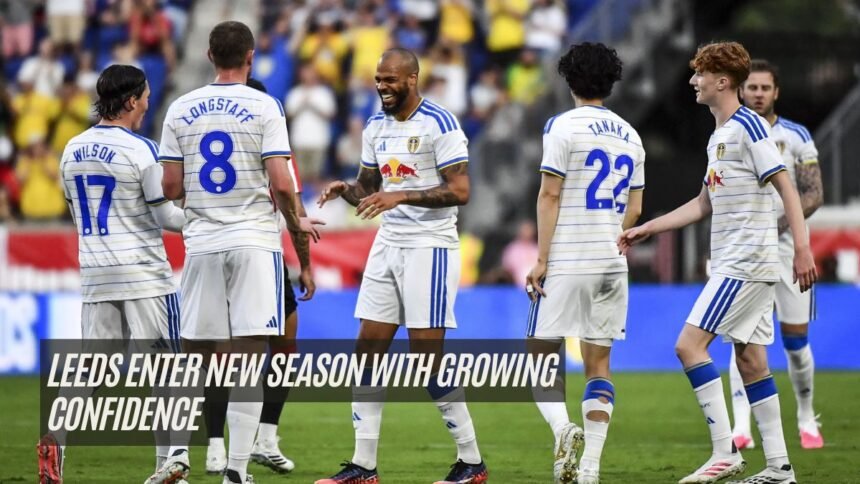
Leeds United appear to have plenty of reasons for optimism heading into the new Premier League campaign. After finishing 14th last season and reaching the FA Cup semi-finals, Daniel Farke has already demonstrated that his side can compete at this level. The Guardian’s writers have collectively placed Leeds 12th in their predicted table, although that figure represents the average prediction rather than Louise Taylor’s individual view.
The second season after promotion is often considered a particularly difficult stage for newly established Premier League teams. Leeds, however, look well positioned to challenge that assumption. The foundation of Farke’s squad has become considerably stronger, with the defence receiving further investment through the club-record £40m acquisition of James Trafford from Manchester City and the £34m arrival of Bosnia and Herzegovina defender Tarik Muharemovic from Sassuolo.
Much of Leeds’ attacking potential could depend on Dominic Calvert-Lewin maintaining his fitness. The striker produced stretches of outstanding form last season, at times proving almost impossible for opponents to contain as Leeds secured a respectable 14th-place finish. His task could become easier this season with Harry Wilson now providing another creative outlet after arriving from Fulham on a free transfer.
Leeds’ eventual survival last term was particularly noteworthy because their campaign initially looked far less secure. By November, an inconsistent run had even put Farke’s position under serious pressure. A tactical adjustment that saw the side operate largely in a 3-5-2 system transformed their fortunes.
Their improvement after that change was striking. From the beginning of December onwards, Leeds would have ranked seventh if the Premier League had maintained a separate table for the second half of the campaign. That late-season momentum offers genuine encouragement, although Farke is aware that pre-season performances do not always translate into competitive results.
Even so, Leeds have produced encouraging displays against strong opposition during their preparations. Farke believes those matches have helped build confidence within the squad.
The manager is targeting what he describes as a move to “a new level”, but he has resisted suggestions that Leeds should immediately be discussing European qualification or silverware. Farke has stressed the importance of remaining realistic, pointing out that Leeds’ best Premier League finish over the past 25 years has been ninth.
His message is therefore one of ambition tempered by patience. The dangers associated with a second season after promotion remain obvious, but Farke believes Leeds have enough quality to make significant progress without getting carried away.
Elland Road transformation
Away from the pitch, one of the most significant developments at Leeds is taking place around Elland Road. The historic stadium, renowned for its atmosphere but increasingly dated in infrastructure, is undergoing a major redevelopment backed by 49ers Enterprises, the investment group associated with the NFL’s San Francisco 49ers.
The project is expected to raise the stadium’s capacity from 37,792 to around 53,000. Increasing the number of supporters able to attend matches is only part of the objective. Leeds also want the modernised ground to generate greater commercial income, potentially giving the club more financial flexibility within football’s spending regulations.
Another motivation is the club’s lengthy season-ticket waiting list, which the expanded stadium could help address.
Importantly, Elland Road is expected to continue hosting matches throughout the construction process. The redevelopment forms part of a broader regeneration vision for the surrounding area and is intended to become a major focal point for the project.
There is, however, concern over the transport infrastructure around the stadium. Plans for a new tram system in Leeds have suffered further delays, while public transport in the area is already limited. Given the congestion that regularly affects this part of the city, handling match-day traffic could become considerably more difficult once the ground is operating at a much larger capacity.
Relationship between owners and supporters
The relationship between Leeds’ ownership and supporters can currently be described as positive.
The club experienced several changes in direction under previous owners, making the stability provided by 49ers Enterprises particularly significant. The California-based group has brought what is generally viewed as a more professional and structured approach.
Its ambitions are also increasingly visible. Trafford’s record transfer, the redevelopment of Elland Road and stronger commercial revenues all point towards a long-term strategy aimed at improving Leeds’ position.
The club’s senior leadership team is regarded as practical and competent. Chairman Paraag Marathe works alongside managing director Robbie Evans and sporting director Adam Underwood, with the trio generally seen as capable of pursuing growth while remaining mindful of football’s financial regulations.
The man in charge
Farke remains one of the more distinctive figures in the Premier League managerial landscape.
The German has joked that his personality is roughly “95% coffee and cake on the sofa and 5% fire beast”. His background is equally unusual. A graduate in economics, Farke initially imagined a career as a sporting director before spending time as a lower-league striker in Germany and later moving into management.
Now 49, he has developed a reputation as an intelligent and thoughtful coach with an engaging personality, a strong sense of humour and an appreciation for literary fiction.
Last season also helped reshape the perception of his managerial career. Farke had previously been associated with the idea of being a “trampoline man”, an unfair description suggesting that his teams were destined either to win promotion or suffer relegation. Guiding Leeds to 14th in their first season back in the Premier League, while also taking them to the FA Cup semi-finals, provided a useful counterargument.
Farke has developed close links with coaches such as Pep Guardiola, Jürgen Klopp and Thomas Tuchel, while describing himself as a football romantic who has learned to balance idealism with practical demands.
His preferred approach is usually built around controlling possession, but he insists that tactical principles cannot come at the expense of what a particular match requires. That flexibility could prove crucial as Leeds attempt to move beyond simple survival.
Key arrival: Tarik Muharemovic
One of Leeds’ biggest pieces of business this summer has been the £34m signing of Tarik Muharemovic from Sassuolo.
The 23-year-old left-footed centre-back has made a particularly strong impression during pre-season. His arrival gives Farke another defender capable of combining physical strength with controlled aggression, while his ability in possession adds another dimension to Leeds’ build-up play.
Supporters have already embraced Muharemovic, with his pre-season clash involving Sunderland striker Brian Brobbey becoming a particularly memorable moment. The Bosnian defender’s willingness to compete physically has quickly earned him the nickname “Bosnian King” among sections of the Leeds fanbase.
Muharemovic previously helped Sassuolo secure promotion from Serie B before playing a significant role in their mid-table Serie A campaign last season. His versatility should also benefit Farke, as he is comfortable operating either within a back three or in a conventional four-man defence.
His early performances suggest Leeds may have found exactly the type of defensive reinforcement they needed. Further forward, Wilson’s arrival could provide another reason for optimism.
Trafford ready for a bigger stage
Leeds also appear to have struck an important deal by bringing James Trafford back into the spotlight.
The 23-year-old England international is currently behind Jordan Pickford in Thomas Tuchel’s squad, but his performances for Burnley in the Championship established his credentials. He was also widely considered unfortunate to spend last season as Manchester City’s second-choice goalkeeper.
Trafford’s ability with the ball at his feet is particularly attractive to Farke. His distribution should complement a team that wants to control possession, while his composure and overall quality could make a difference in tight matches.
Leeds will hope his presence can translate into points across the season, particularly in games where a goalkeeper’s individual performance can determine the outcome.
Trafford’s background adds another interesting element to his story. The son of a Cumbrian farmer, he still makes time to help with lambing when possible. Now, however, he appears ready for a much larger footballing stage and an opportunity to establish himself among England’s leading goalkeepers.
International tournament effects
Leeds’ squad also includes players whose summers were shaped by international football.
Noah Okafor finished the previous campaign strongly with Leeds, but his involvement at the World Cup was limited. The versatile attacker played only 25 minutes, appearing as a substitute against Algeria, as Switzerland advanced to the quarter-finals before Argentina ended their run.
Okafor’s inclusion in Murat Yakin’s Switzerland squad had generated some surprise because of the player’s previous disagreement with the national-team coach. His limited involvement suggested that, despite earning selection, he had not completely convinced Yakin.
Brenden Aaronson had a more positive experience with the United States. The Americans reached the last 16, although Aaronson made only one appearance during the tournament.
The Leeds attacking midfielder had also briefly stepped away from the United States’ pre-tournament camp in late May. The reason was a happier one: Aaronson returned to the group after marrying his long-term partner, Milana D’Ambra, in a wedding that had been planned well in advance.
With key additions, an improving squad and the confidence generated by last season’s recovery, Leeds begin the new campaign with considerably more than survival on their minds. Farke’s challenge will be to turn that optimism into sustained Premier League progress while keeping the club’s ambitions grounded in reality.