






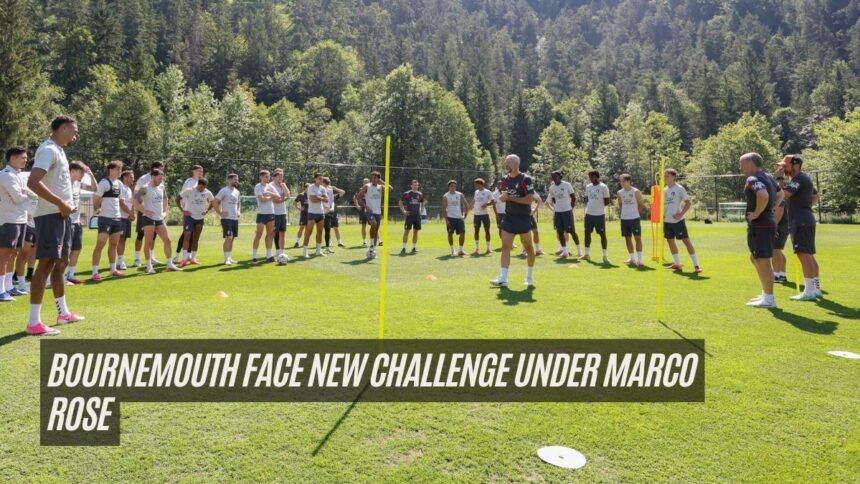
The transition at Bournemouth was unusually cordial. The morning after the final match of last season, Andoni Iraola remained at the club’s secluded training complex on his final day before departing. Rather than simply clearing his office and leaving, the outgoing manager spent around two hours with his replacement, Marco Rose, discussing everything from the squad and tactical ideas to local pubs.
Eventually, sporting director Tiago Pinto interrupted the conversation, reminding the pair that there were other matters requiring their attention. The scene was a telling reflection of the relationship between two coaches whose football philosophies have significant similarities.
Iraola had admired Rose’s Borussia Mönchengladbach team well before his own arrival in England. Rose’s emphasis on attacking vertically helped Gladbach reach the Champions League during his first campaign in charge, making the German coach an important influence on Iraola.
Rose, meanwhile, knows exactly how difficult it will be to follow Iraola. Bournemouth lost several important players for a combined fee exceeding £250m last season, yet still secured European qualification for the first time in the club’s history. Their form became even more impressive after Antoine Semenyo departed in January, with Bournemouth going unbeaten for the remainder of the season.
“It will be difficult to improve on what Andoni achieved,” Rose said during pre-season in Austria. “The pressure is on.”
Europe Raises the Stakes
Rose made his admiration for Bournemouth’s attacking approach clear during his first training session with the squad. He told the players he appreciated the way they had taken on Premier League opposition throughout the previous campaign.
The Europa League, however, introduces a completely different challenge. Bournemouth were playing in England’s second tier only four years ago, and European football will force the club to adapt to a demanding Thursday-to-Sunday schedule.
To prepare, Bournemouth sought advice from Crystal Palace and Nottingham Forest, two clubs familiar with the demands of balancing domestic football and European competition. Rose has a close friendship with Forest manager Oliver Glasner, while Palace lifted the Conference League last season.
Rose has no intention of treating Europe as a reward for last season’s success.
“We are not going to Europe just to enjoy it,” he said. “We want to be competitive.”
Key Players Stay, But Kroupi Is Injured
One major difference from last summer is Bournemouth’s ability to retain their leading players. Alex Scott, Rayan and Eli Junior Kroupi all remained at the club, with Kroupi particularly regarded as one of Bournemouth’s most valuable long-term prospects.
The 20-year-old forward scored more than 10 goals during his first Premier League season and attracted considerable attention from Paris Saint-Germain and other major European clubs. His progress has now been interrupted by an unfortunate foot injury suffered during a pre-season training exercise. Bournemouth expect him to miss at least three months.
The club had already identified two major recruitment priorities before the transfer window: another centre-back following Marcos Senesi’s departure and a forward capable of challenging Evanilson for a starting role.
By early August, both positions had been addressed. Álvaro Rodríguez arrived from Elche, while António Silva joined from Benfica. Rose had previously wanted Rodríguez during his time at Leipzig.
Bournemouth also strengthened at right-back with the arrival of Juanlu Sánchez from Sevilla. The Spaniard will provide competition for Adam Smith, whose remarkable longevity has taken him into his 14th season with the club at the age of 35.
Sánchez also helps compensate for the absence of Álex Jiménez. The latter moved to Fiorentina on loan with an option for a permanent transfer, while he remains suspended from playing in England during a Football Association investigation.
The Work Beyond the Pitch
Bournemouth’s rise has required substantial changes away from the playing field as well.
The club’s 11,357-capacity stadium, the smallest venue in the Premier League, has undergone extensive work this summer to satisfy UEFA requirements ahead of European competition. Every seat is being replaced, while both corners are being filled in as part of an expansion that will add approximately 800 places during the current season.
European qualification also creates financial challenges. UEFA’s squad-cost ratio regulations limit clubs to spending no more than 70% of their revenue on on-pitch costs. Bournemouth ended the 2025-26 campaign at 82%, meaning significant work remains before they reach the required level.
There has been progress elsewhere, however. Bournemouth’s academy received Category One status last month, only four years after operating at Category Three level.
Foley’s Ambition Continues
Bill Foley’s ownership has transformed expectations around Bournemouth. The American billionaire once described himself as a dictator after purchasing the club nearly four years ago, but his aggressive ambition has largely been embraced by supporters.
Foley, whose fortune was built in the insurance industry, has repeatedly set bold targets and then delivered them ahead of schedule. In 2023, he predicted Bournemouth would reach European competition within five years. They managed it in just three.
A similar prediction surrounded the Vegas Golden Knights. When Foley launched the NHL franchise in 2017, he said the team would win the Stanley Cup within six years. Vegas achieved that goal during its sixth season.
His sporting portfolio has since expanded further, with rugby union side Exeter Chiefs joining Lorient, Auckland FC and Moreirense.
Not every decision made under Foley has been universally welcomed, but the owner continues to back his ambitions financially. He turns 82 in December and spends most of his time between California and Las Vegas.
Rose Takes the Reins
Marco Rose’s coaching education began long before he reached the Premier League.
During his playing days as a defender, he worked under prominent coaches including Jürgen Klopp and Thomas Tuchel at Mainz, as well as Ralf Rangnick at Hannover. After retiring from playing, Rose began his coaching career with hometown club Lokomotive Leipzig.
Klopp had already predicted Rose would succeed as a manager after Leipzig reached the Bundesliga in 2004. Since then, Rose has worked with some of European football’s biggest talents, including Erling Haaland and Jude Bellingham at Borussia Dortmund and Dominik Szoboszlai and Dani Olmo at RB Leipzig.
His football is often compared with Klopp’s and, naturally, Iraola’s because of its intensity and aggressive approach.
Bournemouth’s 10-1 pre-season victory over Genoa prompted questions about whether Rose could take that philosophy even further. His response was measured.
“Being more aggressive than Andoni is quite difficult,” Rose said.
There is also football heritage in the family. Rose’s grandfather, Walter Rose, represented Germany in 1937.
António Silva Looks Like a Smart Investment
The current transfer market has made £50m a common benchmark for top-level defenders. Tottenham spent £52m on Jan Paul van Hecke, while Chelsea paid an identical fee for Maxence Lacroix from Crystal Palace.
Bournemouth themselves received £50m when Dean Huijsen moved to Real Madrid last year, although that transfer was triggered by a release clause.
Against that backdrop, the £25.7m Bournemouth spent on António Silva appears particularly attractive. The 22-year-old has established himself at Benfica since breaking into their first team and already possesses experience in the Champions League and Europa League.
Silva has also earned 20 caps for Portugal. Although naturally right-footed, he is comfortable operating as a left-sided centre-back, making him a natural replacement for Senesi.
For Bournemouth, the deal could prove one of the more shrewd pieces of business of the summer.
Bournemouth’s Attack Has Multiple Weapons
The numbers underline why Bournemouth were so difficult to contain last season.
They scored nine goals from counterattacking situations, according to Opta’s definition, matching the Premier League’s highest total in that category.
Yet their attacking threat was not dependent solely on transitions. Set pieces were another major source of goals, with Bournemouth finding the net 14 times from dead-ball situations during the 2025-26 campaign.
Only twice in their previous eight Premier League seasons had they recorded a higher set-piece tally.
Producing such strong numbers from both counterattacks and set plays is unusual, highlighting the variety in Bournemouth’s attacking game.
Gannon-Doak Ready for a Bigger Role
For Ben Gannon-Doak, Scotland’s World Cup qualification created mixed emotions.
The country’s return to the tournament for the first time in 28 years should have been a moment of celebration, but the Bournemouth winger suffered an injury during the November match and had to leave the field after only 21 minutes. Kenny McLean replaced him and later completed Scotland’s scoring in memorable fashion.
Gannon-Doak joined Bournemouth from Liverpool for £25m last August. He subsequently appeared in all three of Scotland’s World Cup matches, starting the opening and closing fixtures.
His performances during pre-season have provided further encouragement. Last season, his opportunities were limited to eight league appearances from the bench, amounting to only 113 minutes.
That is expected to change. With greater trust from Rose and a strong pre-season behind him, the 20-year-old is viewed as a player capable of making a significant impact.
Bournemouth’s World Cup Connections
Several Bournemouth players and staff members also left their mark on the World Cup.
Rayan made history by becoming the first Brazilian teenager to start a World Cup match since Marco Antônio in 1970. The 19-year-old was selected by Carlo Ancelotti for Brazil’s Group C meeting with Scotland.
Having joined Bournemouth from Vasco da Gama in January, Rayan played a role in Brazil’s opening goal, supplying the assist for Vinícius Júnior during the 3-0 victory. After the match, he exchanged shirts with Gannon-Doak.
Tyler Adams was another Bournemouth player whose reputation benefited from the tournament, impressing as the United States progressed to the last 16.
The club’s coaching staff also had international representation. Set-piece specialist Nicolas Gagnon worked with Canada, while goalkeeping coach Frederic de Boever was part of Belgium’s setup.
Alex Scott’s invitation to Thomas Tuchel’s pre-World Cup training camp in Florida provided another indication of his growing reputation. The Guernsey-born midfielder’s selection reflected how highly he is regarded beyond the confines of Bournemouth.
For Rose, the challenge now is to bring all those emerging talents, established players and new arrivals together as Bournemouth enter a season unlike any they have experienced before.