






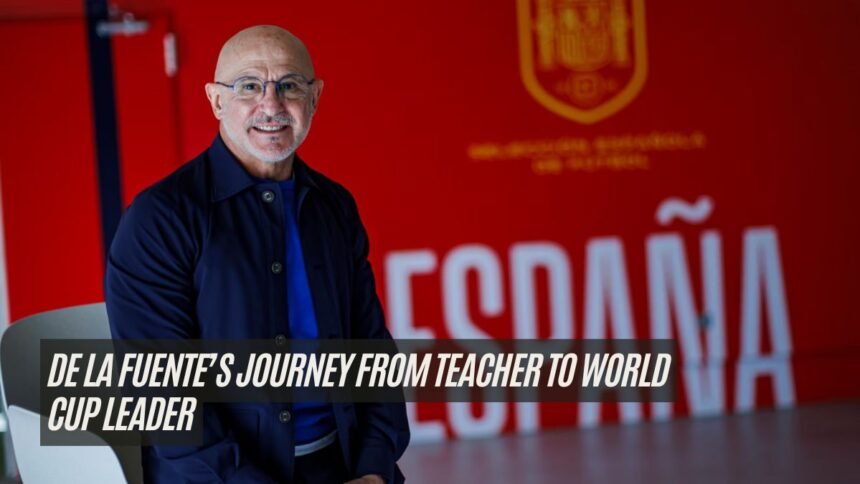
Walk through the headquarters of the Spanish Football Federation in Las Rozas and visitors will find walls covered with photographs of every player who has represented Spain at senior level. More than 800 faces fill the corridors and classrooms, creating a visual history of the national team.
One notable absence, however, is the man currently in charge of Spain’s World Cup campaign. Luis de la Fuente never reached the senior national side during his playing career, stopping at under-21 level. His image is therefore missing from the collection, although he jokes that it would at least serve as a reminder of the long hair he once had.
Despite not appearing on those walls, few people know the building better than he does. Long before becoming Spain’s head coach, De la Fuente spent years teaching there. In many ways, he believes he was also a student throughout that period, learning as much from those around him as they learned from him.
Preparing for the Biggest Stage
As Spain’s squad assembled ahead of their trip to Chattanooga, De la Fuente found himself balancing excitement with careful planning. Players arrived in stages, depending on their club commitments, allowing the coaching staff to assess fitness levels and manage workloads.
The 2024 European Championship-winning manager admits the anticipation is enormous. Reaching a World Cup with Spain is a source of personal pride, particularly considering the route he has taken to get there.
Recent weeks have also highlighted the influence of Spanish coaching across world football. While players such as Fabián Ruiz, David Raya and Martín Zubimendi were involved in major international fixtures, Spanish managers continued making headlines elsewhere.
Former Spain boss Luis Enrique remains among the game’s respected figures, while Mikel Arteta continues to thrive in England. Iñigo Pérez recently guided Rayo Vallecano into a European final, Unai Emery added another continental trophy to his collection, and Pep Guardiola departed after leaving a lasting mark on the Premier League. Meanwhile, Xabi Alonso and Andoni Iraola secured high-profile appointments at elite clubs.
For De la Fuente, none of this is accidental.
The Strength of Spain’s Coaching System
According to the Spain manager, the country’s coaching success is the result of decades of structured development.
He argues that Spanish football has long possessed an outstanding educational framework, supported by regional and national coaching schools. While recent trophies have brought greater attention to that work, he believes the foundations were already in place years ago.
Having spent considerable time inside that system, De la Fuente witnessed its evolution firsthand. He sees a shared football culture connecting many of Spain’s most successful coaches, regardless of where their careers eventually took them.
Several of today’s prominent managers once sat in classrooms where De la Fuente taught. Among them were Xabi Alonso and Andoni Iraola. So too was Argentina coach Lionel Scaloni, who will arrive at this summer’s World Cup as the defending champion.
Lessons Shared With Future Champions
Between 2017 and 2020, while overseeing Spain’s youth teams, De la Fuente also taught on the federation’s UEFA Pro Licence programme. His subjects included football’s tactical development and methods of building effective teams.
The list of students who passed through those courses reads like a football hall of fame. Scaloni attended alongside future Women’s World Cup-winning coach Montse Tomé. Former Spain stars such as Xavi Hernández, Raúl, Victor Valdés, Joan Capdevila, Albert Riera and many others also participated.
De la Fuente recalls distinct personalities within the classroom. Capdevila often provided comic relief, while Scaloni constantly challenged ideas and encouraged debate.
Looking back, he believes some students displayed qualities that hinted at future success. Scaloni, in particular, impressed him with his curiosity and willingness to question established thinking.
The similarities between their careers are not lost on him. Both men progressed from youth football to senior international management and both faced intense pressure to deliver immediate results.
A Special Bond With Scaloni
The relationship between teacher and student has evolved into one between two international champions.
Within a few years of those coaching classes, De la Fuente led Spain to European glory while Scaloni guided Argentina to major international titles. A planned reunion during the Finalissima never materialised due to scheduling complications linked to geopolitical circumstances.
De la Fuente regrets that the match did not happen but remains hopeful of meeting Scaloni during the World Cup.
Football, he believes, has a unique ability to unite people from different backgrounds, cultures and beliefs. The opportunity to embrace an old student on football’s biggest stage would be particularly meaningful.
Learning From Those He Taught
Although he served as an instructor, De la Fuente insists the educational experience worked both ways.
He credits his students with broadening his perspective and keeping him intellectually engaged. Discussions with figures such as Alonso, Xavi, Raúl and Scaloni challenged him constantly, forcing him to refine his ideas and communicate them more clearly.
Every class became an exchange of knowledge rather than a one-way lecture. The pressure of meeting the expectations of such accomplished football minds often pushed him to improve.
For that reason, he considers learning an endless process that extends far beyond football itself.
While trophies eventually fade into memory, he says the impact of education remains. That belief has shaped his approach throughout his coaching career.
More Than Just a Manager
One of the values De la Fuente emphasizes most is respect.
During conversations, he often highlights simple gestures such as saying “please” and “thank you,” believing they help establish standards within a group.
Many members of Spain’s current squad have known him since their youth international days. Players including Álvaro Morata, Dani Carvajal, Unai Simón, Fabián Ruiz, Marc Cucurella, Mikel Merino and Mikel Oyarzabal developed under his guidance long before reaching the senior side.
Because of those longstanding relationships, he views his role as extending beyond tactics and team selection.
The atmosphere inside the squad is equally important. De la Fuente wants players to think collectively rather than individually, creating a culture built on trust and responsibility.
He sees similarities between the current group and the Spain side that conquered the 2010 World Cup. Conversations with former coach Vicente del Bosque have reinforced that impression, particularly regarding the unity within the dressing room.
Managing the Rise of Lamine Yamal
No player embodies Spain’s future more than Lamine Yamal.
The winger first joined the national team setup at just 16 years old while still balancing school examinations with international football. Now 18, he arrives at the World Cup regarded by many as one of the finest players on the planet.
His build-up to the tournament has not been straightforward. A hamstring injury kept him out of action since April, creating uncertainty about his availability.
De la Fuente remains optimistic, noting that Yamal’s recovery has progressed faster than expected. Even so, the coaching staff will carefully assess whether he should start immediately or be eased back into action.
The manager also stresses the importance of psychological support. Spain’s sports psychologist, Javier López Vallejo, plays a key role in helping players handle the enormous pressures that accompany elite football.
Talent Alone Is Not Enough
De la Fuente believes football success requires much more than technical skill.
In his view, character, discipline and emotional resilience are just as important as natural ability. That is why he values good people as highly as good players when building a squad.
Veteran players are expected to guide younger teammates and reinforce standards within the group. Such leadership becomes effective only when relationships are built on mutual respect and trust.
When discussing Yamal specifically, De la Fuente describes him as someone naturally equipped to handle extraordinary attention. The teenager’s maturity, despite relentless scrutiny, continues to impress him.
Many gifted prospects fail to fulfil their potential, he notes, because football demands excellence in countless areas beyond what happens on the pitch.
Comparing Generations
As conversations turn to football’s greatest players, De la Fuente reflects on several legends he has witnessed across different eras.
Johan Cruyff remains one of his personal favourites, while seeing Diego Maradona perform left a lasting impression. Yet he also acknowledges the extraordinary achievements of both Lionel Messi and Cristiano Ronaldo.
Modern football, he argues, differs significantly from the game he played. Training methods, pitches, equipment and lifestyles have all changed dramatically.
He laughs while recalling the routines of his Athletic Bilbao days, when players would finish training, gather for food and drinks, rest, and then play matches the following day.
Despite embracing modern developments, De la Fuente still considers himself a coach with traditional football values. Experience has provided him with better tools to implement his ideas, but his fundamental belief remains unchanged.
For Spain’s World Cup coach, growth never ends. Whether as a teacher, a student or a manager, he insists there is always something new to learn.