






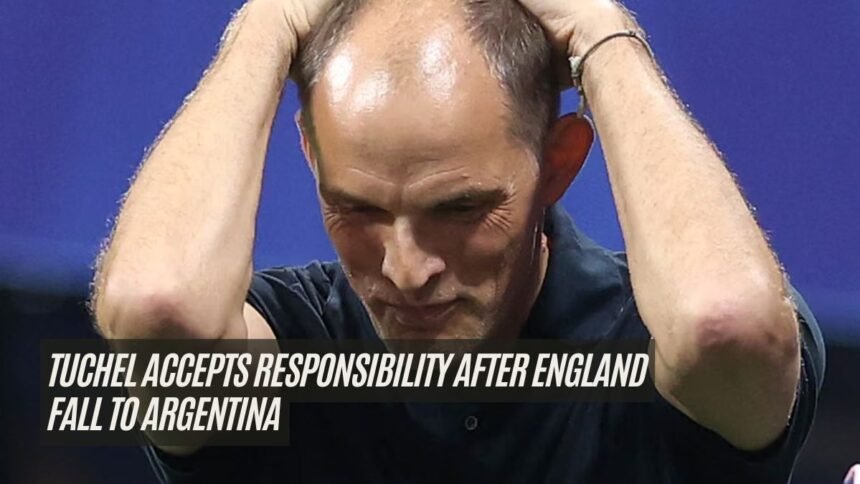
Thomas Tuchel admitted that his own decisions contributed to England’s heartbreaking World Cup exit after Argentina produced another remarkable comeback to secure a place in the final.
England looked set to make history by reaching their first men’s World Cup final played outside home soil. Anthony Gordon gave the Three Lions the breakthrough shortly after the restart, but the momentum shifted dramatically in the closing stages. Enzo Fernández restored parity with a powerful strike before substitute Lautaro Martínez completed the turnaround in the second minute of stoppage time, booking Argentina’s meeting with Spain in Sunday’s final in New York.
England Lost Control After Taking the Lead
The final whistle brought scenes of devastation for England. Several players collapsed onto the pitch, overwhelmed by the result. Captain Harry Kane gathered his teammates before leading them toward the travelling supporters in appreciation of their backing, while Jude Bellingham struggled to contain his emotions.
On the opposite side, Lionel Messi celebrated another major milestone. The Argentina captain dropped to his knees before punching the air after confirming his country’s place in a second consecutive World Cup final.
Tuchel’s substitutions quickly became a major talking point. Only three minutes before Fernández found the equaliser, the England manager withdrew Declan Rice and Reece James while reshaping his side into a five-man defence. Looking back afterward, the German coach admitted the tactical switch failed to produce the intended outcome.
Tuchel Takes Full Responsibility
Speaking after the defeat, Tuchel explained that England altered their defensive setup because the spaces between the lines had become increasingly difficult to manage.
He said Argentina raised both the tempo and intensity of the contest, taking greater risks as they chased the game. According to Tuchel, the South Americans played with freedom because they no longer felt constrained by the scoreline, while England became increasingly cautious after moving ahead.
The England manager acknowledged that responsibility ultimately rests with him whenever tactical decisions fail.
Mentality Not the Main Issue
Despite another painful defeat after holding a lead, Tuchel dismissed suggestions that England’s recurring problems stem from a long-standing psychological weakness.
He argued that similar disappointments have happened under different managers, with different squads and in completely different circumstances, making it difficult to attribute the pattern to a single explanation.
Instead, Tuchel believed his team lost control because they stopped playing proactively once they were in front.
He accepted that many observers would question his tactical calls after the match but insisted that decisions must be made in real time from the touchline. Regardless of outside criticism, he accepted full accountability for the outcome.
Although disappointed, Tuchel said he had no immediate regrets about his players’ effort. He felt England deserved their advantage after producing one of their strongest displays since his appointment and believed the team had performed at a very high level before ultimately failing to finish the job.
Argentina Dominated the Closing Stages
The statistics highlighted England’s dramatic retreat after Gordon’s opener. Between taking the lead and conceding the decisive goal, Tuchel’s side managed only 12 percent possession as Argentina increasingly dictated the match.
Harry Kane admitted England struggled to cope with the relentless pressure.
The captain described the defeat as heartbreaking for everyone connected with the squad, including the players, coaching staff and supporters. Kane believed England performed well for much of the contest but admitted the team’s approach changed after going ahead.
Rather than continuing to attack, England focused on protecting the lead. At the highest level, Kane said, simply trying to survive is rarely enough. Argentina continued committing players forward, creating repeated attacks, while England spent long periods defending deep and blocking shots before eventually being punished.
Tempers Flare After Full-Time
Emotions remained high once the match had ended.
Jude Bellingham appeared to strike Argentina substitute Valentín Barco on the back of the head during an altercation following the final whistle. England reserve goalkeepers Dean Henderson and James Trafford intervened to separate the players, and no disciplinary action was taken by the match officials.
Elsewhere, Manchester United defender Lisandro Martínez celebrated Argentina’s victory by displaying a banner carrying the message “Las Malvinas son Argentinas,” referring to the long-standing dispute surrounding the Falkland Islands.
Argentina’s Belief Never Wavered
Argentina had already demonstrated their resilience earlier in the tournament by recovering from a two-goal deficit to eliminate Egypt in the round of 16, and Lautaro Martínez said that fighting spirit remained central to the squad’s mentality.
The striker felt England pressed aggressively for around an hour but believed the game changed after Gordon’s goal. According to Martínez, England’s deeper defensive position allowed Argentina to circulate possession more comfortably and stretch the play, eventually creating the opportunities needed to complete another comeback.
Scaloni Praises His Players’ Character
Argentina head coach Lionel Scaloni reserved special praise for the determination shown by his squad.
Scaloni said his team consistently responds best when facing adversity and believed the players sensed an opportunity once England had taken the lead. Even though several chances failed to find the net, Argentina continued attacking without losing belief.
For Scaloni, the comeback reflected far more than tactical adjustments. He described it as proof of the passion and commitment his players have whenever they represent their country, insisting that their resilience ultimately carried them into another World Cup final.