





For much of the campaign, Arsenal built their reputation on defensive resilience, physical dominance and an ability to turn dead-ball situations into decisive moments. It felt fitting that such elements would influence the biggest match of their season. What nobody in north London wanted, however, was for the story to conclude in such painful fashion.
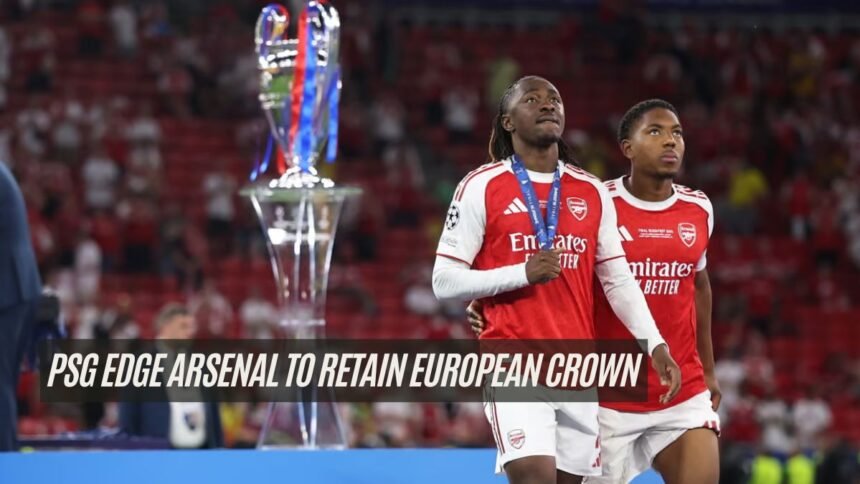
At the end of a dramatic Champions League final at Budapest’s Puskas Arena, Paris Saint-Germain successfully defended their European title by defeating Arsenal in a penalty shootout. The contest stretched over three exhausting hours filled with tactical duels, momentum swings and relentless pressure, eventually ending 1-1 before spot-kicks settled the outcome.
The occasion carried an almost surreal intensity. As the evening unfolded, time seemed to disappear inside the vast stadium. The atmosphere remained constant, a continuous wave of noise echoing around the arena as red, blue and white shirts battled for control of European football’s greatest prize.
By the time penalties arrived late in the evening, the match had already produced countless memorable scenes. Arsenal goalkeeper David Raya was repeatedly attended to by coaching staff during breaks in play, receiving instructions, treatment and hydration as every detail became crucial in the search for victory.
On the touchline, Mikel Arteta lived every second of the final. The Arsenal manager rarely stopped moving, constantly urging his players forward, crouching, shouting instructions and reacting to every challenge. His trademark intensity never faded, even as the contest moved deeper into extra time.
PSG Prove Their Quality Once Again
While Arsenal will leave Hungary heartbroken, PSG fully justified their status as champions. Retaining the trophy required them to overcome one of Europe’s most disciplined and determined sides.
The French club ultimately prevailed because they matched Arsenal’s aggression and organisation while finding moments of quality when they mattered most. Every attacking move, every successful dribble and every opening came at a cost against an Arsenal team determined to make life as difficult as possible.
The final also served as a reminder of football’s enduring appeal. Despite modern demands for instant entertainment, matches of this magnitude still reward patience. The tension built slowly, every phase carrying significance until the smallest details ultimately decided the destination of the trophy.
Young Arsenal Side Earns Respect
Although defeat will sting, Arsenal supporters can take pride from the performance of a youthful squad that included five English players. Arteta’s tactical approach stood up against elite opposition, and several individuals emerged with enhanced reputations.
Among them, Myles Lewis-Skelly delivered perhaps the most impressive display of his young career. Tasked with competing against one of Europe’s strongest midfields, the teenager showed maturity far beyond his years.
Facing Vitinha on the grandest stage in club football would challenge even experienced internationals, yet Lewis-Skelly handled the responsibility superbly. His influence went beyond statistics. Intelligent positioning, relentless energy and a constant willingness to provide passing options made him one of Arsenal’s standout performers.
Several moments highlighted his quality. He drove forward confidently from midfield during the first half and later produced a remarkable recovery run to dispossess Désiré Doué in the closing stages. Alongside Declan Rice, he looked every bit a future midfield option for England at the World Cup.
A Final Played in a Cauldron of Noise
The Puskas Arena provided an impressive backdrop for the occasion. Its towering stands and distinctive roof structure amplified every chant and roar throughout the night.
Supporters from both clubs created contrasting atmospheres. PSG’s ultras generated a constant rhythm with drums and coordinated singing, producing an uninterrupted wall of sound. Arsenal fans responded in a more traditional English fashion, reacting to events on the pitch and feeding off the drama as it unfolded.
Before kick-off, music from The Killers added to the spectacle, though attention quickly shifted to the football once the match began.
Arteta’s team selection contained several notable decisions. Cristhian Mosquera, operating at right-back despite not being a natural fit for the role, faced the daunting challenge of containing Khvicha Kvaratskhelia. Despite the difficult assignment, he produced an impressive display while he remained on the pitch.
Lewis-Skelly’s inclusion was equally significant. His rapid rise from academy prospect to Champions League finalist has been extraordinary, and he justified Arteta’s trust with a fearless performance from first whistle to last.
Havertz Strikes First
Arsenal made the perfect start with the first genuine attacking move of the game.
The goal originated from a fortunate deflection following a Leandro Trossard intervention, sending the ball into Kai Havertz’s path. Suddenly through on goal, the German forward kept his composure and finished emphatically into the roof of the net.
PSG goalkeeper Matvey Safonov had little chance. Although he performed well overall, Arsenal will regret that none of their penalties in the shootout forced him into a save.
The opening goal reflected Arsenal’s strong start. During the early stages, Arteta’s plan worked effectively. PSG enjoyed possession but struggled to translate control into meaningful opportunities.
Arsenal’s defensive organisation was outstanding. Challenges arrived at exactly the right moment, and the back line maintained composure against one of Europe’s most dangerous attacks.
Luis Enrique cut an increasingly animated figure on the sidelines as his side searched for solutions. Arsenal’s intensity repeatedly disrupted PSG’s rhythm, forcing their talented forwards to work much harder than they had become accustomed to during domestic competition.
Dembélé Responds for PSG
The breakthrough PSG had been searching for finally arrived shortly after the hour mark.
Kvaratskhelia’s persistence earned a penalty when Mosquera was judged to have committed a foul inside the area. Ousmane Dembélé stepped forward and calmly converted, placing his effort beyond Raya and restoring parity.
Many teams would have struggled after conceding such a goal in a final. Arsenal did not.
Instead, they regrouped and continued competing. PSG also raised their level, creating an increasingly physical and emotionally charged battle as both sides chased a winning goal.
Neither team could find a decisive breakthrough before the end of extra time, leaving penalties to determine the champion.
Cruel Ending for Gabriel
The shootout produced one final twist.
Gabriel Magalhães, outstanding throughout the match, found himself taking the decisive kick under enormous pressure. Before he struck the ball, the referee delayed proceedings to speak with both goalkeeper and taker, extending the tension even further.
When the moment finally arrived, the defender’s effort sailed high into the crowd.
Almost instantly, fireworks exploded around the stadium as PSG celebrated another European triumph.
Arsenal’s players did not collapse in despair. Instead, they slowly made their way around the pitch, acknowledging supporters who had travelled to witness the occasion. The disappointment was obvious, but so too was the sense that this young squad had reached a level where returning to such a stage is now a realistic ambition.
A Final Worth Remembering
Not everyone has been captivated by PSG during their reign at the top of European football. Some critics have questioned the entertainment value of their dominance.
Yet this final offered a compelling answer.
The contest delivered quality, intensity and drama from beginning to end. It highlighted the thin margins that separate triumph from heartbreak and demonstrated why football remains capable of producing unforgettable spectacles.
For Arsenal, the pain will linger. For PSG, another trophy strengthens their legacy. For everyone who witnessed the night in Budapest, it was a fitting showcase of the game at its very best.